Categorias
Last updated: November 2, 2026 · YRF Textile Emergency Preparedness Team
Buyers who compare only unit prices end up paying twice: freight, storage, quality failures and replacement all add cost after the invoice. This guide walks through the real blanket total cost of ownership, from quoted price to landed pallet, including warehousing and reorder triggers, so your next bulk order is costed end to end across every shipment.
total cost of ownership review
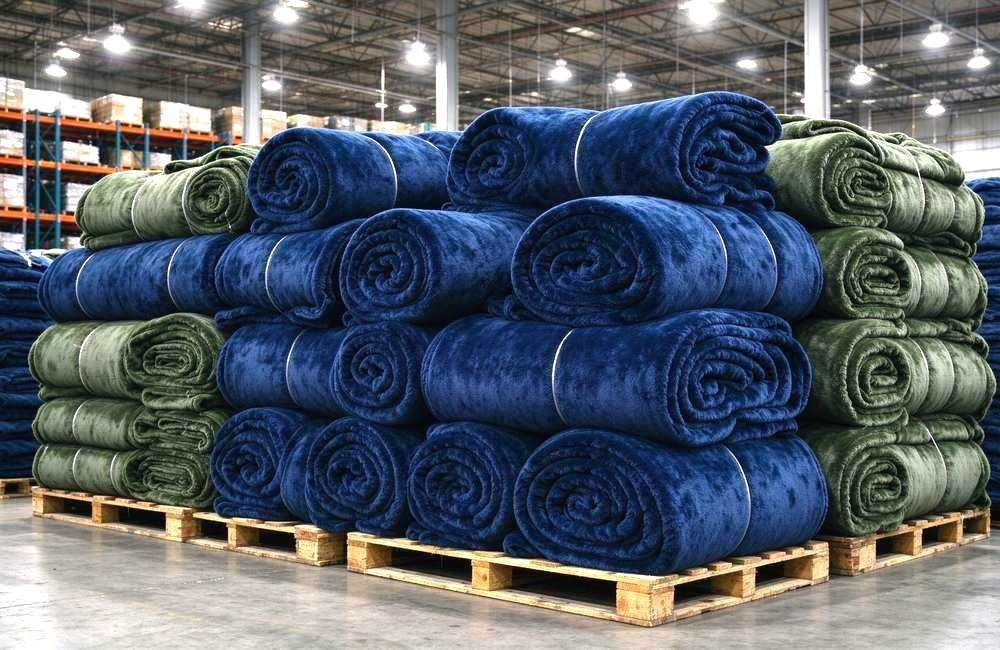
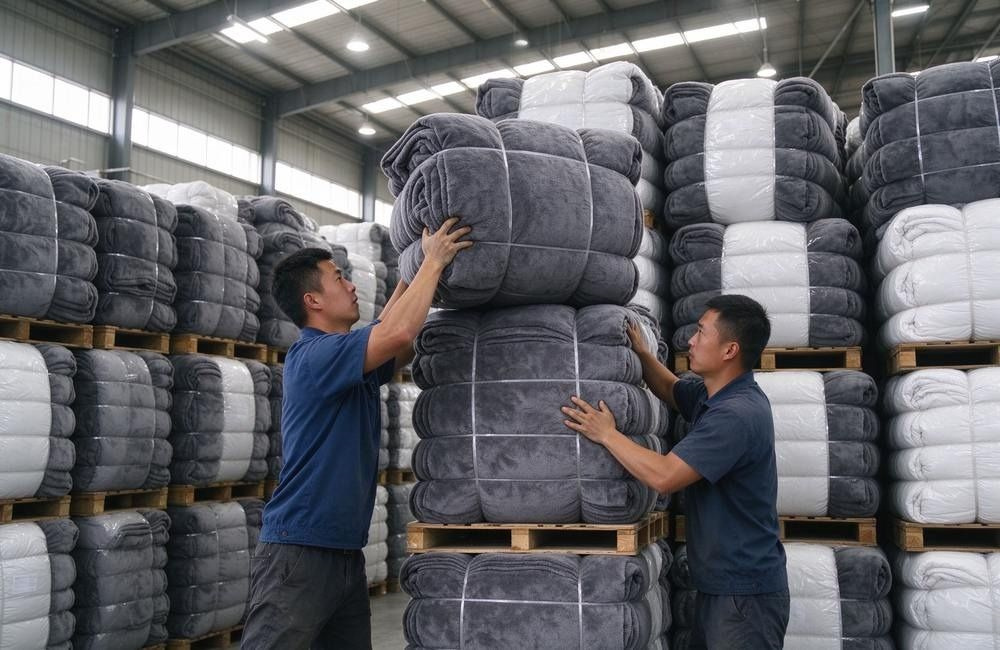
Blanket bales and rolls stacked on warehouse pallets, the starting point for total cost of ownership planning
A total cost review starts with the number most RFQs ignore: how much one blanket costs after it reaches your warehouse. The unit price is the visible part; freight, storage, quality and replacement sit below the waterline. For a 5,000-piece order, the gap between two suppliers on the quoted price can look small, while the gap on freight and replacement can change the whole budget. This guide breaks the total into five layers, shows how each one scales with volume, and ends with a spreadsheet you can reuse for every future purchase.
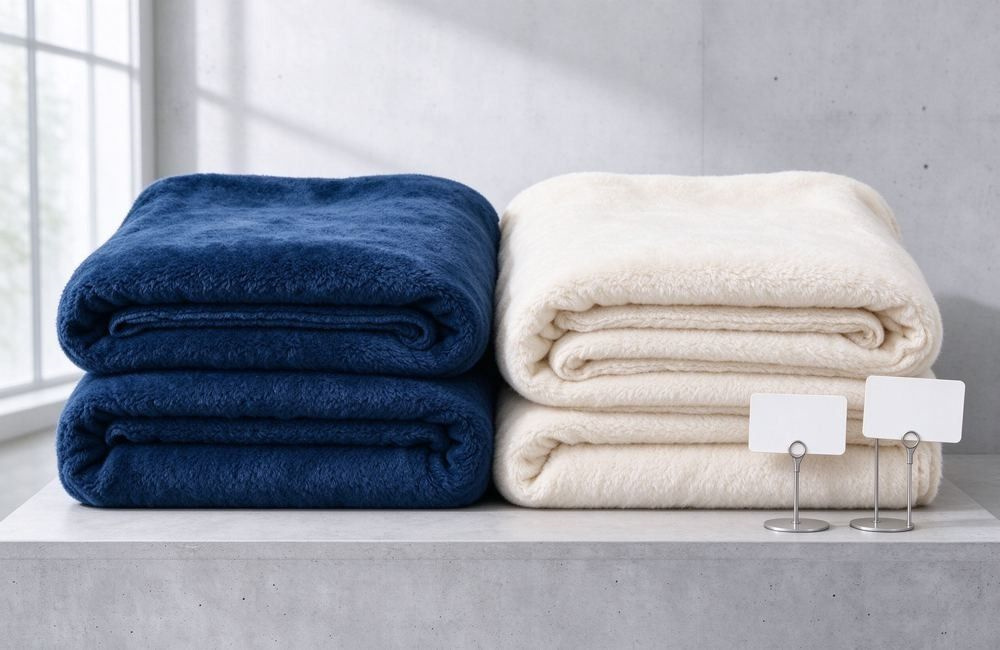
two blanket lines, showingof per-unit price against long-term value for two blanket lines, showing why total cost beats unit price
Procurement teams planning blanket budgets can review whole-of-life costing guidance published by FEMA for public-sector relief purchasing.
A cheap price tag hides the layers that decide what you actually pay. Two blankets can carry the same factory price and differ by a third in total cost blanket procurement once freight, storage and replacement are added. The comparison that matters is not the sticker price; it is the landed cost per usable blanket after a season of use.

Western warehouse staff counting blanket pallets against stock records, mapping storage cost per pallet
Warehouse reality makes the point concrete. A pallet that holds 400 folded blankets at 400 GSM is a different budget item from the same pallet holding 300 heavier blankets: fewer units per pallet raises blanket storage cost per item, and heavier bales raise freight per item. That is why volume and weight sit at the centre of every total cost calculation.

Western logistics workers loading blanket cartons into a container, where volume turns into freight cost
Logistics is where the hidden gap opens. Ocean freight is charged on volume and weight, so a blanket that folds flat or compresses into a bale saves money on every container, every pallet and every mile of inland haulage. The same order can ship at very different blanket shipping cost depending on how the supplier packs it.
On the factory side, the unit price is not a random number; it follows from yarn weight, weave density and finishing. A supplier that quotes the same bulk blanket price as a competitor may be using a lighter fabric, which shows up later as lower warmth or shorter life. Price comparison only works when the specification behind it is identical.

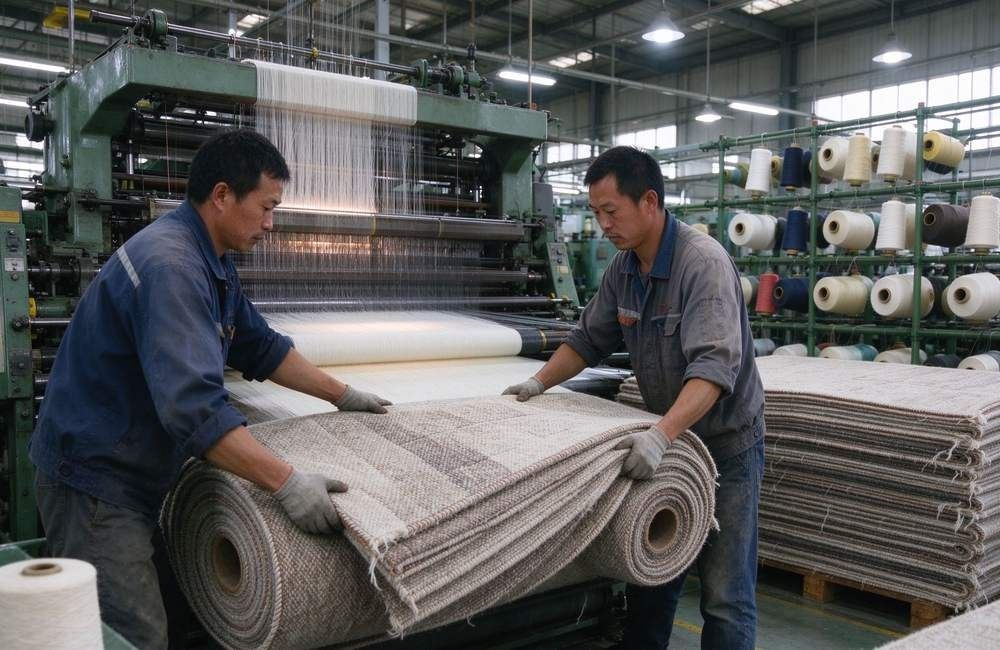
Asian workers running a blanket weaving line with fabric rolls, the production base of unit price
Unit price is easy to compare and easy to get wrong. It captures what the factory charges, not what your programme spends. The
Consider a 10,000-piece order. A difference of one dollar on the unit price is a $10,000 swing on the invoice. A difference of one pallet per container is a swing on freight that repeats on every reorder. A difference of one season in service life changes the replacement rate, which is the largest cost of all on rotating stock.
The practical rule is simple: quote unit price, but decide on total cost. Ask the supplier for the numbers behind the price, compare freight options with the same packing spec, and log replacement data from the field. For a side-by-side view of two fabrics, the Raschel vs wool blend cost comparison breaks down the same layers for shelter and reserve lines.

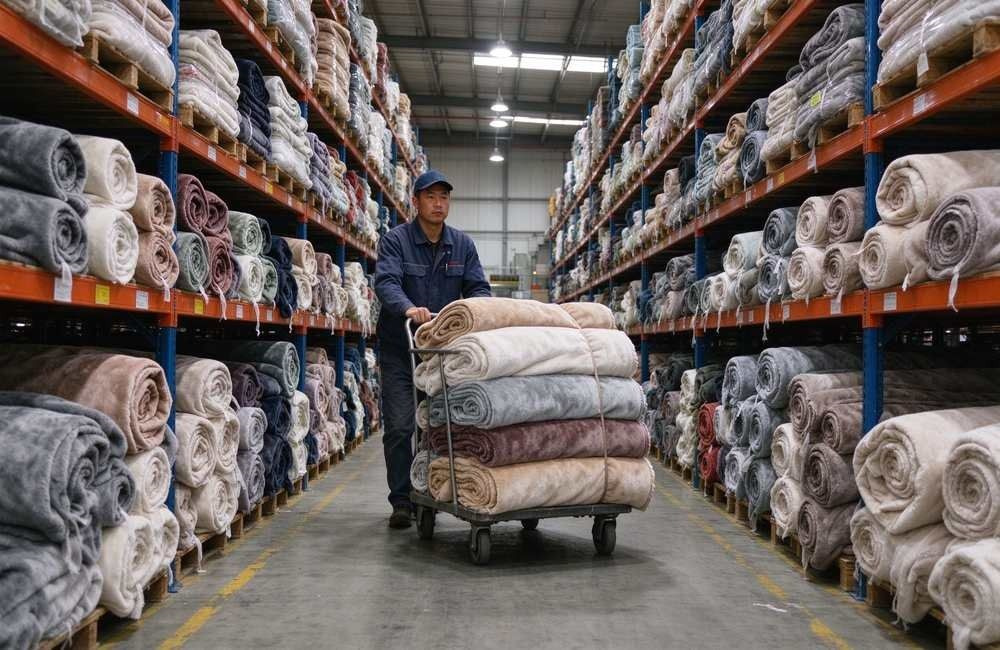
Asian warehouse worker pushing a cart past full racks of blanket cartons, holding cost in practice
Read a quote before you cexcludes freight, duties, warehousing,cludes raw material, yarn, weaving or knitting, dyeing, cutting, sewing, packing and the factory margin. It usually excludes freight, duties, warehousing, quality testing at your end and replacement. Those exclusions are where total cost diverges from the sticker.
Reading a quote line by line also reveals where the money goes. Raw material usually dominates a blanket price, by weaving or knitting, dyeing, finishing and packing. Ask the supplier for the share of each stage, because the share tells you what you are actually paying for: a quote dominated by finishing cost behaves differently from one dominated by yarn.
GSM is the first number to verify, because it decides yarn weight and therefore price. A 350 GSM blanket and a 450 GSM blanket from the same factory carry different material costs; comparing their prices without noting GSM compares different products. Ask the supplier to state the tested GSM, the test method and the folded size on every quote.
Density and pile depth matter as much as GSM for knitted lines. Two blankets can share a GSM number while one carries a denser, more durable pile. The cold duty blanket GSM and material guide explains how to check density and pile on a sample before you lock a price.
Fold the density and pile checks into the same sample review, so the GSM number and the surface feel are approved against one reference.
When a supplier sends a GSM certificate, ask for the test method and the lot date, because a number without a method cannot be compared across quotes. Keep the density and pile checks on the same sample, and record the results next to the price line. That way the cost table shows not only what each blanket costs but why it costs that, and the next negotiation starts from evidence instead of opinions. A dense pile also changes how many blankets fit in a carton, so the density check belongs in the packing review as well.

Close-up of blanket fabric loops showing density that decides washing durability and replacement cost
Freight is usually the second largest line in a blanket budget, and the easiest to cut with good packing. Ocean carriers charge by the greater of actual weight and volumetric weight, so a blanket that folds small saves money even when its weight stays the same.
Container choice changes the freight arithmetic. Less-than-container loads pay a higher rate per cubic metre than full containers, so a programme that orders just under a container pays disproportionately. Size the order to fill the container you will ship, or plan to share consolidation space with other textile goods to bring the rate down.
Volumetric weight follows a simple rule: length × width × height in centimetres, divided by the carrier divisor. A blanket pack that measures 30 × 40 × 14 cm has a volumetric weight around 2.8 kg, while the same blanket packed loose at 40 × 50 × 20 cm climbs to 4 kg. The difference repeats across every unit in the container.
Trade policy adds a second layer. Duties and customs handling vary by classification and origin, and a well-classified product code can save a meaningful percentage on a large order. The WTO tariff schedules are the reference for checking rates before you budget.

Folded blanket stacks of two lines compared for volume, the number that sets freight and storage cost
Folded size sets the carton count, and carton count sets the pallet pattern. A carton that holds 10 blankets instead of 8 cuts cartons, pallets and handling on the same order. Confirm the folded size and carton packing with the supplier, then use those numbers in the freight quote instead of guesses.
Folded size drives the freight bill more than weight for knitted blankets, so compare the folded dimensions of every line before the pallet is planned. A 30 by 40 by 14 cm pack holds more units per carton than a 40 by 50 by 20 cm pack, and the difference shows up in the container count. Compression adds a second saving when the reserve sits for months, because smaller bales cut both warehouse footprint and handling time. Log the folded size on every quote so the comparison stays honest.
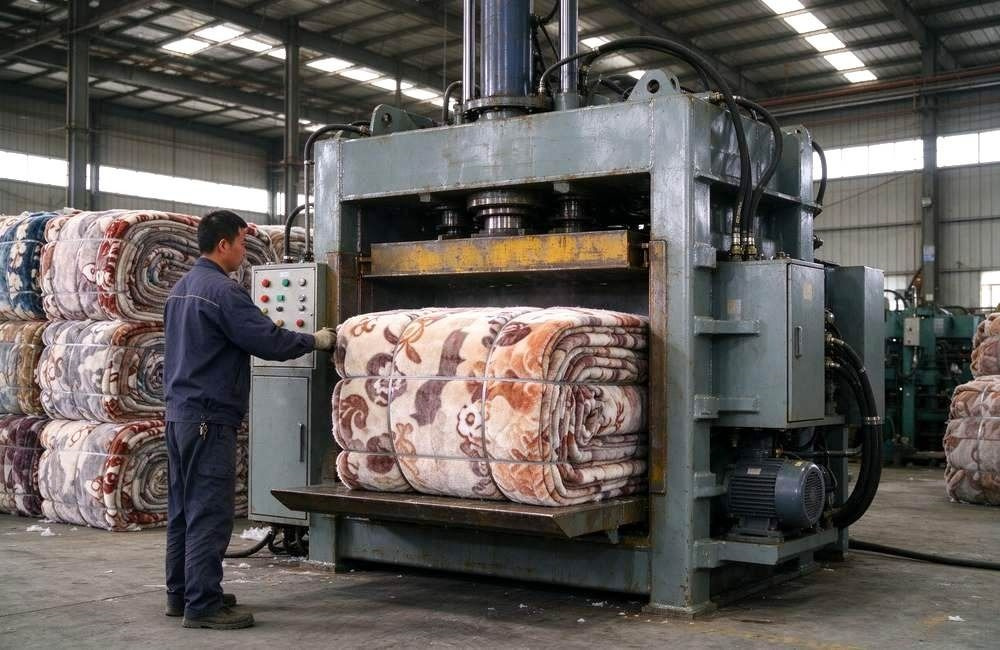
Compression is the biggest single lever on blanket freight cost. Hydraulic baling can cut the volume of a fluffy blanket line by a third or more, and compressed bales stack flat in the container. Reserve programmes that order long stock often switch the whole line to compressed bales and see freight fall on every reorder.
Hydraulic compression pressing blankets into compact bales to cut freight volume and warehouse space
Storage is the layer most pr blanket storage cost because it arrives monthly instead of on one invoice. A pallet occupies a footprint, a rack bay and a share of climate control. The blanket storage cost per unit is simply the monthly warehouse cost divided by the units you keep in that space.
Two storage costs hide inside the monthly bill: climate control and insurance. Blankets stored in humid or hot warehouses degrade faster, and insured stock carries a premium based on declared value. A compressed bale lowers both, because it protects the fabric and reduces the value at risk per square metre of warehouse.
Rotation changes the arithmetic. A reserve line that sits for two years occupies space without returning value, while a fast-issue line moves through the same bay every season. Programmes that log issue and wash data can prove which lines earn their space and which should be compressed or reduced.
Western staff counting blanket bales with clipboards, data that proves or disproves cost assumptions
Compressed bales also win in the warehouse: they stack higher, keep dust off and hold more usable stock in the same bay. The packing decision that cut freight in Section 3 therefore cuts storage too, which is why compression appears twice here.
Qsilent cost line.re the silent cost line. A blanket that shrinks 6% on the first wash, pills after ten washes or arrives with open seams is not a 100-dollar blanket; it is a 100-dollar blanket plus the handling, freight and replacement of the failed copy.
Defect rates are not a mystery when the supplier tests. Ask for the last three production batches’ first-pass rate, and set an agreed defect threshold in the purchase contract. When defects arrive, the conversation shifts from blame to the contract line, and rework cost lands where the contract says it should.
Two numbers stop most quality cost: shrinkage and pilling. Specify shrinkage under 3% in both directions after three industrial washes, and pilling grade 4 or better after ten washes. Suppliers that confirm these numbers on test reports let you compare quality before you commit; those that cannot carry the risk on their side of the ledger.
A weekly count of blanket pallets catches loss and damage before they become a reorder surprise. Assign one owner to the count, log the gap against the expected number, and reconcile the total at the end of each month. The same record feeds the storage cost line, because a warehouse that cannot count its stock cannot price storage. Pair the count with the QC log so every carton that leaves the rack has a tested batch behind it. For a reserve programme the count is not paperwork; it is the early warning system for the whole line.

Asian quality inspectors checking blanket seams and surface, catching defects before they become return cost
Test standards make the numbers comparable. Reference ISO methods for dimensional change and abrasion, and ask the factory to attach the test report to the shipment. A quote that arrives with data is a different risk profile from a quote that arrives with promises.
Asian staff comparing blanket samples against order references before bulk production locks in cost
Thtotal cost way to see total cost is one worked example. Take a 5,000-piece order of 150 × 200 cm blankets, compare a 400 GSM plush line against a 500 GSM dense line, and add the five layers: factory price, freight, storage, quality buffer and replacement.
The worked example also shows sensitivity. If the dense line’s price rose 10% and the plush line’s replacement rate doubled, the conclusion flips; if freight doubled, the compressed line wins by more. Run the table at your high and low scenarios, not just the middle, because budgets are decided at the extremes.
|
Cost layer |
400 GSM plush line |
500 GSM dense line |
|
Factory price per blanket |
$6.20 |
$7.80 |
|
Freight per blanket (compressed) |
$1.10 |
$1.40 |
|
Storage per blanket per year |
$0.35 |
$0.28 |
|
Quality buffer (3% defects) |
$0.19 |
$0.12 |
|
Replacement per blanket (est. 5-yr) |
$1.40 |
$0.70 |
|
Total cost per blanket |
$9.24 |
$10.30 |
On the invoice the plush line looks cheaper by $1.60 per blanket. On the full five-year cost the gap closes to $1.06, and if the dense line survives one more season the difference disappears entirely. That is the point of the exercise: cost per blanket is the number to manage, not the factory sticker.
Run the same table for your own quantities and prices before you commit. The layers are the same for any blanket line; only the numbers change. A supplier that helps you fill in all five lines is signalling a transparent cost structure, and that signal is worth more than a low first quote.

Asian quality staff checking packed blanket samples with labels, verifying pack size that decides carton cost
Quotes are only comparable when the scost you willem is identical. A five-row checklist closes most of the gap: GSM with test method, folded size, carton count, packing type and wash test numbers. Anything a supplier leaves blank is a cost you will discover later.
Quotes also carry an expiry date. Material prices move with cotton and yarn markets, so a price valid for 30 days is a different commitment from one valid for 90 days. Ask every supplier for the validity period and the currency, and compare quotes dated in the same week.
|
Comparison point |
Ask every supplier |
Why it matters |
|
GSM and test method |
Tested GSM + method |
Lighter fabric looks cheaper |
|
Folded size |
Exact pack dimensions |
Sets carton, pallet, freight |
|
Carton packing |
Units per carton |
Drives handling cost |
|
Packing type |
Loose, folded or bale |
Compression cuts volume |
|
Wash test numbers |
Shrinkage + pilling grade |
Predicts replacement rate |
Ask the same five questions in the same order to every supplier. When one quote is loose-packed and another is compressed, the freight comparison is meaningless until the packing is aligned. When one quote lists GSM and another does not, ask for the number before you compare prices.
Price per unit falls with volume, but the curve is not linear. Extra units fill the same container until it is full, so the marginal cost per blanket drops, then jumps when the order spills into a second container. Ask for a quote at your actual quantity, not at a promotional volume that forces a bigger order.

Western customers comparing blanket prices on retail shelves, showing the end price that includes all cost layers
Preal costrms carry a real cost that rarely appears on a price sheet. A 30% deposit plus balance before shipment ties up working capital for the whole lead time; a letter of credit or a staged payment shifts some of that cost. The value of the money tied up is part of the total.
Payment method changes the risk split as much as the timing. A telegraphic transfer carries less documentation cost but more upfront exposure; a letter of credit protects both sides but adds bank fees and compliance work. On large orders, model the bank fees as a line in the total cost, because they are real money either way.
Lead time compounds it. A 90-day lead time means your money sits with the supplier for a quarter. A 60-day lead time releases the same capital sooner, and on repeated orders the faster cycle reduces the average stock you must carry. Buyers who compare only price and ignore lead time leave real money on the table.
Holding cost is the warehouse twin of payment cost. Stock that arrives early sits in a bay and pays storage before it is issued; stock that arrives late forces emergency purchases at higher prices. Plan the delivery window against the season, and let the warehouse schedule, not the calendar, set the arrival date.
Packing mistakes surface at the container, not at the factory, so confirm units per carton, carton weight and label content before the line runs. A packing slip on every carton saves the receiving team hours of counting, and a sealed sample carton lets the buyer verify the pack before the rest ships. Record the packing details in the same cost sheet, because a change in carton size changes freight, storage and handling at once. The best packing line is the one that makes the next stage easier, from QC to the container door.

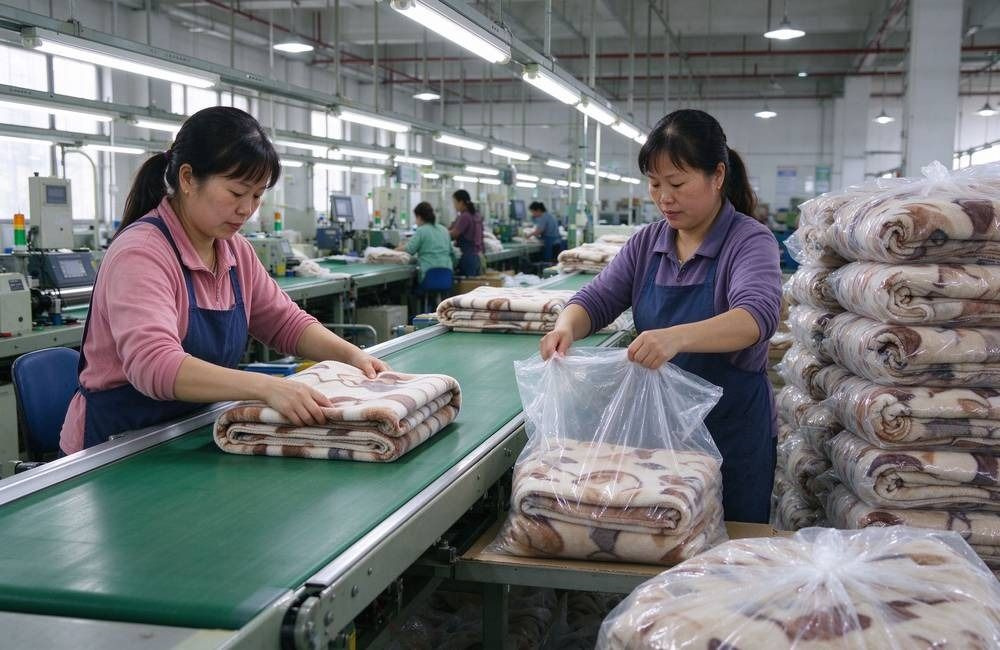
Asian workers folding and bagging blankets, where packing choices change carton size and freight
hidden costsssic hidden costs are sample rounds, re-testing, replacement freight and lost seasons. A sample that fails the wash test forces another round and pushes the season; a shipment with defects forces return freight that can cost more than the blankets themselves.
Insurance and customs brokerage are the fifth and sixth hidden costs. Marine insurance is priced on declared value, and brokerage fees repeat on every clearance. Ask the freight forwarder for a landed cost breakdown that includes both, so the freight line in your spreadsheet is complete rather than optimistic.
Sample cost is easy to undercount because it arrives in small invoices. Two sample rounds, two test reports and one courier bill can add up to hundreds of dollars on a single line. Approve samples against the full spec in one round, and test the wash numbers on the first sample instead of the production batch.
Lost season is the hardest cost to measure and the most expensive. A blanket order that arrives after the cold wave misses the distribution window, and the stock then sits in storage for a year. Schedule against the season with a buffer, and treat the arrival date as a specification, not an estimate.
Asian workers handling woven blanket fabric at the production stage that sets the quoted price
Diffeissues blankets fast budget differently. A shelter issues blankets fast and values low cost per blanket; a patrol post values warmth that holds for a full shift; a reserve warehouse values compact stock that survives years. Allocating by scenario prevents over-spending one line and under-spending another.
When the budget has a hard ceiling, allocation follows a priority order: protect the line that protects people, then the line that protects the mission, then the line that protects the stock. In practice that means shelters and patrol get funded first, and reserve compression is funded from what remains.
Scenario
Cost priority
Best fit
Shelter and family kits
Low cost per blanket
350-450 GSM plush line
Patrol and overnight posts
Warmth per shift
500+ GSM dense line
Long-term reserve
Compact storage
Compressed bales
Humanitarian procurement norms frame the same allocation. The Sphere handbook sets practical service levels for shelter and clothing, and matching your cost split to those levels keeps the programme defensible to funders and inspectors.

Western family wrapped in blankets inside a temporary shelter tent, the scenario that assigns cost per user
The mix is usually a split, not a single line: a plush line for fast issue, a dense line for duty and a compressed reserve behind both. Log usage by scenario for two seasons, then adjust the ratio with real data instead of assumptions.
Western relief workers handing blankets out from a vehicle, distribution cost per item in practice
Repl long-term blanket budget,ne in a long-term blanket budget, and it is driven by service life. A blanket that survives five seasons costs a fifth per season of one that survives one. Service life is set by density, wash resistance and how the programme rotates stock.
Rotation is the cheapest way to extend service life. First-in-first-out issue, seasonal inspection and a retire-by-date on each batch keep the oldest stock moving before it degrades. A programme that rotates well can extend a blanket line’s usable life by a season or more, which lowers the replacement line without changing the fabric.
Wash regimes decide most of it. A programme that washes every issue needs a fabric that holds shape through repeated cycles; a programme that issues once per season can spend less per unit. Match the fabric to the wash regime, and log how many washes each line survives before it is retired.
Relief programmes move blankets fast, so the handover record matters as much as the blanket. Log the quantity handed out, the shelter location and the remaining stock, and use the numbers to set the reorder trigger for the next season. Buyers who inspect the delivered bales against the approved sample close the loop before the stock reaches the shelter. Keep the same record across issues and deliveries so the programme budget can be defended with data. A blanket is not sold until it reaches the person who needs it, and that final step deserves the same precision as the factory line.
Replacement rate is a planning number, not a guess. Track issues, returns and retirements for two seasons, then use the observed rate in the total cost table. Programmes that close this loop find that the most expensive blanket per unit is often the cheapest per season of use.
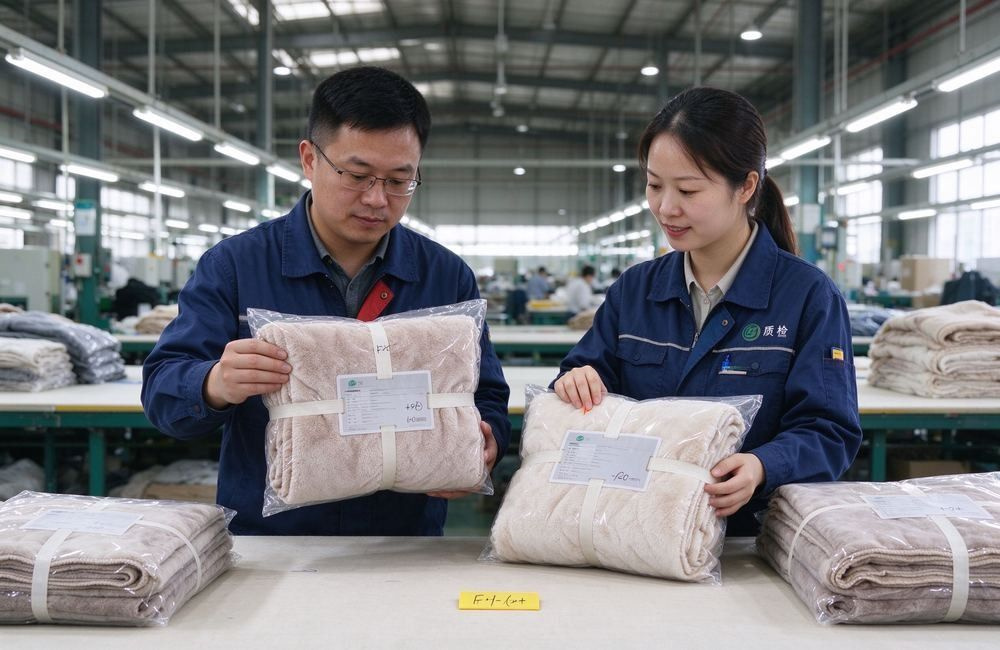
Western buyer inspecting delivered blankets with Asian staff, confirming cost assumptions at acceptance
A reusable sprea price, freight per unit,into a working tool. Six columns carry the whole model: line name, unit price, freight per unit, storage per unit, quality buffer and replacement per unit. The total per blanket is the sum, and the programme cost is the total multiplied by quantity.
Review the sheet quarterly, not annually. Material prices, freight rates and wash data all move within a year, and a stale cost model makes confident-looking decisions on old numbers. A fifteen-minute quarterly update keeps the model honest and turns the spreadsheet from a one-time exercise into a living tool.
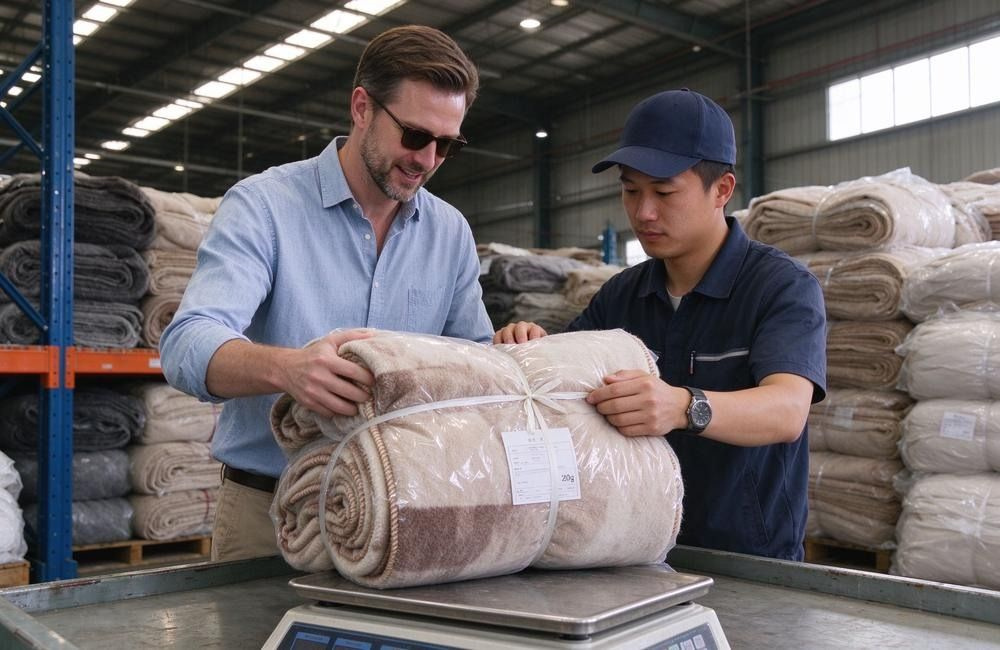
Asian worker moving blanket fabric rolls, inventory value tied up before orders convert to revenue
Build the sheet once and reuse it on every order. Update the freight line when packing changes, the replacement line when wash data arrives, and keep one layout so quotes drop into the same cells. A consistent format makes the comparison automatic instead of an annual debate.

Reusable cost sheet reviewed before the next order
Pair the spreadsheet with the procurement plan so quantities follow the same logic. The annual procurement plan covers product mix, reorder points and season timing; the cost sheet feeds it the numbers behind each decision.
The final check is verification at delivery: weigh, measure and inspect against the RFQ, logging results into the same record. When planned and received numbers match, the total cost model becomes a fact and the next order starts from a cleaner baseline.
The shift from price to total cost is also a shift in evidence. A unit price is one number; total cost is built from freight quotes, pallet counts, test reports and issue logs. Programmes that keep these four records can defend their budget in any review; those that buy on price alone face every cost after the invoice.
The sheet also becomes the handover document when staff change. A new buyer who inherits the model inherits the assumptions, freight rates and wash data behind every decision, so the programme does not restart cost learning with each hire. That makes the spreadsheet more than a tool: the institutional memory of how this programme buys blankets.
Close every purchase with the same three numbers: landed cost, storage cost per year, and observed replacement rate. Log them against the quote estimate, and the gap between planned and actual becomes the input for the next round. That loop, repeated on every order, turns a cost-conscious buyer into a cost-driven programme.

Team cost review before reorder
Blanket total cost of ownership is the sum of five layers: factory price, freight, storage, quality buffer and replacement, all divided per blanket. To calculate it, add quoted price, freight, storage per year, a quality buffer for defects, and replacement spread over the expected service life. The total is the number that belongs in your budget, not the sticker price.

Checking the sample tag before comparing quotes
On a reserve programme the four hidden layers can add 40% to 60% on top of the factory price, and the gap grows with volume and storage time. Freight, storage, quality losses and replacement each add their share, so a $6 blanket can carry a true cost of $9 or more over five years. The premium is smaller on fast-issue lines and larger on long-term reserve stock.
Ocean carriers charge by the greater of actual weight and volumetric weight, so you pay for whichever is larger. Volumetric weight is length × width × height in centimetres divided by a carrier divisor, usually 5,000 or 6,000. A fluffy blanket that packs small reduces volumetric weight, which is why folded size and compression change the blanket freight cost more than the fabric weight.
Folded size sets the carton dimensions, cartons set the pallet pattern, and the pallet pattern sets how many units fit in a container. A blanket pack reduced from 40 × 50 × 20 cm to 30 × 40 × 14 cm cuts volumetric weight and lets the same container carry more units. Confirm the exact folded size on every quote before you compare freight.

Divide monthly warehouse cost by pallets held, then by units per pallet. The result is the blanket storage cost per unit per month.
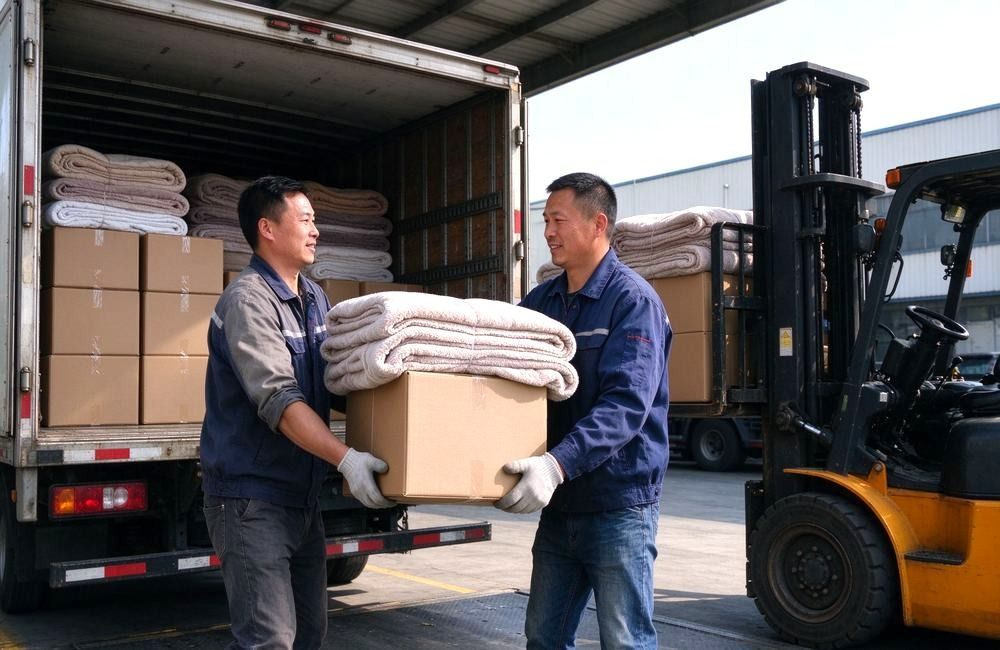
Container loading adds logistics cost to the unit price, and that cost belongs in the total ownership calculation. Storage, handling, transport and the loss that happens during shipment are all part of the real price per blanket, so the budget should include them from the start rather than discovering them at the invoice stage.
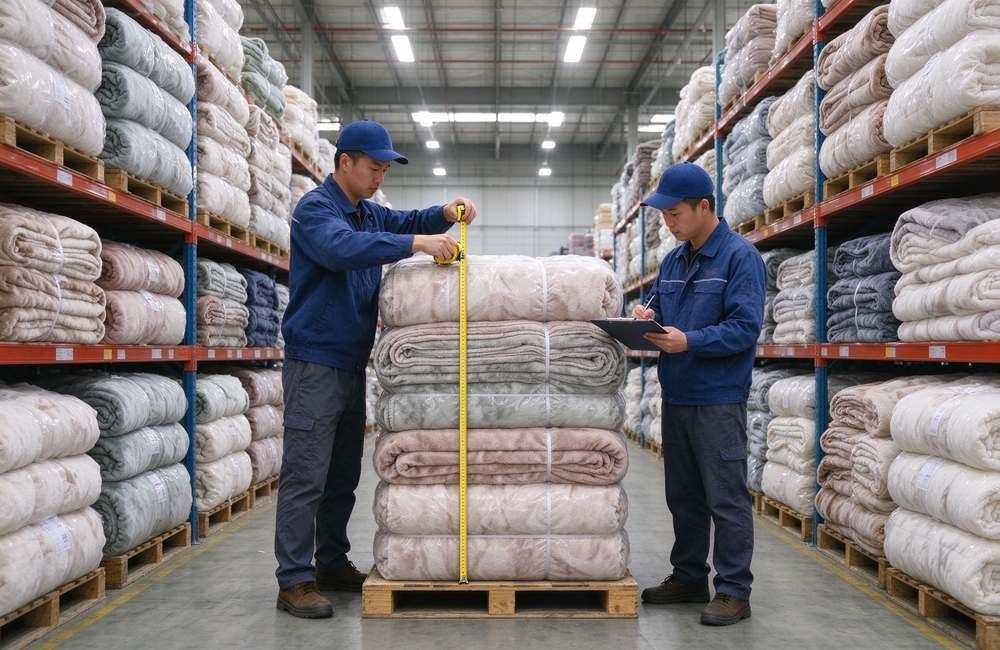
Measuring stock to estimate storage cost
Shrinkage and pilling shorten service life; shorter life raises the replacement rate, the largest line on rotating stock. Specify shrinkage under 3% after three industrial washes and pilling grade 4 or better. Test reports that confirm these numbers let you compare durability before signing.
Compare five points for every supplier: tested GSM with method, folded size, units per carton, packing type and wash test numbers. Align the packing type first, because compressed and loose-packed quotes cannot share a freight comparison. Any blank field in the checklist is a future cost you accept.
They determine how long working capital sits with the supplier. A 30% deposit with balance before shipment ties up cash for the whole lead time; staged payments release it sooner. Tied-up money is a real cost, so compare payment terms with price and lead time, not separately.
A longer lead time locks capital longer and raises the risk of a lost season. An order arriving after the cold wave misses the distribution window, and the stock then pays storage for a year. Plan delivery against the season with a buffer; treat the arrival date as a spec.
Extra sample rounds, re-testing, return freight for defective stock and lost seasons from late delivery. Two sample rounds and two courier bills can cost hundreds on one line, so test the wash numbers on the first sample and schedule with a buffer.
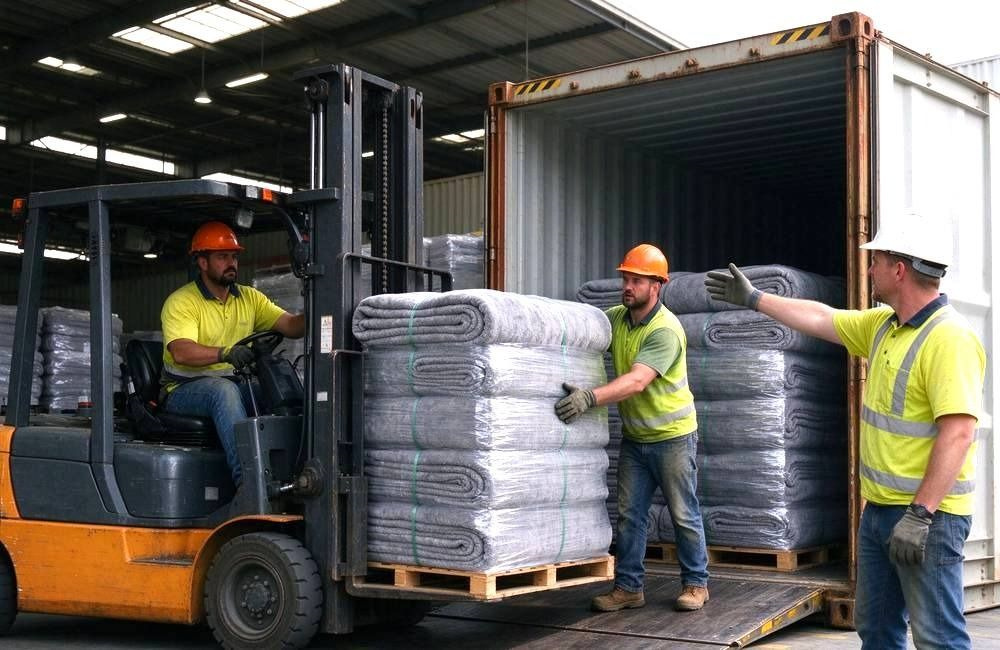
Compression can cut the volume of a fluffy blanket line by a third or more, and the saving repeats on freight, storage and handling. Compressed bales stack flat in the container, so the same order ships in fewer pallets and the blanket shipping cost falls on every reorder. Reserve programmes that order long stock often switch the whole line to bales and see the saving repeat season after season.
Track issues, returns and retirements for two seasons, then divide the retirement count by the total issued to get the observed replacement rate. Multiply the rate by the unit cost to get replacement per blanket. The most expensive blanket per unit is often the cheapest per season of use once replacement is included.
Price per unit falls with volume until the order fills a container, then the marginal cost per blanket jumps when a second container is needed. Ask for a quote at your actual quantity, not at a promotional volume designed to push a larger order. The curve is not linear, so the volume you buy defines the price you pay.
Allocate by what each scenario spends on: shelters value low cost per blanket, patrol posts value warmth per shift, and reserves value compact storage. A typical split is a plush line for fast issue, a dense line for duty and compressed bales behind both. Log usage for two seasons, then adjust the ratio with data.
Ask for tested GSM with method, folded size, units per carton, packing type, wash test numbers and price at actual quantity. Also request freight rate at your volume and payment terms in writing. Suppliers answering all six fields on one page quote transparently; those leaving blanks defer cost to you.
Start with six columns: line name, unit price, freight, storage, quality buffer and replacement, each per unit. The total per blanket is the sum; programme cost is total times quantity. Keep one layout so quotes drop into the same cells, updating freight and replacement lines when packing or wash data changes.
Use this guide as the cost section of your next RFQ: list the five layers, send the same six data requests and compare totals instead of stickers. A wool blend price and a plush price can look far apart on the invoice and nearly identical on a five-year total, so the spreadsheet makes the decision.
For a first total cost review, collect five numbers this week: quoted price, volumetric weight of one pack, units per pallet, monthly storage cost and wash-test shrinkage and pilling grades. With those five numbers you can build a working model before the first sample arrives; each reorder updates the same sheet.
Start with one line and one supplier, fill all five layers from real quotes and warehouse numbers, and let the first model teach you where your own costs actually sit. Every subsequent order updates the same sheet, and the comparison gets faster as data accumulates across seasons.

Reviewing cost quotations
 |

|
Anterior :
Raschel vs Wool Blend Blankets for Emergency Stockpiles: Warmth, Weight, Durability, Storage, Packing and Total Cost Comparison for Bulk Procurement and Relief Teams WorldwidePróximo :
Hotel Blanket Backup Stock: How Hotels Plan Peak-Season Backup Counts Per Room, Storage Space, GSM Weight, Laundry Life and Ordering Timelines with a Wholesale Blanket SupplierLinks amigáveis :
direito autoral © Custom Disaster - Relief Bedding: Tents, Sleeping Bags, Blankets Todos os direitos reservados
a equipe profissional para o serviço !