Categorias
Last updated: November 17, 2026
A global export emergency kit order fails at the border for one reason: the buyer treated every component as the same product. A wall-mounted first aid box, a lithium battery pack, a liquid gel pack and a chemical dressing each follow a different set of rules.
This checklist walks a distributor through every emergency kit category before the container is booked. As a verified export compliant emergency kit and international shipping first aid kit, we supply emergency kit export compliance wholesale to distributors, integrators and institutional buyers worldwide, with full traceability on every emergency kit export we ship.


The hardest shipments are not the ones with one component. They are the ones with five. A single carton can hold a medical device, a lithium battery, a dry dressing pack and a manual. Each item needs a different document.
Our buyers tell us the gap shows up when the freight forwarder asks one question. Is anything in this carton a dangerous good?
The right answer is a category-by-category map. List every component in your export emergency kit, then list the rule that touches it. Medical devices go one way. Lithium batteries go another. Liquids and gels go a third. Every emergency kit component needs its own document trail.
We pair a 100-person wall-mounted ABS box with a lithium-plus emergency pack. The wall box is a fixed first aid point. The lithium pack is a portable radio-and-light unit. Both ship dry, shipment-safe and document-ready.
This guide turns that map into a working checklist. We cover medical device registration for the United States, the European Union and other markets. We cover UN38.3 for lithium, air versus sea freight for liquids and gels, REACH and OSHA for chemicals, multilingual labels, ISPM-15 pallets and the four documents every export emergency kit carton needs.
Read it once before you book the container. A well-documented emergency kit clears the border on the first try.
Our emergency kit export compliance wholesale model collapses five rule sets into one dossier, so an importer shipping an export compliant emergency kit to many markets does not chase five separate agencies.
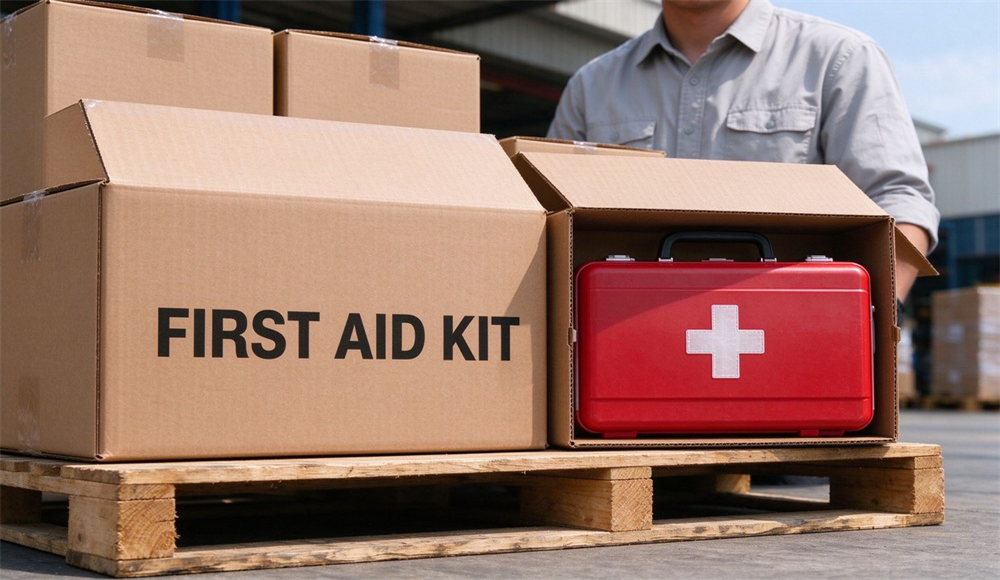
Most new exporters make the same mistake. They treat an emergency kit as one product with one HS code.
In reality, a global export emergency kit is a collection of components, and each component carries its own regulatory path. In this emergency kit export compliance wholesale guide, we cover international shipping first aid kit specifications, export compliant emergency kit sizing, MOQ tiers and export documentation, so procurement teams can shortlist in one afternoon.
A wall-mounted ABS first aid box with dry dressings is a general product in some markets and a medical device in others. A lithium-powered radio is a dangerous good for shipping purposes. A liquid gel pack is banned from air freight and restricted on sea. A chemical dressing touches REACH in Europe and OSHA in the United States.
The border does not care that these items sit in one carton. Customs inspectors check each item against its own rule set. A carton that passes on four items fails on the fifth. At emergency kit customs entry, every component is screened separately. Build an emergency kit shipping compliance map before the order.
The practical fix is a compliance map before the order. List every item, tag the rule, prepare the document. That map is the working document this article is built around. It takes an hour to draw and saves weeks of delay on every global emergency kit shipment.
Distributors who ship to multiple markets face a second layer. The United States, the European Union, the Middle East, Southeast Asia and Africa each run their own registration systems. A product cleared for Los Angeles can still be refused in Rotterdam.
That is why this guide is organized by category, not by country. A wall box follows the same medical device logic whether it lands in Dubai or Frankfurt. The registration name changes; the rule set does not.
Every unit we ship is built as an export compliant emergency kit for global resale, and an international shipping first aid kit buyer receives a dry, document-ready pack. Whether you import to North America, the Middle East or Southeast Asia, an export compliant emergency kit from a single supplier keeps your reorders consistent across markets.

Every global order ships as one of two proven units, not a custom build. The table below lines up the 100-person wall-mounted ABS box and the lithium-plus emergency pack side by side so you can match each unit to a use case before quoting.
Our global range rests on two proven units. The first is a 100-person wall-mounted ABS box for 100 people, sized 43 by 32 by 15 cm and weighing about 3.7 kg. It ships in white, orange and green.
The second is a lithium-plus emergency pack that pairs a hand-crank solar radio with an LED torch. It carries a sealed lithium battery, so every shipment travels with UN38.3 test summary and an MSDS. It is built for distributors who need a portable power-and-light unit in the same carton as a wall box.
This split matters. A wall box is fixed to a wall and serves daily first aid. A lithium pack moves with a person and serves power and light. The two units solve different problems, and the documents they need are different.
The 100-person ABS box is chosen for global distributors because ABS is a rigid, light plastic that ships well. The white, orange and green options let buyers code sites by zone. The wall box mounts at eye level near a door, where staff already move.
The lithium-plus pack is chosen for disaster-prone markets where power outages last days. The hand crank and solar panel mean the pack never needs a wall charger. The LED torch doubles as a signal light. That combination is the quiet value of a portable emergency power unit.
Both units ship dry, with no liquids, no gels and no glass. That single choice removes the largest category of shipping restriction before the order is booked.
Item
100-Person Wall-Mount ABS Box
Lithium-Plus Emergency Pack
Model
100-Person ABS Box
Lithium-Plus
Format
Wall-mounted ABS box, 100-person set
Portable radio + LED torch pack
Size
43 × 32 × 15 cm / 3.7 kg
Handheld
Power
n/a
Sealed lithium battery, UN38.3
Best for
Fixed first aid point in offices, clinics, depots
Portable power and light during outages
Colors
White / orange / green
Dark orange / black

A global emergency kit is not one product. It is a wall box, a lithium pack, dressings, chemicals and packaging, each under a different regulator. The map below pairs every category with the rule it triggers, who files it, and the document we hand over.
Product Category
Rule Triggered
Who Files
Document We Prepare
Wall box with therapeutic claims
FDA (US), MDR (EU), SFDA (KSA), TGA (AU)
Importer of record
Contents list, CE declaration, expiry dating
Lithium battery pack
UN38.3, MSDS, air vs sea rules
Manufacturer + importer
UN38.3 summary, MSDS EN + destination language
Liquids and gels
Air freight ban, sea DG declaration
Importer of record
We ship dry; liquids sourced locally at destination
Chemicals in adhesives, ink, cables
REACH (EU), OSHA SDS (US)
Manufacturer + importer
REACH SVHC screening report, OSHA-aligned SDS
Packaging and documents
ISPM-15 wood, invoice, packing list, B/L, CO
Logistics + chamber of commerce
ISPM-15 stamp, four-document data pack
Use this map as your pre-order checklist. Before booking a container, confirm the importer holds FDA registration (US), Health Canada listing, TGA approval (AU) or PMDA filing (JP). We prepare the product data each registry asks for — you file locally.
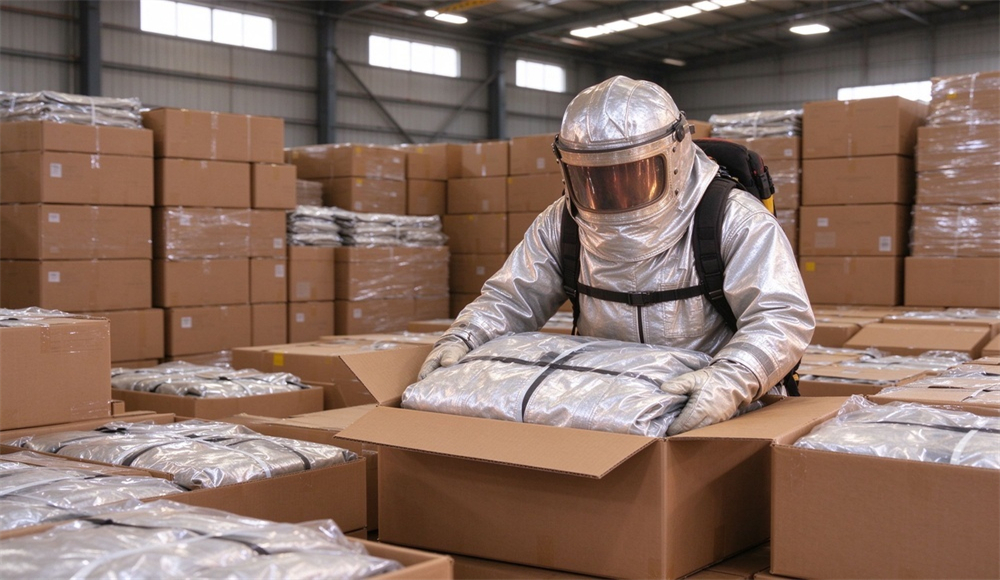
The category map above tells you which rules apply. This table zooms into the two units themselves — format, power, size and best-use case — so you can choose between the wall ABS box and the lithium pack for each market.
Feature
100-Person Wall-Mount ABS Box
Lithium-Plus Emergency Pack
Model
100-Person ABS Box
Lithium-Plus
Format
Wall-mounted ABS box, 100-person set
Portable radio + LED torch pack
Power
n/a
Sealed lithium battery, UN38.3
Size
43 × 32 × 15 cm / 3.7 kg
Handheld
Best for
Fixed first aid point in offices, clinics, depots
Portable power and light during outages
Pick the wall ABS box for fixed first-aid stations and the lithium pack for households and vehicle kits. If your distributor stocks both, mark cartons clearly — the lithium pack triggers UN38.3 and MSDS, while the dry wall box only needs FDA listing and ISO 9001 paperwork.
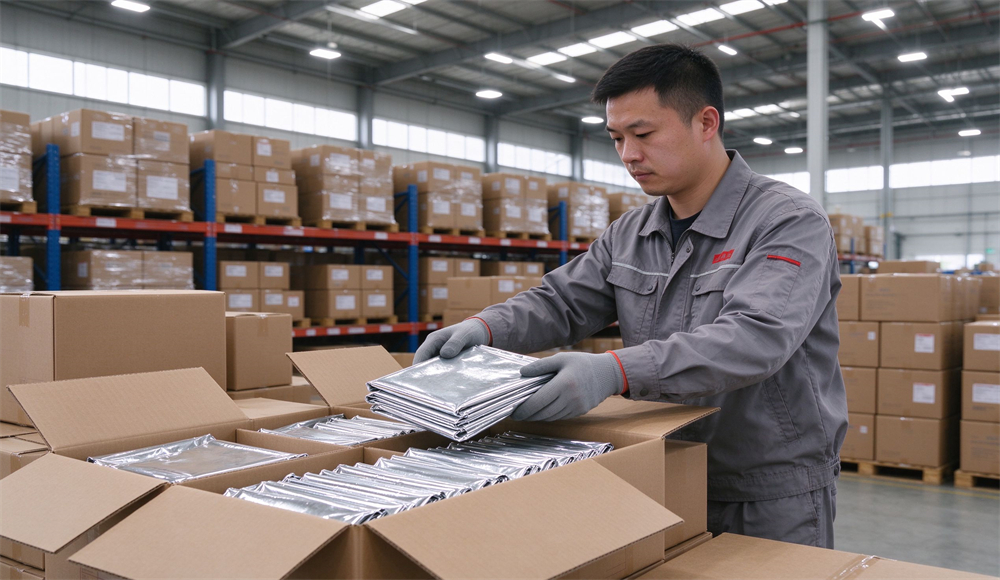
Inside every wall box you will find 28 items, each with its own compliance note. The table below lists every item, its quantity and the US FDA rule that governs it. Auditors and importers read this table line by line at goods-in.
#
Item
Qty
Compliance Note
1
Adhesive Bandage 72×19mm
20 pcs
FDA 510(k) exempt, 21 CFR 880.6255
2
Sterile Gauze Pad 7.5×7.5cm
5 pcs
FDA 510(k) exempt, EO-sterilized, 21 CFR 880.2950
3
Conforming Bandage 5cm
1 roll
FDA 510(k) exempt, 21 CFR 880.6255
4
CPR Face Shield, one-way valve
1 pc
FDA 510(k) exempt, 21 CFR 880.6300
5
Nitrile Exam Gloves, powder-free
4 pairs
FDA 510(k) exempt, ASTM D6319 biocompatibility
6
Antiseptic Wipe, 70% IPA
10 pcs
FDA OTC monograph, 21 CFR 333
7
N95 Respirator
5 pcs
NIOSH N95 approved, 42 CFR 84
8
Thermal Blanket, Mylar
2 pcs
CPSC general-use safety, lead-safe
9
Emergency Whistle, ABS
1 pc
CPSC, toy-safe if kitted for children
10
Hand-Crank Flashlight
1 pc
FCC Part 15 SDoC, CE EMC, RoHS
11
LED Headlamp, 3×AAA
1 pc
FCC Part 15 SDoC, CE EMC, RoHS
12
Emergency Poncho, PE
2 pcs
CPSC + REACH compliant
13
Triangle Bandage
2 pcs
FDA 510(k) exempt
14
Medical Tape 2.5cm×5m
1 roll
FDA 510(k) exempt
15
Trauma Pad 20×20cm
1 pc
FDA 510(k) exempt sterile
16
Tweezers, stainless 304
1 pc
FDA general-use, food-grade stainless
17
Scissors, medical grade
1 pc
FDA 510(k) exempt
18
Safety Pins, stainless
6 pcs
CPSC lead-safe (<100 ppm)
19
Eye Pad, sterile
2 pcs
FDA 510(k) exempt sterile
20
Instant Cold Pack, ammonium nitrate
1 pc
DOT 49 CFR 173.134 non-hazardous when sealed
21
Burn Gel Sachet, water-jelly
5 pcs
FDA OTC monograph
22
Eye Wash Solution 100ml
1 bottle
FDA 510(k) exempt, IVD
23
Sealable Bag PE 20×25cm
2 pcs
FDA food-contact, 21 CFR 177.1520
24
First Aid Guide, English
1 pc
N/A — English only; localizable on request
25
Emergency Contact Card
1 pc
N/A
26
Multi-Tool Pliers
1 pc
FDA general-use + CPSC
27
Cable Ties, nylon
10 pcs
RoHS + REACH
28
Notebook + Pencil
1 set
FSC paper, ASTM D4236 non-toxic
Three items drive most questions: the adhesive bandage (21 CFR 880.6255, FDA 510(k) exempt), the sterile gauze (EO-sterilized, 21 CFR 880.2950) and the instant cold pack (no ammonium nitrate leak on QC). For CA destinations, add a Health Canada MDEL reference. For AU, we attach TGA AUS 530000 numbering.

When a global container clears customs, the forwarder asks for a specific set of documents. The table below lists every paper we prepare, who signs it, which shipments require it and the lead time. Keep this list with your importer of record.
Document
Issued By
Required For
Notes
FDA Establishment Registration
FDA
US-bound medical devices
Registration number on commercial invoice
FDA 510(k) Clearance (if applicable)
FDA
Class II devices only
Our standard dressings are 510(k) exempt
FDA Device Listing
Manufacturer
All medical exports to US
Per device code
CPSC General Certificate of Conformity
Manufacturer
Non-medical articles to US
Whistle, poncho, multi-tool, electronics
FCC SDoC (Supplier's Declaration of Conformity)
FCC
Electronic items
Hand-crank radio, LED headlamp
UL / ETL Certification
NRTL
Electrical (optional but recommended)
Not mandatory for battery-driven kits
RoHS Declaration
Manufacturer
Electronics
Directive 2011/65/EU
REACH Declaration
Manufacturer
EU-bound (even if not primary market)
SVHC 0.1% threshold
ISO 9001:2015 Certificate
Certification Body
Quality management
3-year validity
BSCI / Sedex Audit Report
Audit Firm
Social compliance
Buyer-required
Packing List with HS Code
Manufacturer
Worldwide
HS 3005.90 / 4202.92
Commercial Invoice
Manufacturer
Worldwide
Incoterms: FOB / CIF / DDP
Bill of Lading / Air Waybill
Carrier
Shipping
ATA Carnet
Chamber of Commerce
Temporary shipments / trade shows
If samples for exhibition
Certificate of Origin
Chamber of Commerce
Preferential tariffs
GSP / FTA / RCEP depending on destination
Before you place a first-time global order, request the full document pack in writing. We issue the FDA establishment registration number, ISO 9001:2015 certificate and UN38.3 summary within 5 working days of PO. FDA 510(k) clearance — rarely needed for our Class I dressings — takes 60–90 days if triggered.
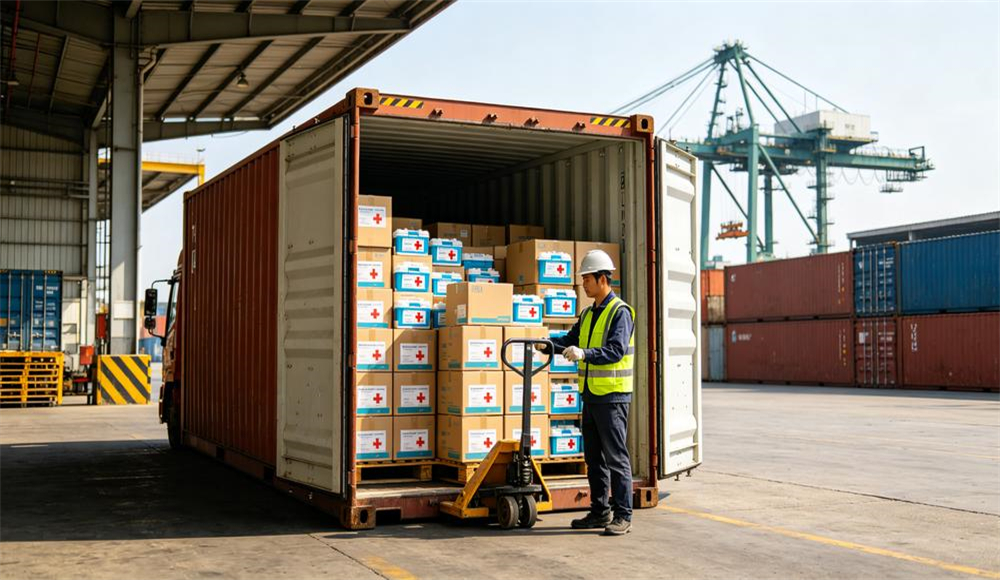
A wall-mounted first aid box becomes a medical device the moment its contents carry a therapeutic claim. A box of dry dressings and gloves is generally a general product. A box that claims wound treatment, pain relief or infection prevention triggers medical device rules.
In the United States, the FDA classifies medical devices into three classes. A simple first aid kit usually falls into Class I, the lowest risk. Class I devices need establishment registration and device listing, but not 510(k) premarket notification. The importer of record usually handles the registration. Map each destination's import regulation first aid kit rules before booking.
In the European Union, the Medical Device Regulation (MDR) applies to any product that treats, diagnoses or prevents disease. A first aid kit with therapeutic claims falls under MDR. The importer must have an EU Responsible Person on file and the product must carry CE under MDR.
In other markets, the rules vary. The United Arab Emirates requires a DMOH or MOHAP registration. Saudi Arabia requires SFDA. Australia requires TGA. Each market has its own timeline and fee. The common thread is that the importer of record, not the supplier, files the registration.
We align our contents list with general first aid expectations and avoid items with therapeutic claims. That keeps the kit in the general product category and away from the heavier medical device conformity assessment. Buyers who need MDR-classified contents should tell us before order.
The practical lesson is simple. A wall box that holds only dressings, gloves and bandages ships as a general product. A wall box that holds anything with a treatment claim ships as a medical device. The difference is in the contents list, not the box.
The lithium-plus pack carries a sealed lithium battery. Lithium batteries are classified as dangerous goods under international shipping rules. They cannot travel by air without special packaging, and they cannot travel by sea without the correct paperwork. Plan a battery regulation emergency kit file before booking.
UN38.3 is the United Nations test standard for lithium batteries. Every battery type must pass a series of tests covering altitude, temperature, vibration, shock and short circuit. The test summary must travel with every shipment. Every lithium-equipped UN38.3 emergency kit ships with the test summary.
The MSDS, Material Safety Data Sheet, describes the battery's chemical composition, handling precautions and emergency response. It must be in the language of the destination country. We provide MSDS in English and the common destination languages on request. Every shipment carries an MSDS emergency kit data pack.
Air freight and sea freight differ sharply. Air freight requires fully regulated cargo airlines, special packaging and a trained shipper. The cost can double the product price. Sea freight on a standard container works as long as the UN38.3 summary and MSDS accompany the bill of lading.
We pack the radio and torch in their retail boxes, then in a master carton. The outer carton carries the lithium battery handling mark and the UN number. The carton is not pallet-mixed with wet goods, because battery and moisture do not mix.
For distributors new to lithium shipments, we recommend a small trial container first. That trial lets the importer file their dangerous goods declaration and build the paperwork habit before a full order.
Liquids and gels are the most common cause of air freight rejection. A bottle of saline, a tube of gel, a jar of ointment and a packet of cooling gel each trigger different rules. Air freight bans most liquid and gel shipments in passenger aircraft holds.
Sea freight is more permissive, but still restricted. A liquid shipment needs a dangerous goods declaration, a sea-waybill note and the correct UN class. The carton must be leak-proof and absorbent-lined. The cost of a single rejected carton often exceeds the value of its contents.
Our range ships dry on purpose. We pack dressings, gloves, bandages, a whistle, an emergency blanket and a multi-tool. We pack no liquids, no gels, no ointments, no glass. That choice removes the largest category of shipping restriction before the order is booked.
Buyers who need liquid contents should source them locally. A wall box that arrives with a dry core from China and a locally sourced saline bottle is cheaper, faster and safer than a container that sits at the airport for three weeks.
This is also a safety choice. A liquid that leaks in a container can ruin an entire pallet. A dry shipment arrives complete, dry and ready to shelve. That reliability is the quiet value of a dry-only policy.
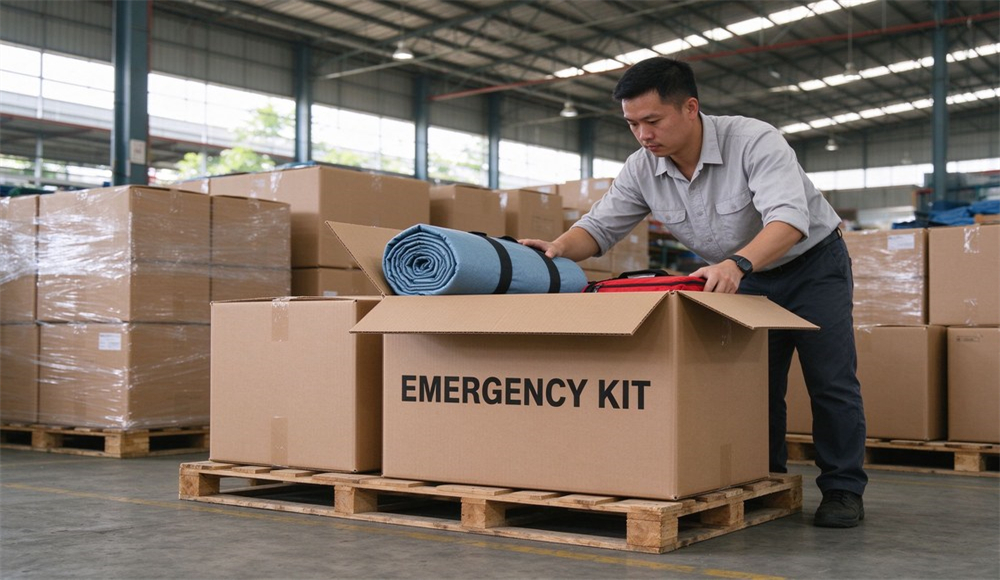
A first aid kit touches more chemicals than most buyers expect. The adhesive on a bandage, the ink on the manual, the rubber seal on the box and the cable insulation on the radio all contain regulated substances.
In the European Union, REACH restricts hundreds of substances, including lead, phthalates and SVHC candidates. Our manufacturing partner runs a REACH screening on every batch and provides the report on request. The screen covers the SVHC candidate list, which now runs to over two hundred substances.
In the United States, OSHA governs workplace safety and hazard communication. A product sold to a US workplace needs the right SDS and hazard labeling. The OSHA Hazard Communication Standard aligns with the UN GHS system, so the same data sheet works on both sides of the Atlantic.
Other markets add their own layers. China has its own chemical inventory. Japan has CSCL. Australia has NICNAS. The common thread is that the importer of record must declare the product's chemical composition to the local regulator.
We avoid exotic items that are hard to screen. A cheap imported dressing can fail the SVHC screen and delay a whole container. We buy dressings from suppliers who provide their own REACH and OSHA statements. That screening habit is what keeps repeat orders clean.
The practical lesson is simple. A product that looks fine on the shelf can fail a chemical screen on a technicality. The screening report is the document that proves it does not. Ask for that report before you place a repeat order.
Every export carton needs labels that the destination market can read. An English-only label is a customs violation in most non-English-speaking countries. The minimum set is English plus the destination language.
For the European Union, that means English, French and German for the core markets, plus Italian, Spanish or Dutch on request. For the Middle East, that means Arabic. For Southeast Asia, that means the local language. We prepare multilingual labels on request.
The label must carry the importer name, the importer address, the product name, the CE mark where applicable and the WEEE crossed-out wheelie bin for electronic items. The label must be durable enough to survive a sea voyage. A paper sticker that rubs off in transit is a customs violation.
We apply labels as durable pad prints on the ABS box and as laminated stickers on the outer carton. The label size follows the destination market's regulation. A buyer who sells to both Germany and Saudi Arabia gets two label versions on the same product.
The manual follows the same rule. A radio sold in Paris needs a French manual. A wall box sold in Riyadh needs an Arabic manual. We prepare multilingual manuals on request, reviewed by native speakers before print.
Wooden packaging crosses every border. A pallet without the ISPM-15 heat treatment stamp can be refused entry at the destination.
The stamp proves the wood has been heat-treated to kill pests. We use heat-treated ISPM-15 pallets for every export order. Pricing for emergency kit export compliance wholesale is tiered by container volume; as a international shipping first aid kit, we quote landed costs that include international shipping first aid kit consumables, custom packaging and pre-shipment QC.
Cartons are stacked on the pallet in a stable pattern. Heavy cartons go at the bottom. Light cartons go on top. The stack is strapped and shrink-wrapped so nothing shifts on the sea voyage. Fragile ABS boxes are packed corner-up with foam dividers.
The pallet height follows the destination container. A 20-foot container takes a lower stack. A 40-foot high cube takes a taller stack. We plan the pallet pattern to maximize fill without breaking cartons.
Container loads are planned to balance weight and maximize fill. We coordinate the booking, the export declaration and the dangerous goods note for the lithium battery. The buyer receives a clear arrival plan rather than a vague promise. Plan emergency kit freight around pallet height and container type.
Delivery timing is planned around the importer's storage capacity. A phased arrival across two or three weeks spreads unpacking and inspection. We adjust the schedule to the receiver's calendar. A calm delivery day keeps the whole rollout on track.
One contact owns the shipment. That person handles the booking, the documents and the arrival. When a question arises at the port, the buyer calls one number. Clear ownership keeps a large logistics chain from becoming a tangle of messages.
The document pack defines an export compliant emergency kit shipment. It pairs a commercial invoice with a packing list, bill of lading and certificate of origin, so the international shipping first aid kit container moves without re-documenting.
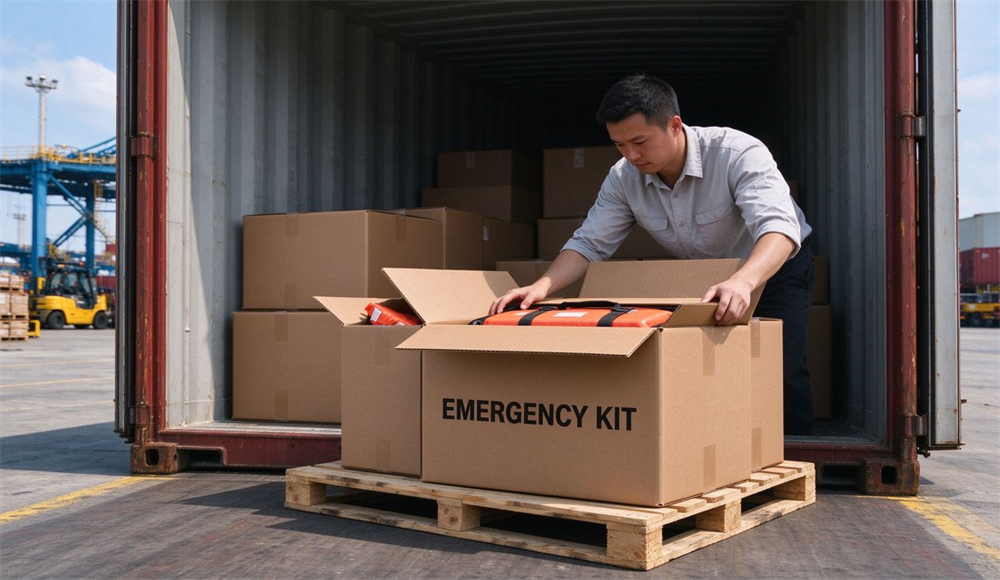
Every export carton needs four documents. The commercial invoice names the buyer, the seller, the goods and the value. The packing list names each carton and its contents. The bill of lading is the contract with the carrier. The certificate of origin proves where the goods were made. A complete export documentation kit clears most ports on the first try.
We prepare all four documents on request. The commercial invoice follows the importer's format. The packing list names every wall box and every lithium pack by carton. The bill of lading is issued by the carrier we book. The certificate of origin is stamped by the local chamber of commerce.
These four documents are the minimum. Some buyers ask for additional documents: a quality inspection certificate, a fumigation certificate for the pallet, an MSDS for the battery, a UN38.3 test summary, a CE declaration, a REACH screening report. We prepare each on request and bundle them into a single data pack.
The data pack travels with the shipment. A receiver, a customs officer and an auditor all read the same pack. That single source of truth is what turns a delivered container into a verifiable entry.
For repeat orders, we keep the document template on file. A reorder takes a short message rather than a fresh data pack. The same invoice format, the same packing list and the same bill of lading ship every time. That continuity is the value of a trusted supply line.
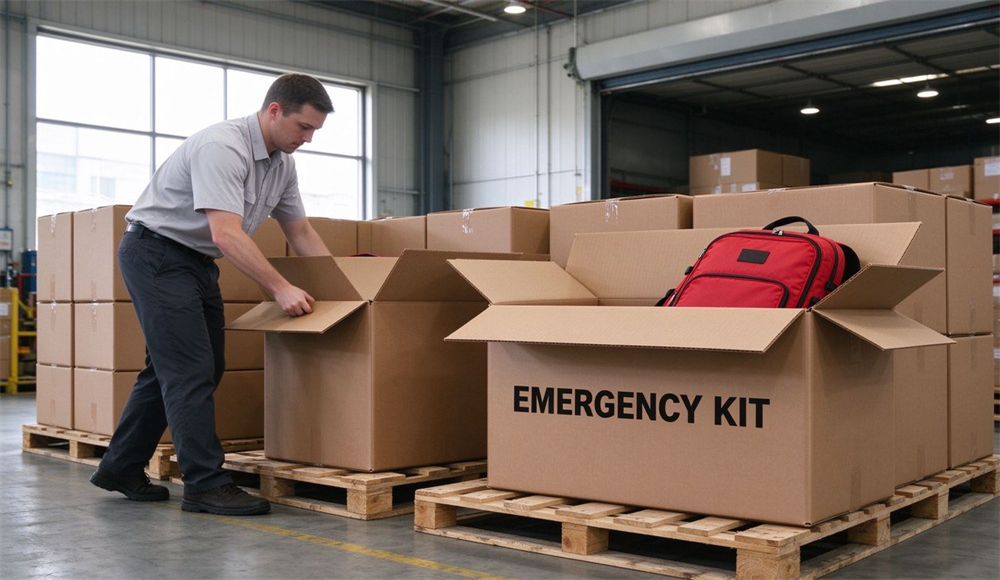
Quality control is where a reliable partner earns repeat orders. Each export compliant emergency kit is line-checked against the contents manifest, and every international shipping first aid kit container is verified before loading so it clears customs on arrival.
Quality control on every global export emergency kit starts at the production line.
Our manufacturing partner runs each order through a set check before packing: contents count, compartment layout, marking and outer-box condition. For repeat orders, our export compliant emergency kit account team reorders the same international shipping first aid kit configuration, keeping emergency kit export compliance wholesale pricing stable across quarters.
Every kit is built to a fixed bill of materials. When a repeat order arrives, it follows the same list as the first. There is no drift between batches. This consistency matters in regulated markets, where a change of supplier can trigger a fresh conformity assessment.
Materials are chosen for global compliance. ABS boxes must be rigid and cleanable. Radio cables must meet RoHS and REACH. Dressings must meet common first aid expectations. We avoid exotic items that are hard to restock or unsafe to ship.
Consumables carry clear expiry dates. Masks, wipes and dressings are dated for rotation. A distributor scans dates during the annual stock check. That habit keeps every kit current and prevents an expired item reaching a real event.
We support sample approval before a full run. A distributor who sees the actual wall box, the lithium pack and the marking can approve with confidence. A trial unit locks the spec before mass production. That prevents a batch that misses the mark.
Factory information stays protected in our work. We present the product and the paperwork, never the factory's identity. This protects both the partner and the buyer's direct channel. One trusted face carries the whole global program.
Every shipment passes 25 QC stations before it leaves the factory. The table below lists each check, the station that runs it and the standard we measure against. You can audit this list at goods-in with the same 25 points.
Buyers usually audit three stations at goods-in: item count, expiry dating and FDA registration number on the invoice. If any of the 25 points fails during production, we hold the batch and re-shoot the load photos before dispatch. FBA prep orders add an FNSKU scan match at station 20.
The checklist ends with booking a forwarder who knows an export compliant emergency kit container. Repeat buyers of our emergency kit export compliance wholesale program then reorder in hours, not weeks.
#
Check
Station
Standard
1
Item count per kit (BOM match)
Production line
Counted vs BOM; variance ≤0
2
Expiry date stamp legibility
QC bench
Date + batch number printed
3
FDA registration number on invoice
Document desk
Matches FDA database
4
510(k) exemption letter on file
Document desk
21 CFR 880.6255 cited
5
CPSC General Certificate signed
Document desk
Non-medical items covered
6
FCC SDoC for electronics
Document desk
Radio + headlamp test reports attached
7
NIOSH N95 approval number
Document desk
TC-84A-xxxx verified
8
REACH SVHC declaration
Document desk
0.1% threshold screened
9
RoHS declaration
Document desk
Electronics tested
10
California Prop 65 screen (<100 ppm)
QC bench
Lead + phthalate test report
11
ISO 9001 certificate valid
Document desk
Within 3-year validity
12
BSCI audit report valid
Document desk
Within 1 year
13
US importer name + address on carton
Packaging line
Per FDA prior notice
14
FNSKU / barcode scan match (FBA prep)
Warehouse
Amazon-compliant label
15
Carton drop test (80 cm)
QC bench
3 drops per corner
16
Pallet ISPM-15 mark
Warehouse
IPPC stamp
17
Carton weight ≤20 kg
Warehouse
Manual-handling safe
18
Inner-bag seal integrity
QC bench
Heat-sealed
19
Whistle audibility (≥100 m)
QC bench
Sampled every 500 pcs
20
Radio crank-power functional test
QC bench
10 cranks → LED lights
21
Nitrile glove powder-free check
QC bench
Visual + weight check
22
Gauze sterile pouch intact
QC bench
EO indicator dot changed
23
Instant cold pack seal integrity
QC bench
No ammonium nitrate leak
24
Manual English proofread copy
Document desk
Safety wording checked
25
Container loading photo record
Warehouse
Photo + video per container

This is the operational checklist your global importer will walk through with you. Ten steps cover the product, the importer registrations and the logistics paperwork. Use it to scope your first container or a repeat order.
|
Category |
Rule Triggered |
Who Files |
Documents We Prepare |
|
Wall box with therapeutic claims |
FDA (US), MDR (EU), SFDA (KSA), TGA (AU) |
Importer of record |
Contents list, CE declaration, expiry dating |
|
Lithium battery pack |
UN38.3, MSDS, air vs sea rules |
Manufacturer + importer |
UN38.3 summary, MSDS EN + destination language |
|
Liquids and gels |
Air freight ban, sea DG declaration |
Importer of record |
We ship dry; liquids sourced locally at destination |
|
Chemicals in adhesives, ink, cables |
REACH (EU), OSHA SDS (US), local inventories |
Manufacturer + importer |
REACH SVHC screening report, OSHA-aligned SDS |
|
Labeling |
English + destination language |
Manufacturer |
Multilingual label layout, manual |
|
Packaging |
ISPM-15 wood, carton stacking |
Logistics |
ISPM-15 stamp on pallet, packing list |
|
Shipping documents |
Invoice, packing list, B/L, CO |
Manufacturer + chamber of commerce |
All four documents bundled into data pack |
Run through this checklist before your first container, and again before every repeat order. The first row is the medical device row, the second is the lithium battery row, and the rest are importer and logistics rows.
The first row is the medical device row. A wall box with therapeutic claims needs FDA registration in the United States, MDR in the European Union and local registration elsewhere. The importer of record files the registration.
The second row is the lithium battery row. Every shipment needs UN38.3 and MSDS. Air freight needs regulated cargo. Sea freight needs the documentation in the bill of lading.
The third row is the liquid and gel row. We ship dry on purpose. Buyers who need liquids source them locally.
The fourth row is the chemical row. REACH screening covers the European Union. OSHA SDS covers the United States. The importer declares the composition to the local regulator.
The last two rows are packaging and documents. ISPM-15 pallets cross every border. The four documents are invoice, packing list, bill of lading and certificate of origin. We prepare each on request.
For distributors who want one trusted source for the global market, our wall-mounted ABS box plus lithium-plus pack emergency kit range is the clear starting point. It pairs a fixed first aid point with a portable power-and-light unit, built for category-by-category customs clearance.
Global buyers get a documented compliance map, multilingual labels and ISPM-15 pallets ready for the importer of record. A single emergency kit container can clear Los Angeles, Rotterdam and Dubai with the right paperwork from day one.
Need a full global program or market-specific add-on? We prepare every document to your importer's spec. Send us your destination markets, your importer details and your volume. We will quote a complete compliance package for your distribution program.

FDA registration covers US imports, but every other market adds its own filing. The table below lists the extra requirements for US, CA, AU, JP and Gulf destinations. Confirm your target markets before we quote.
Destination
Additional Requirements
United States
FDA Establishment Registration + Device Listing on invoice; CPSC General Certificate for non-medical; FCC SDoC for electronics; California Prop 65 warning only when required (we provide <100 ppm lead/phthalate test reports).
Canada
Health Canada MDEL for medical devices; CSA cETL for electrical; bilingual EN/FR labeling per Consumer Chemicals and Containers Regulations.
Australia
TGA registration for therapeutic goods; RCM mark (ACMA) for electronics; GST customs processing; packaging EPR (National Packaging Targets).
Japan
PMD Act (Pharmaceuticals and Medical Devices) registration; PSE mark for electronics (denki); METI notification; JIS-labeled manual in Japanese.
Middle East (GCC)
SASO / SABER certification for Saudi Arabia; ESMA / Emirates Quality Mark for UAE; ESMA-approved Arabic label; halal-free materials (no pork derivatives in bandages).
Southeast Asia
Singapore HSA registration; Malaysia MDA; Thailand FDA; Philippines FDA; Indonesia BPOM + SNI mark; typically rely on FDA/CE documentation for fast-track acceptance.
The US adds the heaviest paperwork: FDA establishment registration, device listing on the invoice and CPSC general certificates. Canada needs Health Canada MDEL. Australia attaches TGA AUS numbering. Japan requires PMDA filing and a Japanese-language manual. For Gulf markets, we prepare SFDA and GCC documents.
Whether you run an import company, a distributor or a retail chain, partnering with a specialist in an export compliant emergency kit keeps your range consistent. Our international shipping first aid kit program also handles mixed-carton splits and destination-language labels for multi-market buyers.
FAQ — Global Export Compliance
Do I need FDA registration to export first-aid kits to the US?
Yes. The manufacturer must hold FDA Establishment Registration and list each device under 21 CFR 807.20. Our facility is registered; we print the registration number on the commercial invoice and include a registration letter in the export file.
Are your standard kits 510(k) exempt?
Yes. Adhesive bandages, gauze, conforming bandages, medical tape and trauma pads fall under 21 CFR 880.6255 General Medical Devices — 510(k) exempt. We include the exemption letter in every US-bound shipment.
What about CPSC for non-medical items?
Non-medical articles (whistles, ponchos, multi-tools, electronics) need a CPSC General Certificate of Conformity. We prepare this certificate per shipment, covering lead, phthalate and small-parts safety.
Do electronic items need FCC certification?
Yes. Hand-crank radios and LED headlamps require FCC SDoC (Supplier's Declaration of Conformity) under Part 15 Subpart B. We attach the test report from an FCC-recognized lab.
Can you ship DDP to Amazon FBA?
Yes. We support full FBA prep: polybag, FNSKU label, carton label, pallet labeling, and DDP to the Amazon fulfillment center of your choice. Add 7 working days for prep.
What about Australian TGA or Health Canada?
TGA registration for Australia, Health Canada MDEL for Canada. We support both using our existing FDA / CE documentation — lead time adds 15–30 days for local registration.
What documents come with every shipment?
Packing list with HS codes, commercial invoice, Certificate of Origin, FDA registration letter (US), CE DoC (EU), FCC SDoC, CPSC General Certificate, test reports, BSCI audit, ISO 9001, and MSDS for chemical / battery contents.
Can you handle restricted substances like California Prop 65?
Yes. We provide a Prop 65 warning label only when required. All components are tested to <100 ppm lead and <0.1% phthalates, well below the Prop 65 thresholds.
What HS code should I declare on the US customs entry?
Typically 3005.90 (medical dressings impregnated) or 4202.92 (kit bag with contents). US MFN duty is 0–7% depending on the code. We print the exact HS code per SKU on the packing list. A clean HS code on an export compliant emergency kit carton speeds the international shipping first aid kit through customs without a document call-back.
What is your MOQ for a global trial order?
We accept sample orders (50 kits), LCL trial shipments (1–5 pallets), and full containers. 20GP ≈ 2,500–3,500 kits; 40HQ ≈ 6,000–8,000 kits. We support FOB, CIF and DDP terms. Under DDP we also handle port clearance so your export compliant emergency kit consignment clears on arrival, and each international shipping first aid kit container ships with a complete document pack.
YRF Textile Co., Ltd
Bulk emergency kits, first-aid boxes and rescue gear for distributors worldwide.
Contact
Email: info@yrftextile.com
Global export, FDA/MDR aligned, UN38.3 lithium orders welcome.
Company
About Us · All Emergency Kits
We work with families and communities worldwide. Whether you order a single kit or a container load, our team quotes within 24 hours and ships with FOB, CIF and DDP terms.
 |

|
Links amigáveis :
direito autoral © Custom Disaster - Relief Bedding: Tents, Sleeping Bags, Blankets Todos os direitos reservados
a equipe profissional para o serviço !