Categorias
Last updated: 27 November 2026
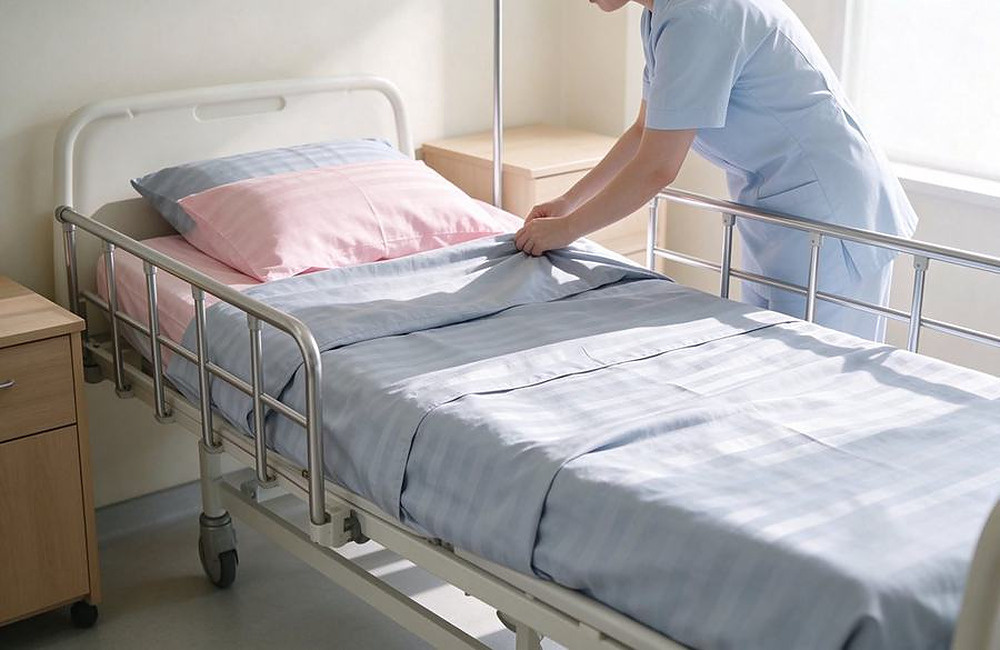
Colour is a specification here — grey-blue for the ward, pink for the postnatal floor.

A hospital linen store: sheets, drawsheets and pillowcases counted by department before the trolley run. Colour is not decoration here, it is a routing instruction.
Hospital bed linen is judged by wash life as much as hand feel. Coarser 21s yarn usually outlasts finer 32s under repeated industrial washing, while 32s gives the softer hand that patient rooms ask for. At 180 gsm a 32s sheet survives about 100 industrial washes; the 21s version at 150 gsm goes where barrier performance matters more than hand.
This page sets out the yarn choice, the barrier limits and the tests buyers actually request. So which yarn count survives a hundred industrial washes, and which one does not?
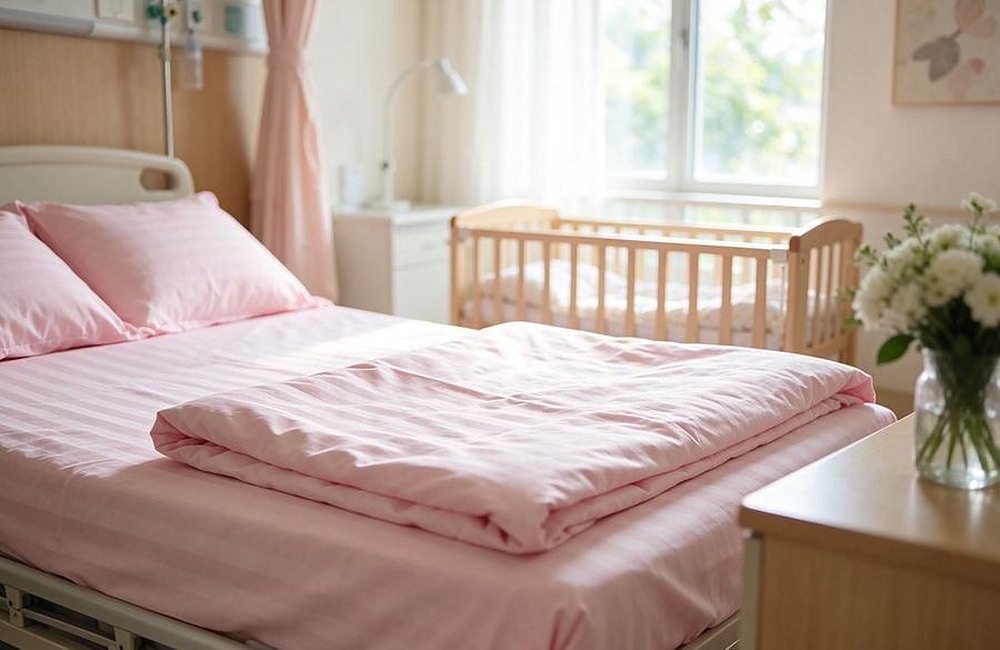
Pink satin stripe — the colour most postnatal and maternity floors specify when they refurbish a ward.
Quick answer: Hospital linen has to do three things hotel linen does not: survive disinfection chemistry without losing strength, act as a barrier between the patient and the mattress, and carry a colour code that keeps a department's linen inside that department. A sheet that passes a hotel wash regime can still fail all three.
The two products look alike on a shelf and behave nothing alike in service. A hotel sheet is judged by how it feels on the first night and how it looks after sixty washes a year at 60°C with a mild detergent.
A hospital sheet is judged by what it still does after a hundred industrial cycles, some of them at 71°C for ten minutes with alkali and chlorine in the bath.
Four differences decide how the fabric is built. The industrial laundering and dimensional change methods behind every figure here are set out in the ISO textile standards. Our production is based in Foshan, Guangdong, China, where cutting, sewing and packing are handled in-house.
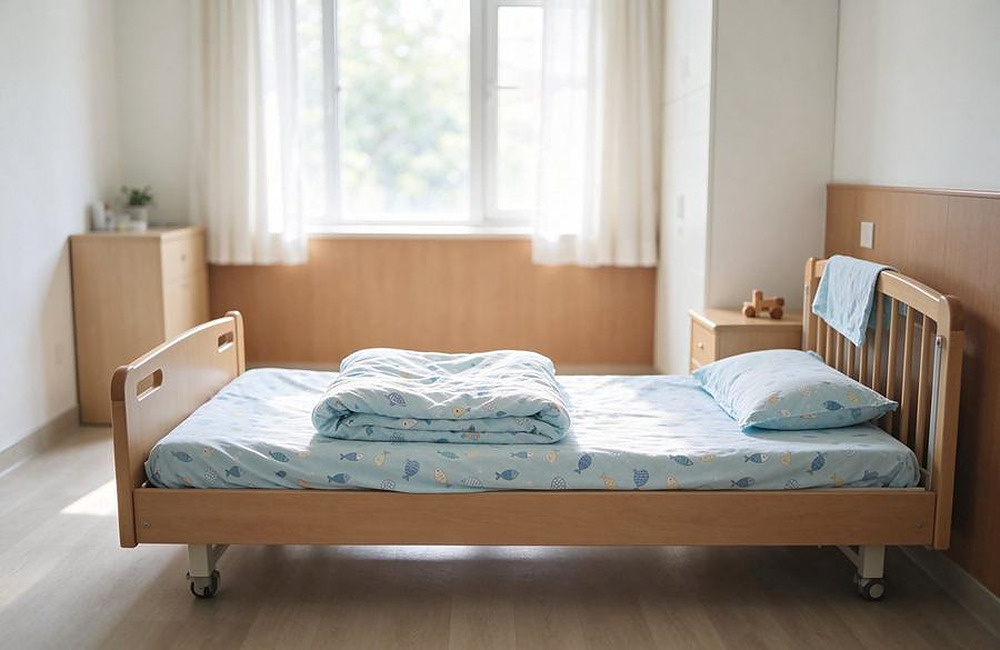
Print, not colour — a child ward reads calmer with a small repeating motif.
A hotel runs a sheet through its laundry perhaps fifty to eighty times a year. A hospital may process the same linen three times a week, and the linen is expected to hold its size, colour and strength across that whole life.
The industry measures this with ISO 15797, which specifies industrial washing procedures with a stated number of cycles; method 6 runs a hundred. A supplier who quotes "washable" without a method number has not told a buyer anything testable.
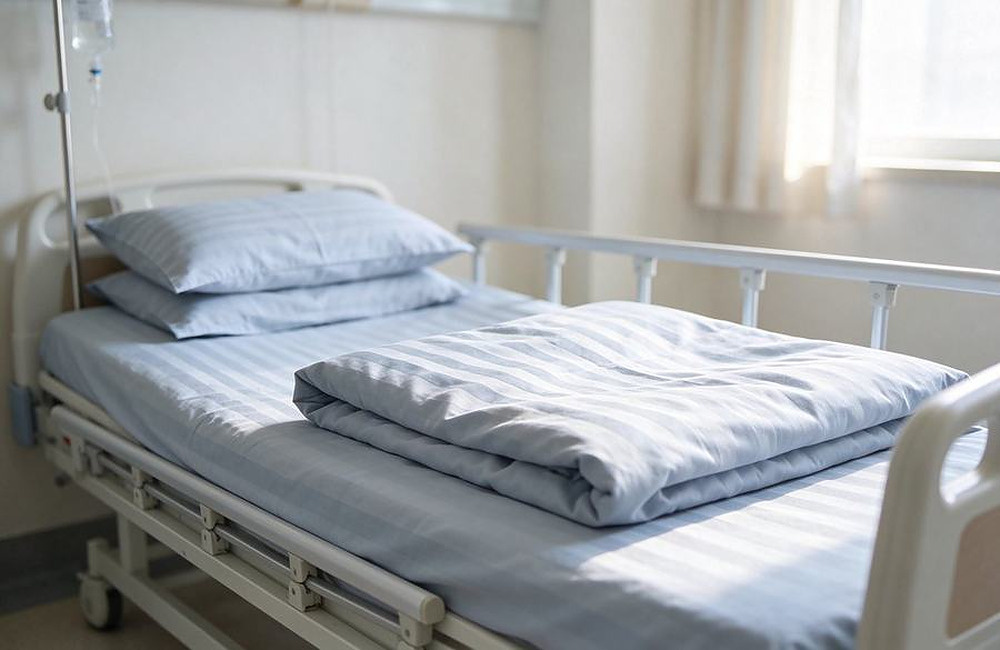
The same grey-blue across a whole bay, so a department can be read at a glance.
Hospital linen sits on the fomite path. That single fact drives the wash profile: thermal disinfection at 71°C for at least ten minutes, or a validated chemical disinfection cycle, plus segregation of infected linen at source.
Hotel linen rarely needs any of it. The practical consequence for fabric is that hospital sheets meet hotter water, stronger alkali and more frequent bleaching, all of which attack cotton faster than a hotel wash does.
A hotel uses colour to match a room scheme. A hospital uses colour to route linen through a building: theatre green, ward blue, infected or isolation red, and often a fourth tone for maternity or paediatrics.
The colour has to survive the same hundred cycles as the white, which rules out reactive dyes that are cheap but bleed at 71°C. This one difference alone removes a large part of the low-cost supply from consideration.
A hotel replaces a sheet when it looks tired. A hospital replaces it when it fails: a tear at the hem, a seam that has gone, a sheet that no longer fits the mattress after shrinkage.
Buyers therefore ask for breaking strength in newtons, shrinkage percentage and seam strength, and they test them rather than judge them by eye. Appearance still matters, but it is the last of the four, not the first.
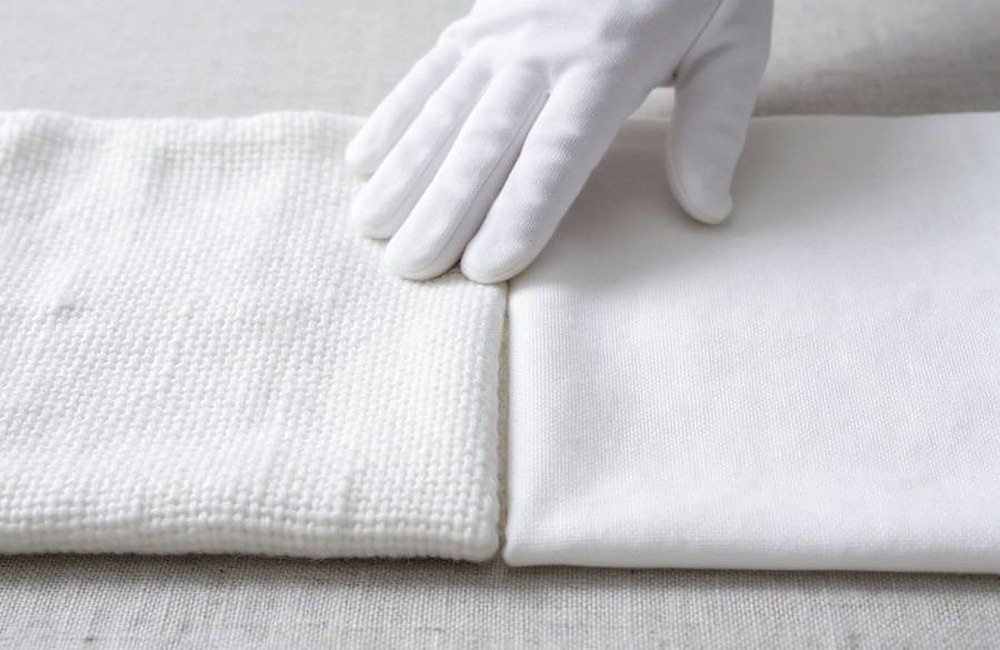
21s and 32s side by side under the same light. The coarser yarn reads heavier and slightly more open; the finer one is smoother and thinner at the same nominal construction.
Quick answer: Yarn count follows the department. A 21s yarn at 125 to 150 gsm resists abrasion and repeated high-temperature washing, which suits emergency and general wards; a 32s yarn at 130 to 150 gsm gives the hand and drape that maternity and premium rooms expect, at a higher cost per set.
The yarn count question is not a quality ranking. It is a fit question, and the answer changes room by room. 21s singles are the economical choice for high-turnover properties: heavier, more abrasion-resistant, and cheaper per square metre because the yarn is coarser and the weave can be set tighter.
32s gives a softer hand and a finer surface, which is what a private room or a maternity ward is paying for.
Intensive care, emergency departments, theatres and any area running three or more linen changes a day. These are the places where a sheet is bleached most often, laundered hottest and handled most roughly during the change.
A 21s plain weave at 120 to 130 gsm holds up here longer than a finer yarn at the same weight, because there is more fibre per unit length to lose before the cloth fails.
Private patient rooms, maternity, paediatric wards and any department that scores patient experience. A 32s sheet at 135 to 150 gsm in a twill reads noticeably smoother against skin, and the surface takes print and embroidery better when a trust wants its name on the hem.
The trade is wash life: at the same weight the finer yarn has less margin, so it usually needs a higher gsm to reach the same cycle count.
40s is the hotel and retail count, and it turns up in hospital catalogues because buyers compare across categories. On a general ward it is the wrong answer: the hand is lovely and the wash life is short.
Where it does work is outpatient, clinic and administrative bedding, and any low-turnover area where comfort outranks cycle count. Writing the count per department, rather than per hospital, is how this gets resolved.
|
Department |
Yarn |
Weight |
Colour code |
Wash target |
Barrier / Size |
|
Theatre |
21s plain |
125–135 gsm |
Green |
ISO 15797 method 6 line |
Not required on the sheet / 90×200 |
|
ICU / HDU |
21s plain |
125–135 gsm |
Blue |
Method 6, thermal 71°C |
Drawsheet, not fitted sheet / 90×200 / 100×210 |
|
General ward |
21s or 32s |
120–135 gsm |
White or pale blue |
Method 6 |
Optional / 90×200 |
|
Maternity |
32s |
135–150 gsm twill |
Pale pink or mint |
Method 4 or 6 |
Washable pad under sheet / 90×200 |
|
Paediatrics |
32s |
130–145 gsm |
Yellow or print |
Method 4 |
Washable pad / Cot 70×140 |
|
Isolation |
21s plain |
125–135 gsm |
Red or amber |
Method 6 with chemical disinfection |
Full barrier sheet / 90×200 |
|
Outpatient |
40s |
115–125 gsm |
White |
ISO 6330 domestic |
None / 90×200 |
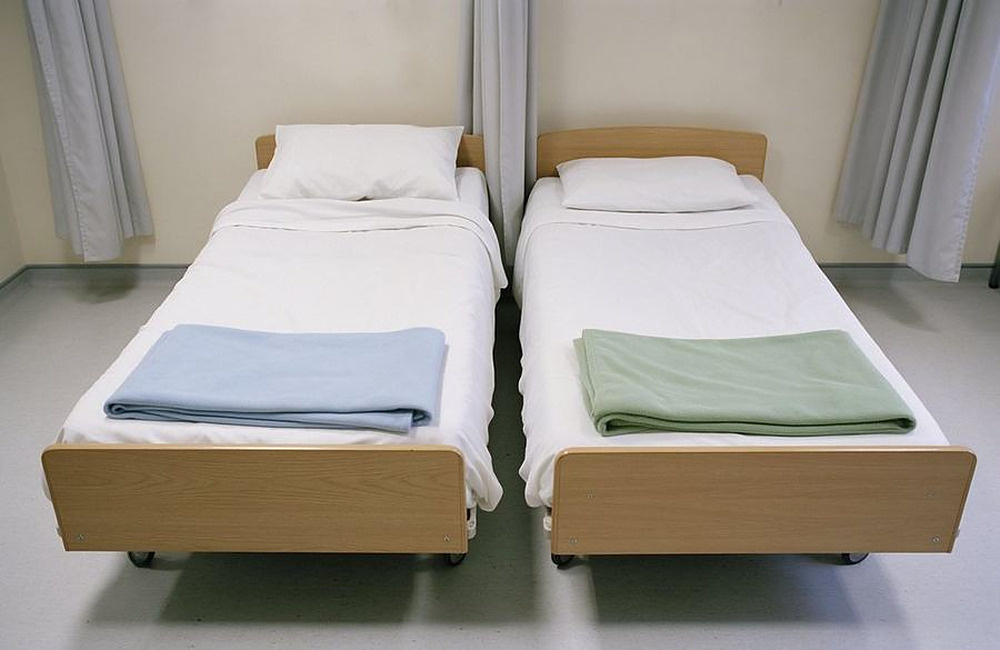
The same ward, two yarn counts: 21s at 125 to 150 gsm on the left, 32s at 130 to 150 gsm on the right.
Quick answer: Barrier performance is measured after 100 washes, not at delivery. A coated or laminated fabric that passes a hydrostatic test at cycle one often fails at cycle 100, because the coating cracks at the fold lines and the seam tape lifts — so the specification has to state the wash count at which the barrier is still required.
Waterproof hospital sheeting is the category where claims run furthest ahead of performance. Laminated fabric, meaning a polyurethane film bonded to a knitted backer, gives a clean waterproof result and a poor wash life.
A coated fabric, meaning a polymer layer applied directly to the cloth, is cheaper again and worse. Neither is a hundred-cycle product, and a buyer who specifies "waterproof for 100 industrial washes" without naming a test method is inviting a submission nobody can honour.
Lamination puts a discrete film between two layers, so the waterproofing is a separate component that can delaminate, bubble or crack at the fold lines.
Coating bonds a polymer into the fibres themselves, which is thinner and more flexible but abrades away at the contact points where a patient's weight and the bed mechanism work hardest.
Both fail at the edges first: hems, corner seams and the drawsheet loops, because that is where flexing concentrates.
Published field data gives the honest range.
A study across 148 US healthcare facilities tracking washable incontinence pads found real service life at 29 to 30 laundering cycles, with a spread from 23 to 40.
That is the number to plan replacement volumes against, not a supplier's headline.
The same pattern applies to barrier sheets: the film does not fail on cycle one hundred, it degrades measurably long before that and the failure is first seen as a damp patch at 3 a.m., not on a test report.
A barrier that stops water but not vapour is a heat trap, and wards notice within a shift. Moisture vapour transmission is measured under ISO 15496 and reported in g/m²/24h; the higher the figure, the more vapour passes.
Upright moisture vapour transmission under ASTM E96 is reported differently and in g/m²/24h as well, with the test conditions stated.
A specification that asks only for "breathable" has left the number out, which means the two bidders will answer on different bases.
What not to claim. A laminated barrier does not survive a hundred industrial washes, and no coating on the market does either. If a tender asks for both waterproofing and 100-cycle life, the honest answer is to offer a barrier with a stated cycle life, plus a separate non-barrier sheet for the same bed. Barriers are also not the pressure-relief layer; that job belongs to the mattress, which is why healthcare mattress requirements come into the same conversation.

Quick answer: Colour coding is a control system, not decoration. One colour per department lets linen room staff return a sheet to the right ward without reading a label, which cuts cross-department mixing and the infection-control questions that follow it.
Colour coding is the cheapest infection-control tool a hospital owns and the one most often specified in words rather than numbers. The usual scheme is three zones: theatre in green, general wards in white or pale blue, and infected or isolation linen in red or amber.
A fourth tone, often yellow or a print, marks paediatrics and maternity so that a cot sheet never ends up on an adult bed.
Theatre green is deliberately dark enough to hide blood staining, which matters for staff morale more than for hygiene but is the reason the colour persists.
Ward blue is light enough to show a stain at the change, which is the point: a sheet that hides contamination is worse than one that shows it.
Isolation red must be unmistakable at arm's length on a trolley, in artificial light, and through a plastic bag.
A colour code built on a disperse or direct dye will not survive the wash profile.
Reactive dyes hold shade through repeated alkaline washing at 71°C, which is why they cost more and why they are what a hundred-cycle specification implies.
Vat dyes are more fast again but rarely justified on a sheet. The practical question for a buyer is not "can you dye it red" but "which dye class, and what is the ISO 105-C06 result after the stated cycles".
A code only works if it survives the laundry, the trolley and the store.
Three things keep it legible: a dyed body rather than a coloured hem, because hems wear first; a woven or printed label that states the department in text as well as colour, for staff who cannot distinguish red from amber; and a size run per colour, so that a red sheet exists in the sizes the isolation rooms actually use.
Codes that stop at one size end up ignored.
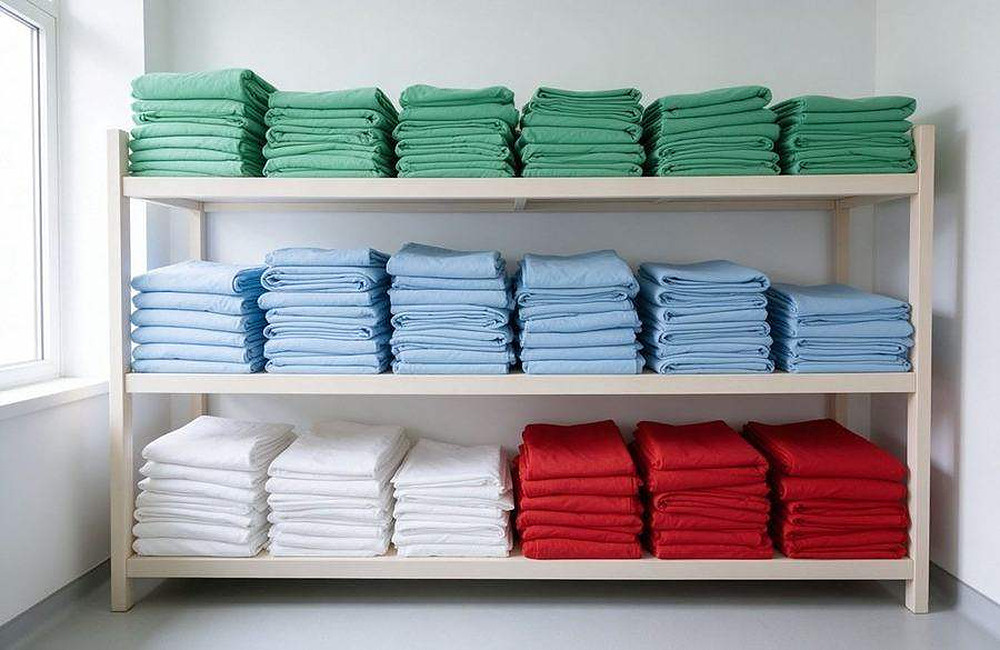
Linen sorted by department colour on a store shelf: green for theatre, pale blue for wards, red for isolation. The colour is read at arm's length, on a trolley, in artificial light.
Quick answer: Thermal comfort and patient throughput pull in opposite directions: a 180 gsm sheet feels warmer and heavier, but it dries slower and lengthens the laundry cycle, while a 130 gsm sheet dries fast and suits high turnover. Most wards settle at 130 to 150 gsm with a separate warmer option for long-stay patients.
Bed linen sits between a patient's skin and a mattress for most of a day, so it does affect comfort, and it is the cheapest variable a ward can change.
What it does not do is relieve pressure. That is a mattress function, and any supplier who implies a sheet prevents pressure injury is selling something the sheet cannot deliver.
For the adjacent buying decision, see institutional bedding sourcing.
Three things: friction at the skin, moisture next to the skin, and the microclimate between body and mattress.
A rough or creased sheet raises shear when a patient is repositioned, and shear contributes to tissue damage alongside pressure.
A sheet that wets and stays wet keeps the skin macerated, which weakens it. A heavy, low-permeability sheet traps heat. All three are real, and all three are modest next to the mattress's own contribution.
Plain weave at 120 to 130 gsm is the ward standard because it is light, permeable and cheap to replace. Twill at 135 to 150 gsm feels smoother and drapes better, which matters on a maternity or private ward.
Sateen at 150 to 180 gsm is a hotel answer and is usually the wrong specification in a hospital, since the denser surface traps more moisture at the same breathability figure. None of these choices changes pressure at the sacrum; they change friction, moisture and feel.
Where a ward has a repositioning protocol, a low-friction turning sheet does more for shear than any change of bed linen. These are separate products, usually tubular or flat slide sheets, and they are laundered with the rest of the linen.
The specification point is that they add a wash load and a size run, so a trial that ignores them will undercount laundry volume by ten to fifteen percent on a high-dependency ward.
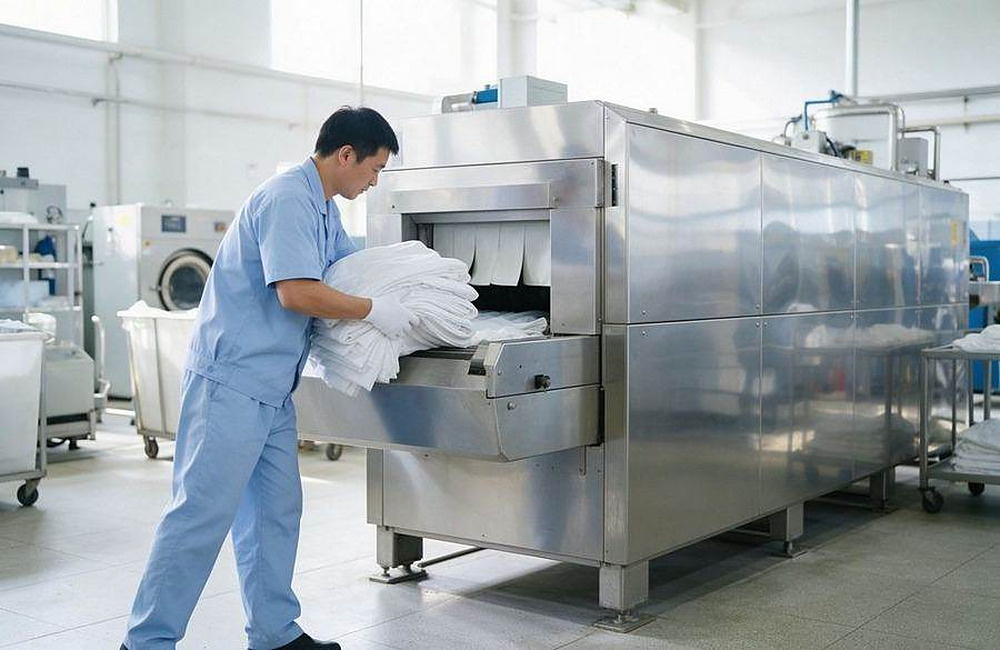
A tunnel washer being loaded with ward linen before a thermal disinfection cycle runs. Sheets see 71°C for ten minutes here, several times a week.
Quick answer: Washing chemistry decides the specification more than the weave does. Chlorine bleach, alkaline detergent and high-temperature disinfection all attack cotton, so a fabric that is not engineered for that regime loses strength and colour long before its wash count is reached.
Hospital laundry chemistry is harsher than any hotel's, and the fabric has to be built for it.
Thermal disinfection typically runs 71°C for at least ten minutes at the load. Chemical disinfection substitutes a validated product and a shorter, cooler cycle.
Both routes sit inside a quality system, and that system is where most specification confusion starts.
Thermal disinfection costs energy and stresses the cloth through heat, but leaves no residue and is easy to validate with a temperature record.
Chemical disinfection costs less energy and is gentler on the fibre at lower temperature, but introduces a residue that must be rinsed and a chemistry that must be monitored.
A hospital usually runs both routes on different linen classes: thermal for cottons, chemical for barrier fabrics that cannot take 71°C repeatedly.
Alkali at wash pH 10 to 11 opens the cotton fibre and releases soil, and it also degrades it over repeated cycles.
Chlorine bleach is the most damaging common agent: it attacks cellulose directly, and a hundred chlorine cycles will reduce breaking strength substantially.
Peracetic acid and oxygen-based bleaches are the usual substitutes where a trust wants both hygiene and fibre life. A supplier's wash-life figure is only meaningful if the bleach regime is stated alongside it.
This is the most common misreading in healthcare textile tenders. EN 14065 specifies a risk analysis and biocontamination control system, known as RABC, for a laundry operation. It certifies how a laundry processes linen, not what a textile product is.
A tender that lists EN 14065 among product requirements has either copied a laundry specification or expects the laundry, not the supplier, to hold it. The correct response is a written clarification, plus the product tests that actually apply.
The same logic applies to washable bedding for care settings, where the barrier product carries its own cycle-life figure and its own laundering instructions rather than a system certificate.
Three phrases that need a standard behind them.
"Hospital grade" is not a standard. "Antibacterial" needs a named test method and a stated result. "EN 14065 certified linen" is a category error: the standard covers the laundry process, not the sheet.
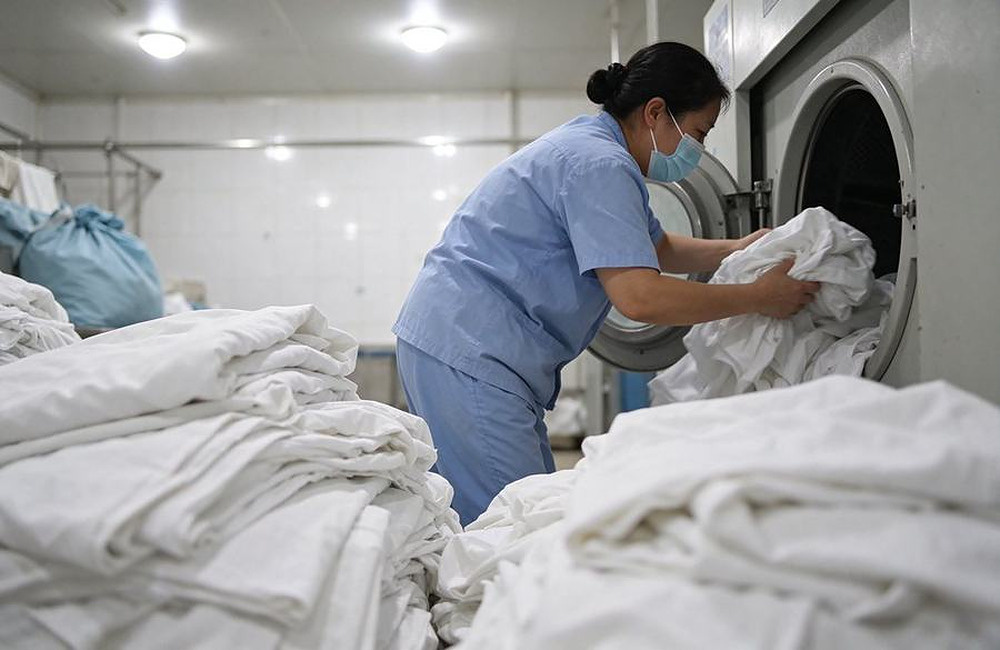
Chlorine bleach, alkaline detergent and 71 °C disinfection are decided before the fabric is woven, not at the wash wheel.
Quick answer: Three test legs carry the compliance argument: ISO 15797 for industrial laundering over a stated number of cycles, ISO 105 for colour fastness with a minimum rating, and GB 18401 for skin-contact safety. A tender that names all three is asking for reports, not claims.
Healthcare linen testing rests on three legs, and a bid is weak if any one of them is missing. Industrial wash durability comes from ISO 15797.
Colour and dimensional stability come from the ISO 105 series and ISO 6330 with ISO 5077.
Chemical safety comes from GB 18401 for the Chinese market and from OEKO-TEX or REACH declarations elsewhere. Buyers increasingly ask for all three, and they ask for the method number with each.
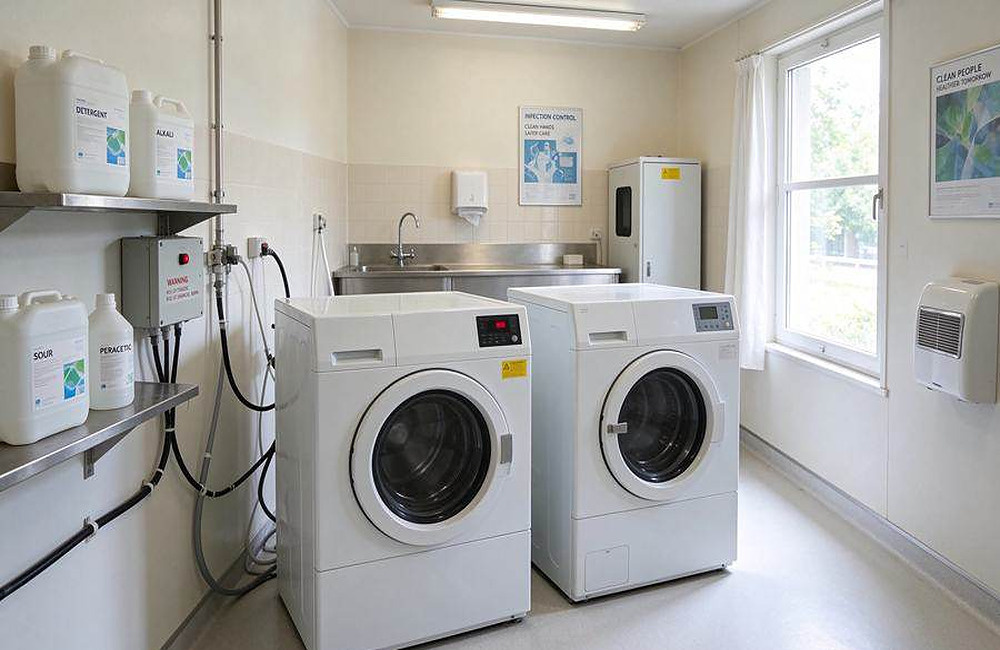
The wash chemistry is as much a part of the specification as the GSM, because the chemicals decide the wash life.
ISO 15797 defines industrial washing procedures for workwear and textiles, and its value lies entirely in which method was run. Method 4 is the fifty-cycle procedure and method 6 the hundred-cycle procedure; a report that says "tested to ISO 15797" without the method tells a buyer nothing about life expectancy.
Ask for the method, the number of cycles, and the measured change in breaking strength and shrinkage after them. Colour fastness and water resistance procedures are defined by AATCC.
Colour fastness to washing is ISO 105-C06, reported as a grey-scale grade; healthcare linen is usually specified at grade 4 or above.
Colour fastness to rubbing is ISO 105-X12, reported separately for dry and wet, and the common healthcare requirement is dry 4 and wet 3-4.
Two numbers, two tests, and a bid that reports a single "colour fastness" figure has merged them, which is a clarification waiting to happen.
Dimensional change after laundering is measured with ISO 6330 by ISO 5077, and 3 percent or less is the usual acceptance line for a hospital sheet.
Breaking strength is ISO 13934-1, reported in newtons for warp and weft separately, because a sheet fails along one direction long before the other.
Pilling is ISO 12945-2, usually specified at grade 4. Each of these gives a number a buyer can score rather than an adjective they have to trust.
Property
Standard
What the report states
Typical requirement
Wash durability
ISO 15797, method 4 or 6
Cycles run, strength and size change after them
Method stated; method 6 for ward linen
Colour fastness, wash
ISO 105-C06
Grey-scale grade
Grade 4 or above
Colour fastness, rub
ISO 105-X12
Dry and wet grades separately
Dry 4, wet 3-4
Shrinkage
ISO 6330 with ISO 5077
Percentage change after stated cycles
3% or less
Breaking strength
ISO 13934-1
Newtons, warp and weft
Stated minimum per direction
Pilling
ISO 12945-2
Grade after stated rubs
Grade 4
Chemical safety
GB 18401, class B
Class, plus tested items
Class B for skin contact
|
Property |
Standard |
What the report states |
Typical requirement |
|
Barrier vapour |
ISO 15496 |
g/m²/24h |
Stated minimum |
Every colourway gets the same check — the weave and the hem, not just the shade.
Pre-shrunk linen is not a claim, it is a number from a wash cycle.
Ask for the drop after five cycles at the temperature the hospital actually uses, not the figure from a single laboratory wash at 40 degrees.
A sheet that shrinks two percent in a 60-degree cycle will no longer fit the mattress it fitted at the trial, and the mattress depth does not change with the fabric.
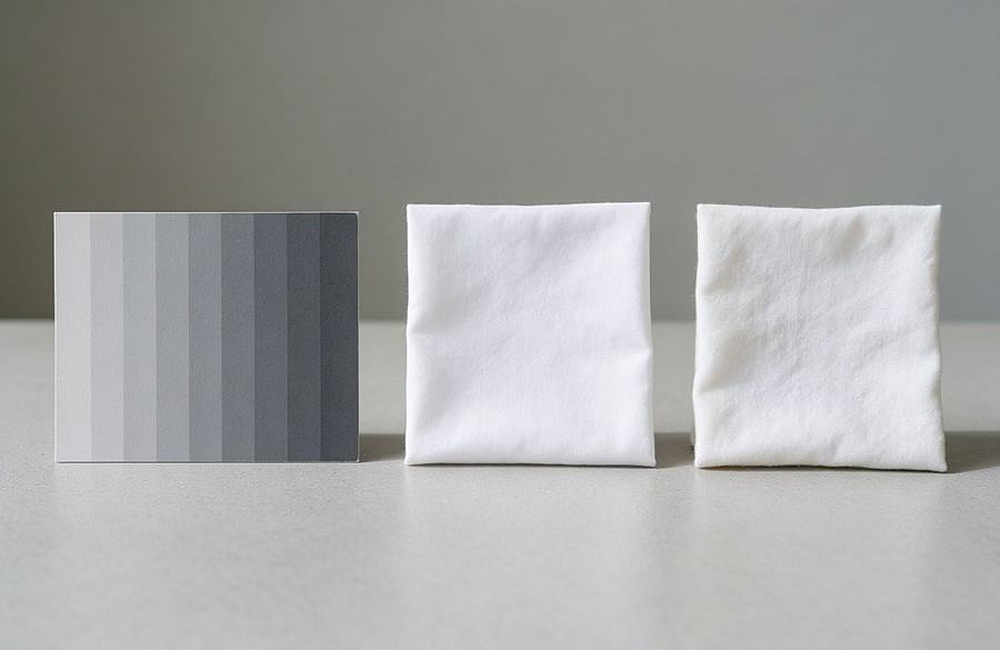
Grey-scale comparison against a washed swatch. The grade is read against a card, not judged by eye, which is why the report carries a number.
Quick answer: Hospital bed sizes are 90×200 and 100×210 cm, and the skirt follows the mattress: 30 cm on a standard 20 cm mattress, 35 to 40 cm on a profiling bed with a 20 to 23 cm alternating-pressure mattress. Getting that wrong is the most common cause of a torn hem in month one.
Hospital beds come in two working sizes in most markets, and a third for special care. The standard ward bed is 90×200 cm.
The longer and wider institutional bed, common in German, Nordic and some Middle Eastern estates, runs 100×210. Paediatric cots run 70×140.
Getting the size run right removes more returns than any other single specification decision.
A 90×200 bed takes a 90×200 sheet with a 30 cm skirt on a 15 cm mattress, or a 35 cm skirt on a 20 cm mattress.
A 100×210 bed takes its own size; a 90×200 sheet will not fit it, and stretching one over is how hems tear in the first month.
Both sizes need a matching drawsheet and pillowcase, and the pillowcase is usually 50×75 for a 45×70 pillow, or 48×74 where the market is more European.
A profiling bed with an alternating-pressure mattress raises the mattress depth to 20 to 23 cm, so the skirt goes to 35 or 40 cm.
An alternating-pressure system with air cells can push the effective depth higher again, and here a fitted sheet is often the wrong product: a flat sheet tucked under is easier to change and does not fight the cell movement.
Specifying "fits alternating-pressure mattresses" without a depth is how a ward ends up with sheets that pop off at the corner.
A duvet cover is sized 5 to 8 cm larger than the duvet it holds, in both dimensions, so the duvet can settle without pulling the seams.
A 200×200 duvet takes a 208×208 cover. A hospital using 150×200 duvets needs 158×208.
Getting this wrong shows up as a cover that will not sit flat, and it is one of the few sizing errors that a buyer can see without measuring. For the adjacent buying decision, see washable bedding for care settings.
|
Bed type |
Mattress size |
Sheet size |
Skirt depth |
Pillowcase |
|
Standard ward |
90×200, 15 cm |
90×200 |
30 cm |
50×75 / 48×74 |
|
Standard ward |
90×200, 20 cm |
90×200 |
35 cm |
50×75 / 48×74 |
|
Long institutional |
100×210, 20 cm |
100×210 |
35 cm |
50×75 |
|
Profiling / ICU |
90×200, 20–23 cm |
90×200 plus depth |
35–40 cm |
50×75 |
|
Paediatric cot |
70×140 |
70×140 |
25–30 cm |
35×45 |
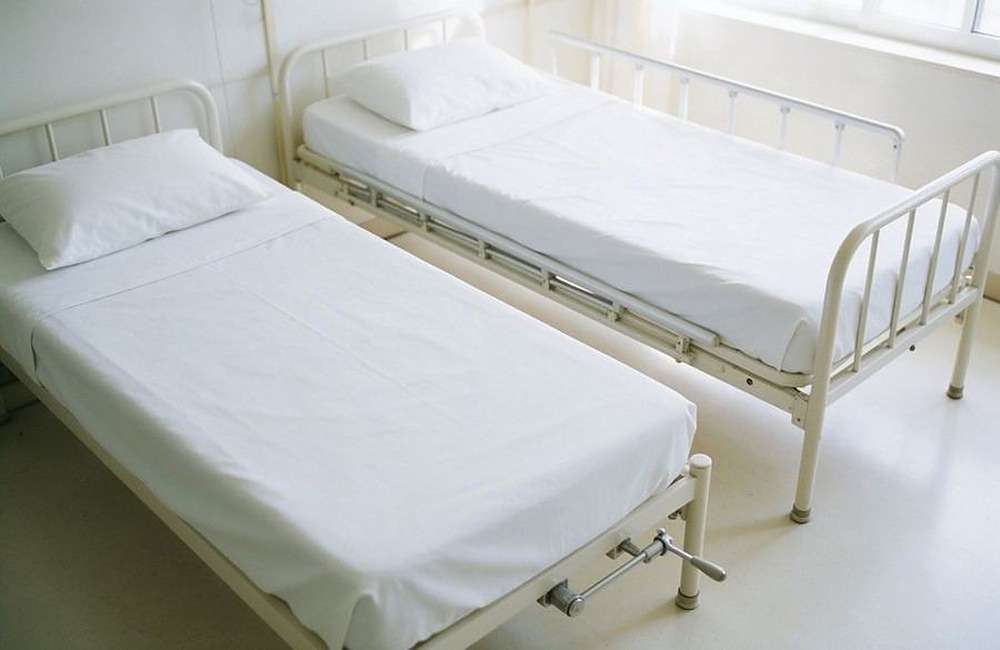
A 90×200 ward bed and a 100×210 institutional bed side by side. The longer bed takes its own sheet; stretching a 90×200 over it is how hems tear in the first month.
Quick answer: Public healthcare tenders usually specify the wash cycle count under ISO 15797, a colour fastness rating under ISO 105, formaldehyde and pH limits under GB 18401, plus a barrier requirement stated after a wash count. Tenders that do not name these are usually decided on price alone.
Public hospital linen tenders converge on a small set of clauses, and the clauses repeat because they were copied from an earlier framework.
Reading them in advance is the difference between a bid that is scored and a bid that is set aside. Five families of clause carry most of the risk.
Flammability requirements in healthcare tenders usually target the mattress and the mattress protector, not the sheet.
In the UK, BS 7177:2008+A1:2011 covers mattresses, mattress pads, divans and bed bases across four hazard classes of low, medium, high and very high risk; the ignition sources are EN 597-1 for a smouldering cigarette and EN 597-2 for a match flame, which are the domestic low-hazard tests,
so a hospital mattress is assessed against the higher classes with a risk assessment rather than on those domestic tests alone. Some markets apply cigarette-ignition and open-flame rules to mattress sets as well, and a tender quoting those clauses is naming the mattress rather than the sheet.
A tender that asks for a flammable-resistance certificate on sheets has usually borrowed a clause from the mattress section; the honest answer names the standard that applies and states what has been tested.
Chemical safety for skin contact is GB 18401 class B in China and OEKO-TEX Standard 100 elsewhere, with REACH declarations covering restricted substances for the EU.
"Hypoallergenic" and "anti-allergy" are marketing terms without a test method; what a tender can actually verify is a class, a certificate number and a list of tested items.
Where a trust asks for latex-free, that is answerable at fibre and elastic level rather than as a product claim.
Tenders specify the department colour scheme, the seam type and the label content, and these three are the clauses most often answered loosely.
Seam requirements are usually double-stitched at 1.0 to 1.5 cm with a stated inner flap; labelling requires fibre content, wash instructions, size and often a trust asset number.
A labelled hem that will not survive fifty industrial washes fails the label clause as surely as it fails the fabric clause.
Most frameworks ask for a sample with the bid and reserve the right to run a wash trial before award.
Where a trial is specified, thirty washes is the usual single cycle, and a bidder who has never run its own product through thirty industrial cycles has no data to answer the result.
Sizing the trial properly, on the correct machine and the correct chemistry, is part of bid readiness rather than a post-award task.
|
Clause |
What it usually asks |
Standard that applies |
What to submit |
|
Flammability |
Flame resistance on mattress or protector |
BS 7177:2008+A1:2011 class; national rules elsewhere |
Report naming the class and the assembly tested |
|
Skin safety |
Restricted substances for skin contact |
GB 18401 class B; OEKO-TEX Standard 100 |
Report with class and tested items |
|
Colour coding |
Department colour scheme, shade held after washing |
ISO 105-C06, grade 4 or above |
Fastness report per colour |
|
Seams |
Double-stitched, stated seam width, inner flap |
Buyer specification, verified on sample |
Pre-production sample with seam measurement |
|
Labelling |
Fibre content, wash instructions, size, asset number |
ISO 3758 care symbols; local textile labelling rules |
Approved label artwork |
|
Wash life |
100 industrial cycles |
ISO 15797, method 6 |
Report with method number and measured change |
Where the clauses contradict each other.
A tender that asks for both a 100-cycle wash life and a waterproof barrier on the same fitted sheet is asking for something that does not exist at commercial scale. The same document often asks for thermal disinfection compatibility and a low-temperature chemical cycle. Raise both at the clarification stage, in writing, before the deadline, and let the buyer's addendum settle it. The wider sourcing questions behind these clauses sit in institutional bedding sourcing.
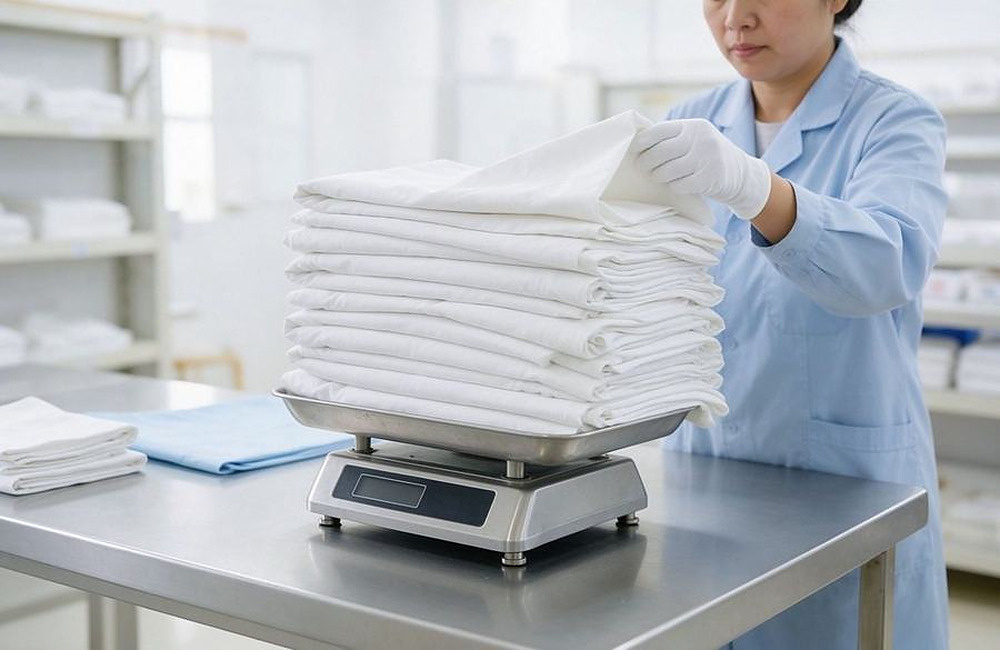
A newly delivered batch weighed on a receiving bench before it goes into stock. A short count is cheapest to catch here.
A thirty-cycle wash trial is the smallest honest test of hospital linen.
It is long enough to expose shrinkage, colour drift, seam failure and any barrier delamination, and short enough to run inside a tender timetable.
Anything shorter measures the fabric's appearance, not its service life.
Put at least six pieces of each candidate into the trial, including one fitted sheet, one flat sheet, one pillowcase and one barrier item where relevant.
Record the piece and its position at cycle zero, photograph and measure it, then wash according to the intended regime, not a convenient one.
Measure at cycle ten, twenty and thirty. A single end measurement hides whether the failure was gradual or sudden, and gradual failure is what a buyer plans replacement volumes against.
Five measurements carry the result: length and width change against ISO 6330 and ISO 5077, colour grade against the grey scale, seam integrity at the hem and corner, breaking strength where the buyer will ask for it, and for barrier items a leak check with water held for one minute.
Photograph the same corner each time, from the same angle. The comparison across thirty cycles is what convinces a committee, and a set of consistent photographs does it faster than a page of numbers.
Three outcomes matter.
A sheet that has shrunk beyond 3 percent by cycle thirty will not fit at cycle sixty. A sheet whose colour has drifted two grey-scale steps has failed the routing system, not just the aesthetics.
A barrier that leaks at cycle thirty will not reach a hundred, whatever the supplier says. None of these is a reason to reject the product outright; all three are reasons to write a replacement interval into the contract, with a number attached to it.
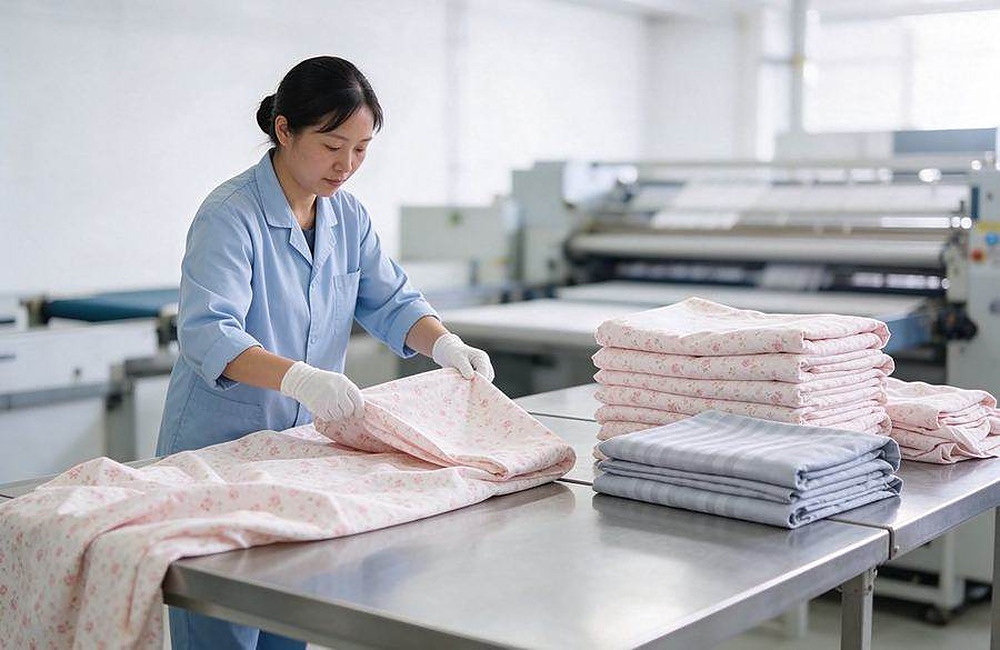
Two colourways through one finishing bench, folded to the same footprint so a ward trolley stacks either one.
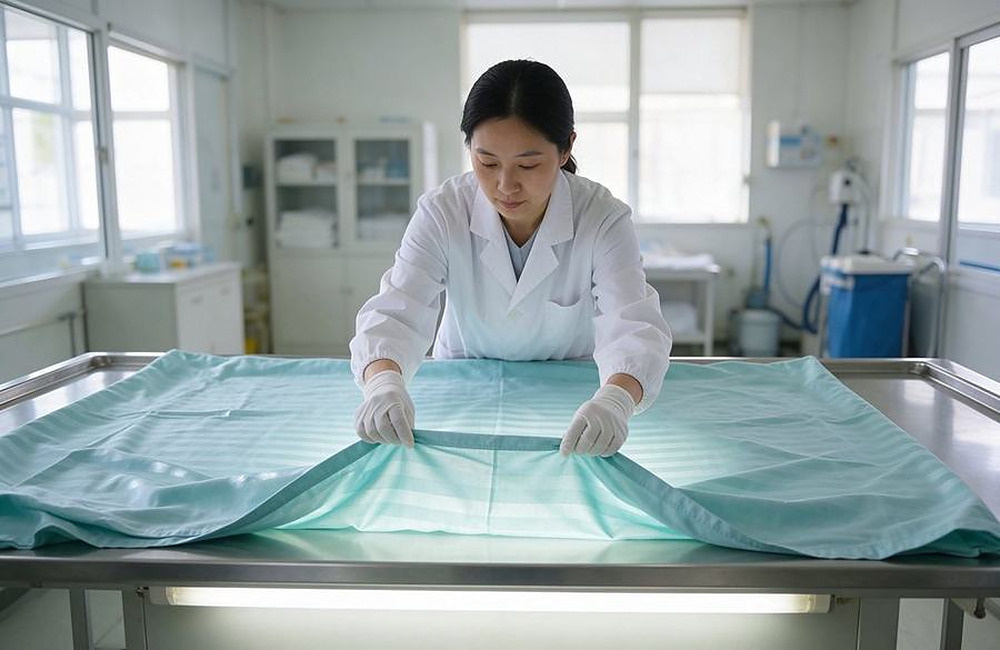
A washed sheet checked on a lighted table answers three questions at once: how much it shrank, whether the weave lost strength at the crease lines, and whether the surface has started to pill.
Measure the drop before and after, pull the fabric across the table edge, and compare the surface against a new sheet from the same lot.
A single cycle tells you little; the figure that matters is the one taken after the wash cycle count the property actually runs.
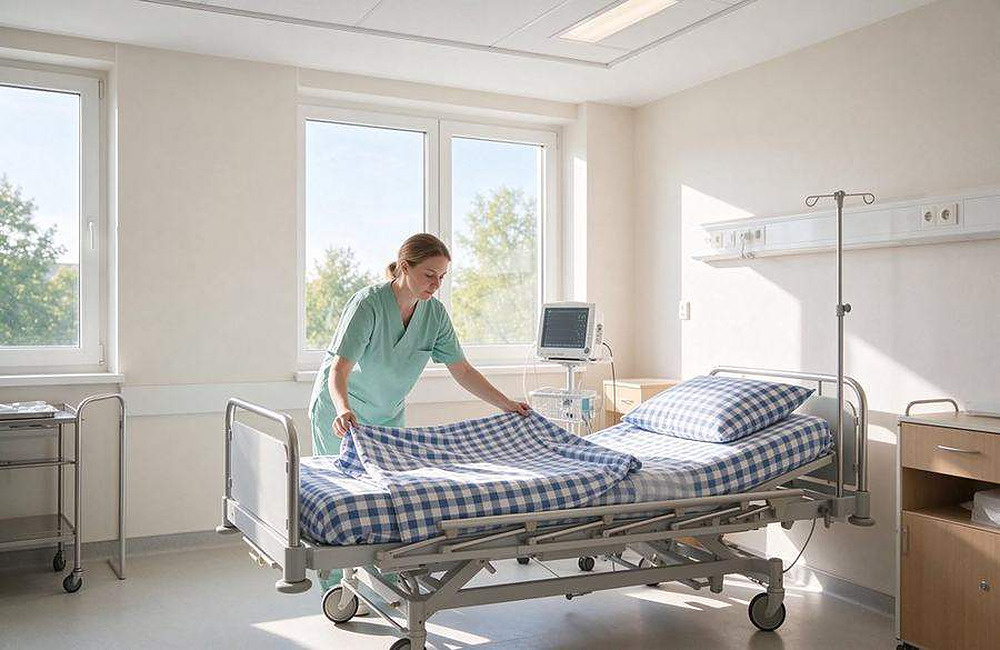
Check in critical care — pattern hides the marks that plain white keeps.
An ICU bay turns linen faster than a general ward, because the bed is occupied around the clock and the change interval is shorter.
Stock for that department is usually planned at three to four times the general ward holding, and the extra volume is in flat sheets and draw sheets rather than in decorative items.
If the department list is not split in the stock plan, the ICU runs short while the general floors sit on excess.
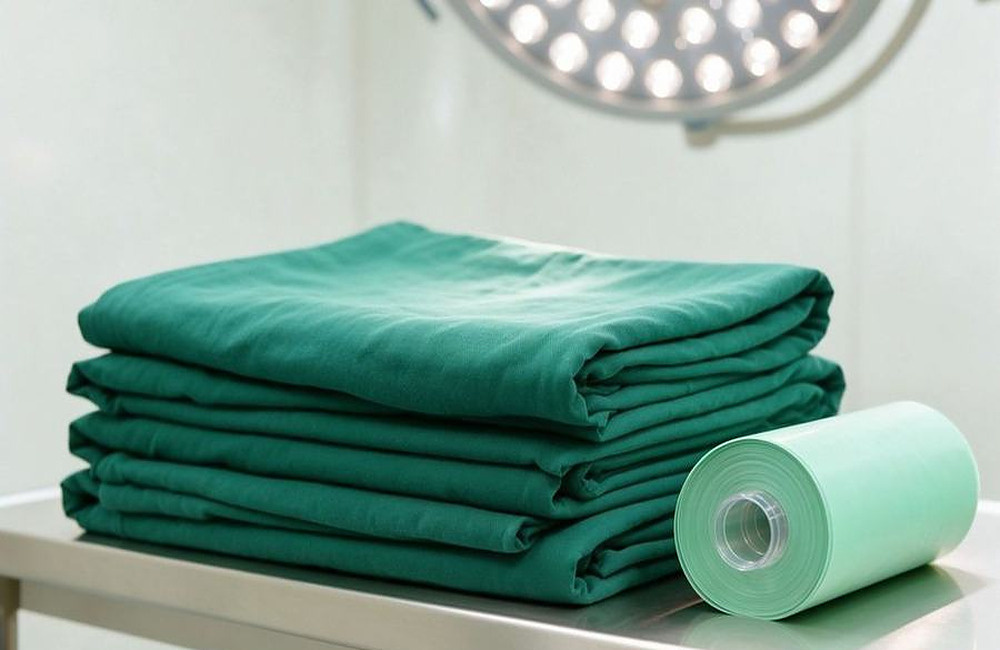
Theatre linen in green, stacked after a change. The colour hides staining, and it survives the wash because the dye class holds shade at 71°C.
Theatre linen is coded by colour so that it never re-enters a ward circulation by mistake.
Green for theatre, blue for wards, and a separate wash programme for each, because the theatre set carries a different contamination profile.
The colour coding is a process control, not a decoration, and a supplier who cannot hold the colour run across reorders breaks the control at the first replacement order.
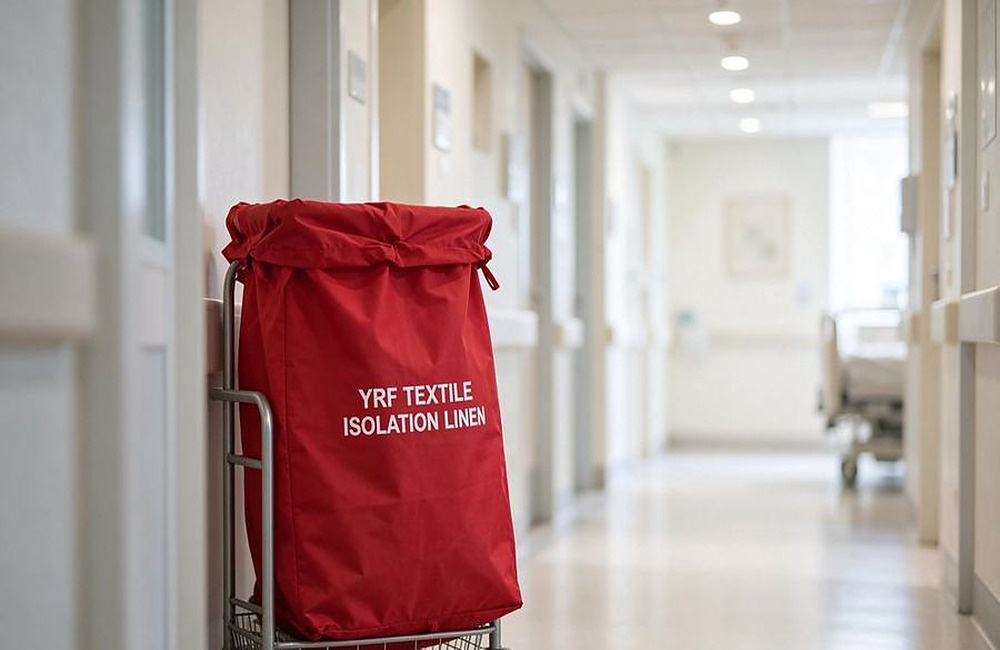
Isolation linen bagged in red on a trolley. The colour has to be readable at arm's length, in artificial light, before anyone opens the bag.
Isolation linen leaves the room in a bag marked for that purpose, and the bag colour is the instruction to the laundry.
Red for infectious, and the bag is not opened at the ward.
The linen specification and the bag specification belong together, because a bag that splits in the corridor defeats a barrier fabric that passed every laboratory test.
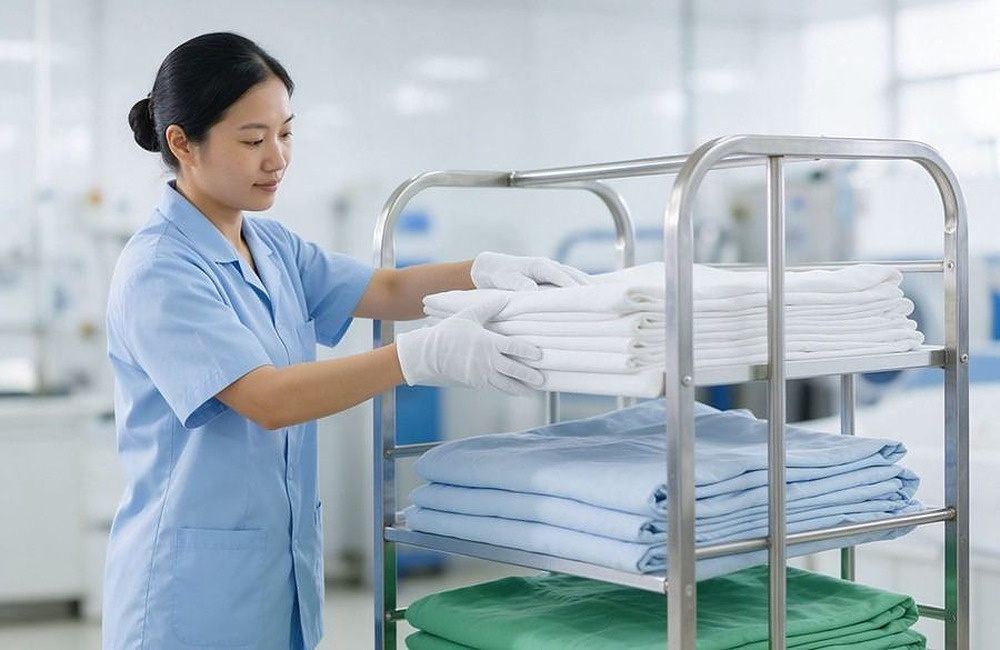
Sorted linen on a laundry trolley before loading. Thermal and chemical routes run on different linen classes in the same building.
Sorting at the laundry decides whether the ward gets its linen back correctly. Colour by department, size run by colour, damaged items pulled before the wash rather than after.
A trolley sorted this way lets one operator load a hundred kilos in a shift without mixing the theatre set into the ward set, which is the failure that a barcode system is meant to prevent.
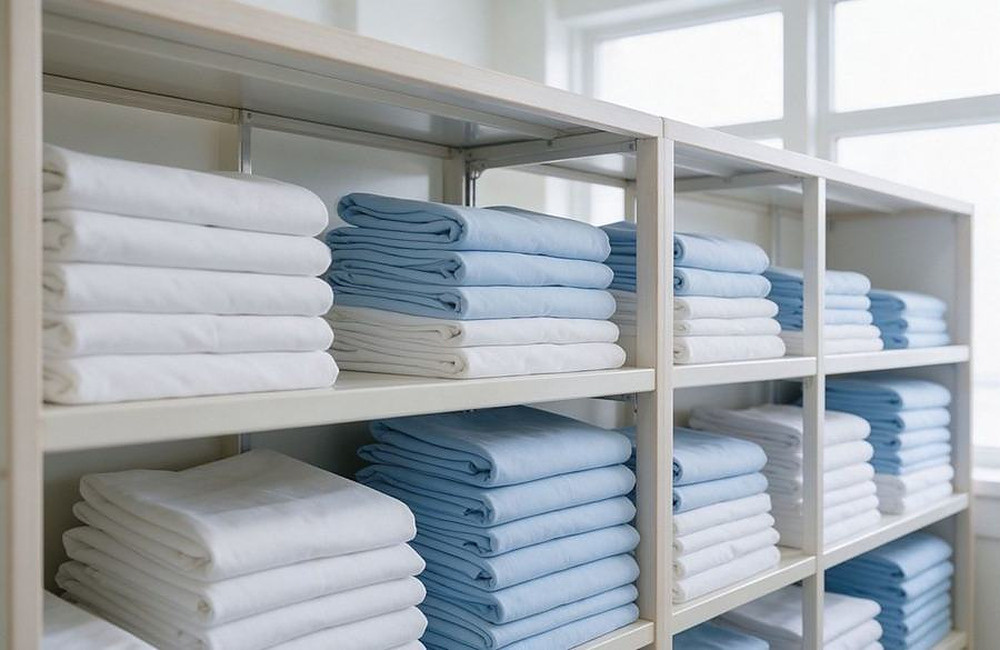
A linen room shelf with a size run per colour, so that the right sheet exists for the right bed.
A linen room shelf organised by colour and size run is the cheapest inventory control in the hospital. Housekeeping takes what the shelf shows, the supervisor counts what is missing, and the reorder is read from the gap rather than from a stock report.
The shelf layout is part of the specification, and a supplier who packs by department rather than by mixed carton makes it possible.
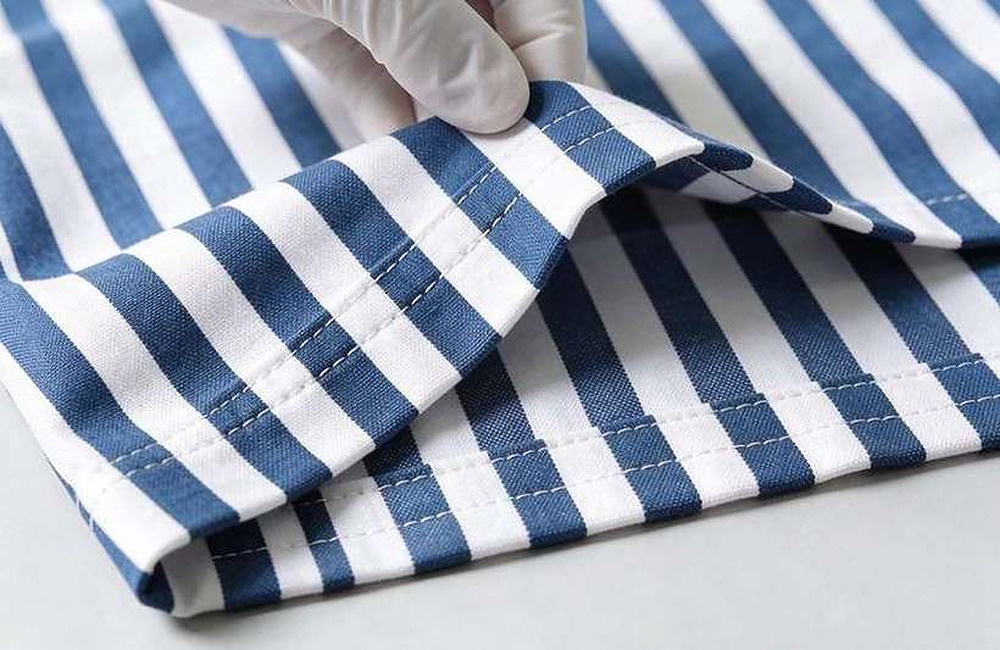
The hem is where a striped sheet fails first — the seam has to follow the stripe.
The hem is where a hospital sheet fails first. A double-stitched hem at 1.0 to 1.5 centimetres survives industrial washing that a single row of stitching does not, and the seam allowance is wide enough to re-hem once if the sheet is cut down for a smaller bed.
Anything narrower is a false economy, because the replacement cost lands on the laundry rather than on the supplier.
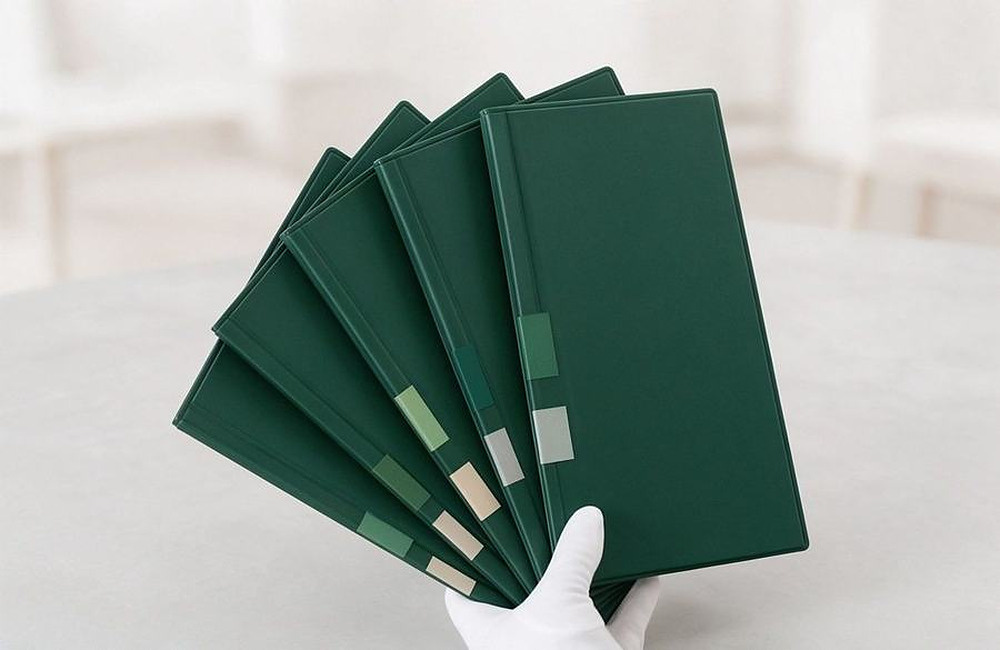
Test reports filed by property and by cycle method, ready for a tender submission.
Is 21s or 32s better for hospital sheets?
Neither is better in the abstract. 21s is the economical choice for high-turnover departments: it is heavier at the same weight, more abrasion-resistant and cheaper per square metre. 32s gives a softer hand and is the right answer for maternity, paediatrics and private rooms. Many hospitals run both, split by department rather than by building.
Can you make waterproof hospital sheets that survive 100 washes?
A laminated or coated barrier does not survive a hundred industrial cycles. Published field data puts real service life for washable barrier pads at 29 to 30 cycles, with a spread from 23 to 40. We quote a cycle life with a number and plan replacement against it, rather than claiming a hundred.
Do you offer colour-coded linen by department?
Yes, in reactive dyes that hold shade through alkaline washing at 71°C. Standard zones are theatre green, ward pale blue or white, and isolation red or amber, with a fourth tone for maternity or paediatrics. Each colour is supplied with ISO 105-C06 results and in the size run the department actually uses.
What tests do you provide for healthcare linen?
ISO 15797 with the method number stated, ISO 105-C06 and ISO 105-X12 for colour, ISO 6330 with ISO 5077 for shrinkage, ISO 13934-1 for breaking strength, ISO 12945-2 for pilling, GB 18401 class B for skin safety, and ISO 15496 for barrier vapour transmission. Certificate numbers are supplied per item on request.
What sizes fit a 100×210 hospital bed?
A 100×210 sheet, with a 35 cm skirt on a 20 cm mattress. A 90×200 sheet will not fit that bed, and stretching one over tears the hem within the first month. Pillowcases are 50×75 for a 45×70 pillow, or 48×74 in more European markets.
How do you handle barrier fabric breathability?
Vapour transmission is measured under ISO 15496 and reported in g/m²/24h, with the figure stated on the specification. Where a buyer uses ASTM E96 upright methods, the result is reported on that basis with the test conditions named. A specification that only asks for "breathable" leaves two bidders answering on different bases.
Does EN 14065 cover your linen?
No, and this is the most common misreading in tenders. EN 14065 specifies a risk analysis and biocontamination control system for a laundry operation. It certifies how linen is processed, not what the product is. Test reports are arranged per order; the laundry that processes the linen may hold RABC certification separately.
What yarn count should a theatre use?
21s plain weave at 125 to 135 gsm, in green. Theatre linen is changed most often and bleached most aggressively, so it needs the coarser yarn. A 32s sheet at the same weight has less margin and will lose strength sooner under the theatre wash profile.
How much does hospital linen shrink?
Acceptance is usually 3 percent or less after the stated wash cycles, measured under ISO 6330 and reported with ISO 5077. Pre-shrunk woven cotton with mechanical compaction holds well inside that line. A sheet that has gone beyond 3 percent by cycle thirty will not fit by cycle sixty.
Do you supply drawsheets and turning sheets?
Yes. Drawsheets follow the same department colour and size logic as the flat sheet, and low-friction turning sheets are supplied as a separate item. Both add to laundry volume, which is why a trial that omits them undercounts volume by ten to fifteen percent on a high-dependency ward.
What is the minimum order for hospital linen?
Minimums are set per item, not per order, and they move with construction, colour and packing. A multi-item hospital order usually starts at one container, with each item's minimum confirmed against the specific specification rather than quoted as one number.
Can you support a wash trial before award?
Yes. We supply trial pieces in the department colour and size, with a record sheet for cycle counts and the five measurements that carry the result. Thirty cycles, measured at ten, twenty and thirty, is the cycle we quote against.
Foshan Yiroufang Textile Manufacture Co., Ltd | Hospital bed linen and bedding | Foshan, Guangdong, China
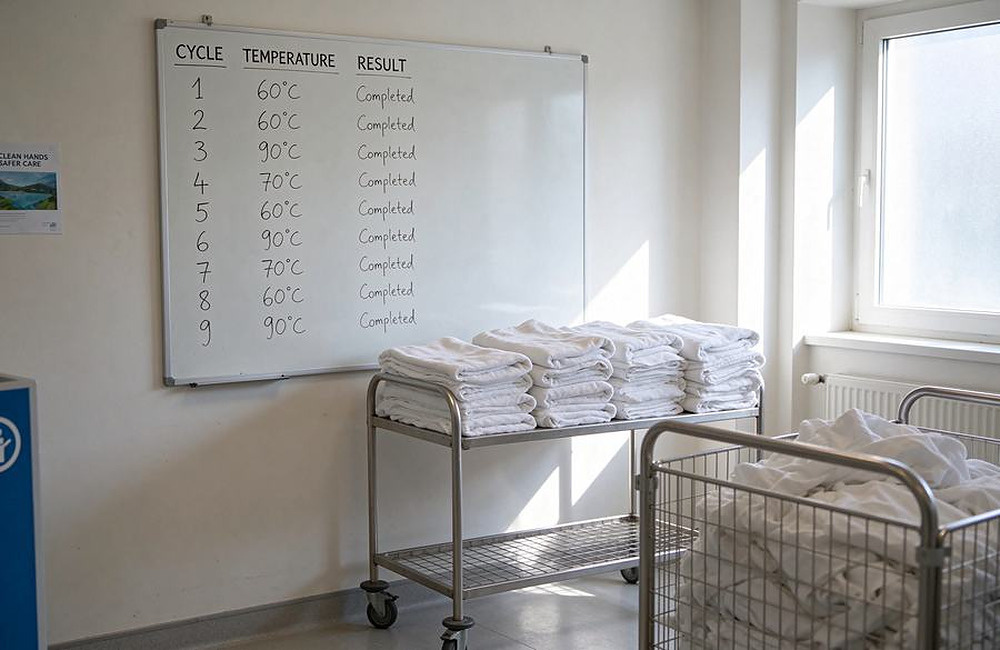
Thirty washes per cycle, recorded: a trial that is not written down is a trial nobody can defend.
Write to lisa@yrftextile.com with the room count and the specification sheet; the reply comes back with finished sizes and the report references.
Send your department list with bed sizes and your current wash regime.
What comes back is a count-by-department plan: yarn, weight, colour class, skirt depth per mattress, and the test reports each line needs. That plan is what a tender response is built on. For the adjacent buying decision, see healthcare mattress requirements. Ask for the department yarn plan
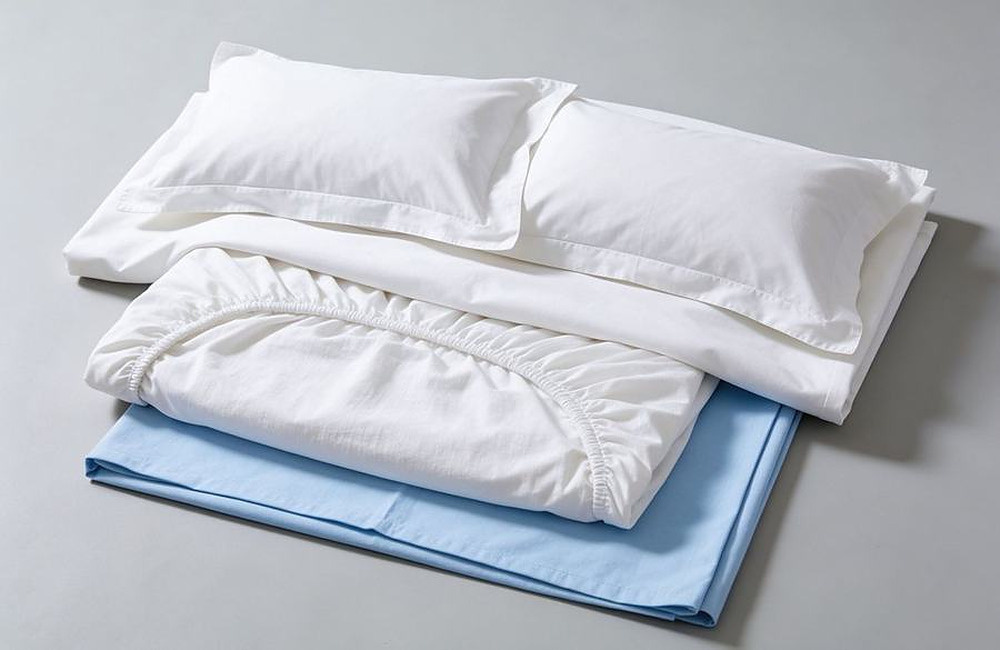
A full hospital linen set: fitted sheet, flat sheet, pillowcase and drawsheet in ward colours.
A full department set is easier to price than a list of items, because the ratio between fitted sheet, flat sheet, pillowcase and draw sheet is what drives the total.
Send the department list with bed counts and the change interval, and the set can be built and quoted as one line rather than as twenty items that purchasing has to reconcile.
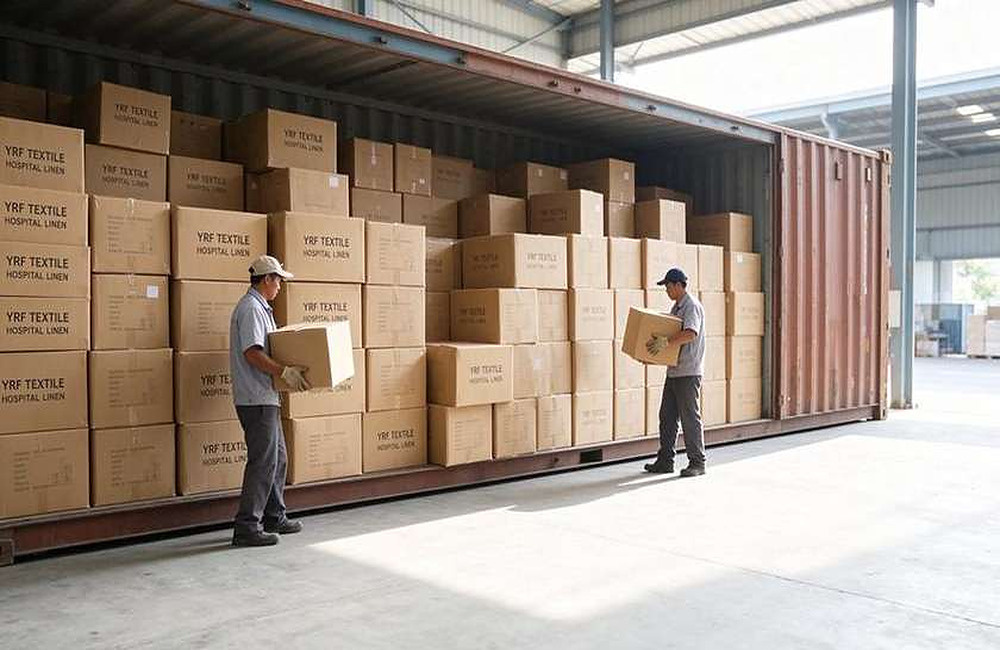
Cartons of hospital linen loaded for a phased consignment, marked by department colour so the receiving store can sort without opening every box.
A phased consignment is normal for a hospital opening, and it changes the packing plan rather than the product. Cartons are marked by department and by phase, so that the first ward can open while the second is still in transit.
Reserve the fabric for the whole project at the first run, because a second mill run in the same colour will not match the first on a hospital floor. Limits for harmful substances in textiles, including bedding and towelling, are published by OEKO-TEX.
Anterior :
Washable Waterproof Bedding for Nursing Homes: TPU and PVC Laminate Options, 20cm Mattress Depth, 90 by 200cm Sizes, Pre-Wash Handling and Stock Planning for Care Home ProvidersPróximo :
4 Star Hotel Bedding Specification: 60s Combed Cotton, 200-240 GSM Sateen, Three Star and Five Star Comparison, Shrinkage Control and Budget Allocation for Hotel Purchasing TeamsLinks amigáveis :
direito autoral © Custom Disaster - Relief Bedding: Tents, Sleeping Bags, Blankets Todos os direitos reservados
a equipe profissional para o serviço !