Categorias
Last Updated: October 12, 2026
Fire and chemicals are two different threats — a flame is heat, a chemical cloud is poison — and a firefighter hazmat suit may face both at once. This guide maps the protection levels, fabrics and bulk chemical protective clothing buying.
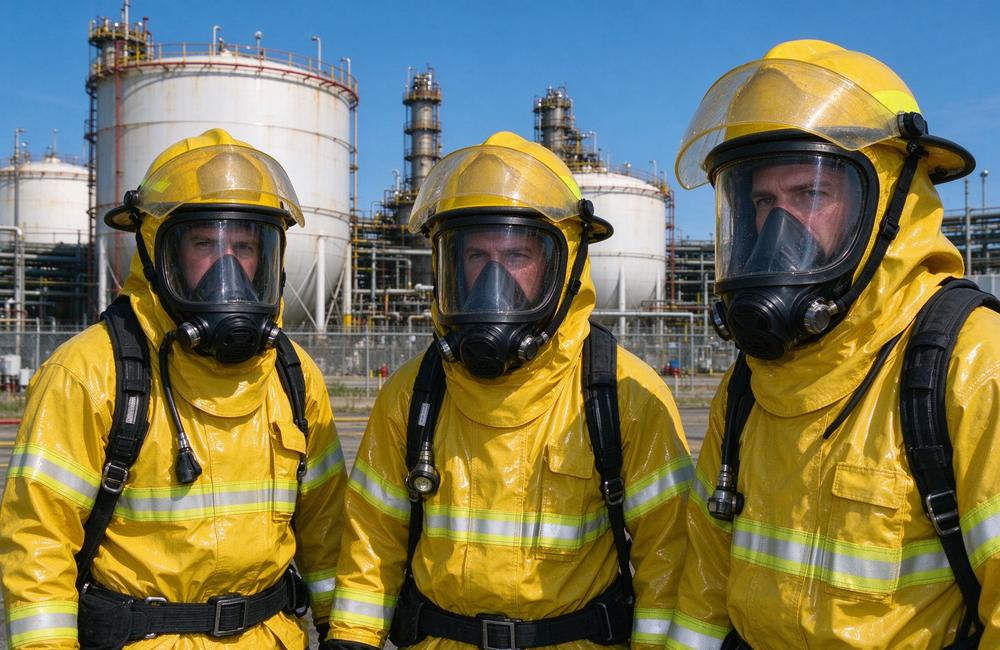
Chemical response teams rely on firefighter hazmat suits for combined fire and chemical scenes.
Fire and chemicals rarely arrive separately. A leaking tank catches fire, a burning warehouse releases gas, and a rescue in a contaminated building exposes the crew to both hazards at once. That double threat is why a fire resistant chemical suit is built as a system: a vapor barrier that also resists flame, sealed entry points that keep liquids out, and an SCBA interface that stays airtight while the wearer works. Protection levels in this guide run from gas-tight Type 1 suits for vapor hazards to lighter classes for splash and dust work, and each class answers a different scene rather than a different price point.
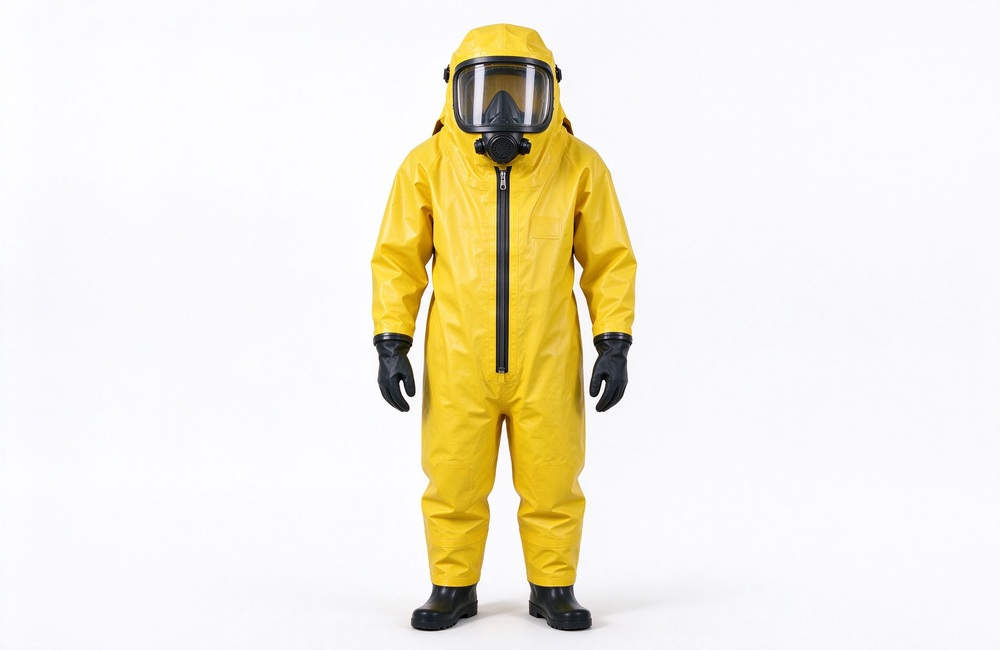
A fire proximity hazmat suit combines flame resistance with chemical barrier layers.
Chemical firefighting is different from structural firefighting. The crew may face a burning tank, a ruptured pipeline or a contaminated building, where toxic vapor and heat attack at the same time. A chemical protective clothing for firefighters system is designed so that every layer answers one threat: the shell blocks flame and heat, the barrier blocks liquids and vapors, and the facepiece keeps the rescuer breathing clean air.
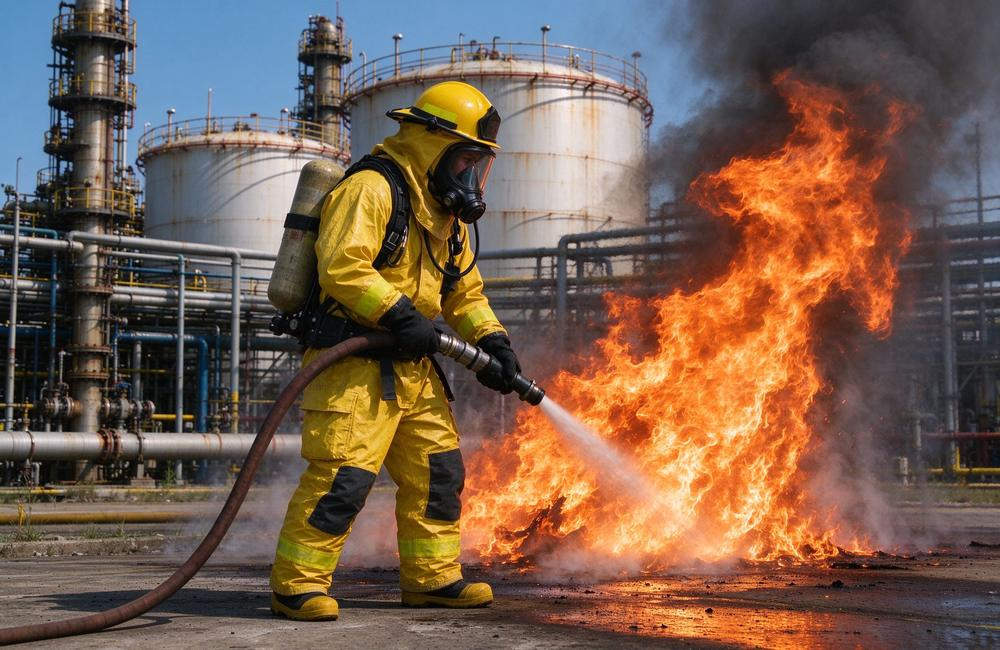
Tank and pipeline fires force crews to work in heat and chemical vapor together.
Most fire departments stock several lines: structural turnout gear for building fires, proximity suits for radiant heat, and firefighter hazmat suits for chemical scenes. The right choice depends on the hazard. A leaking drum in a warehouse, a derailed tanker on a highway, an acid spill inside a lab — each scenario changes the protection level you need. The sections below walk through the levels, the fabrics, the standards and the buying checklist so you can match the suit to the real job.
This article is written for fire departments, chemical plants, emergency response teams and procurement agencies that buy hazmat suit with SCBA systems in quantity. The reference values below are drawn from certified hazmat product lines supplied across China, including the XF 770-2008 and GB 24539-2021 families, so you can check them against your own tender documents.
If you are new to chemical protective clothing, start with protection levels. International standards classify suits from gas-tight to limited splash protection, and the class you choose decides what the crew can safely touch, breathe near and work in.
One more decision belongs before the response: communication. When the crew dresses in gas-tight suits, voices are muffled and radios may not pass through the barrier. Teams agree in advance on hand signals, radio channels with external microphones, and a bailout word that means immediate withdrawal. The best firefighter hazmat suit still depends on the crew inside it being able to talk to each other and to the command post.
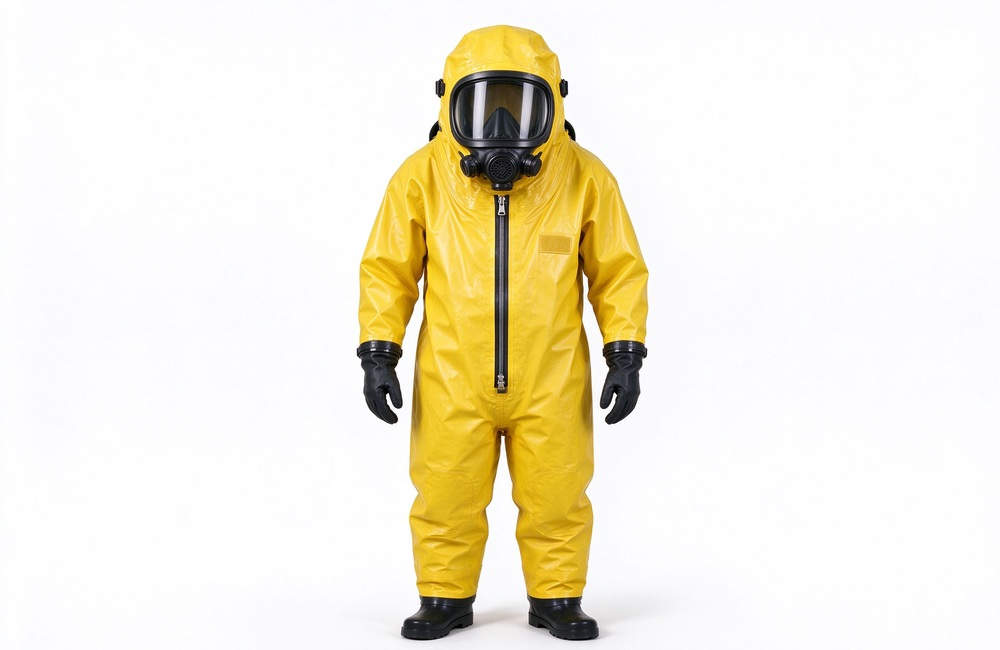
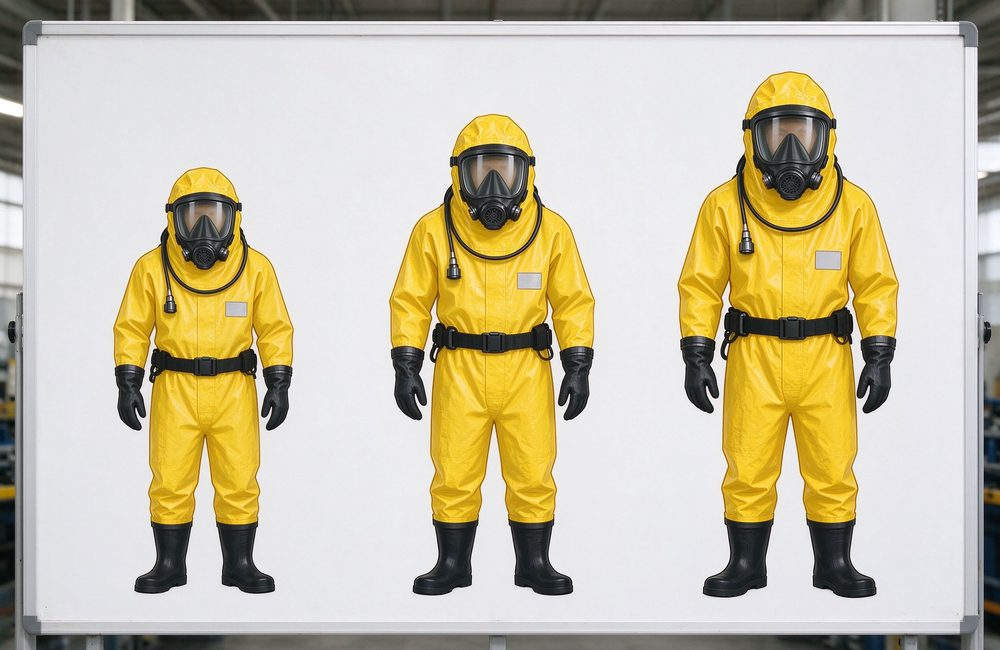
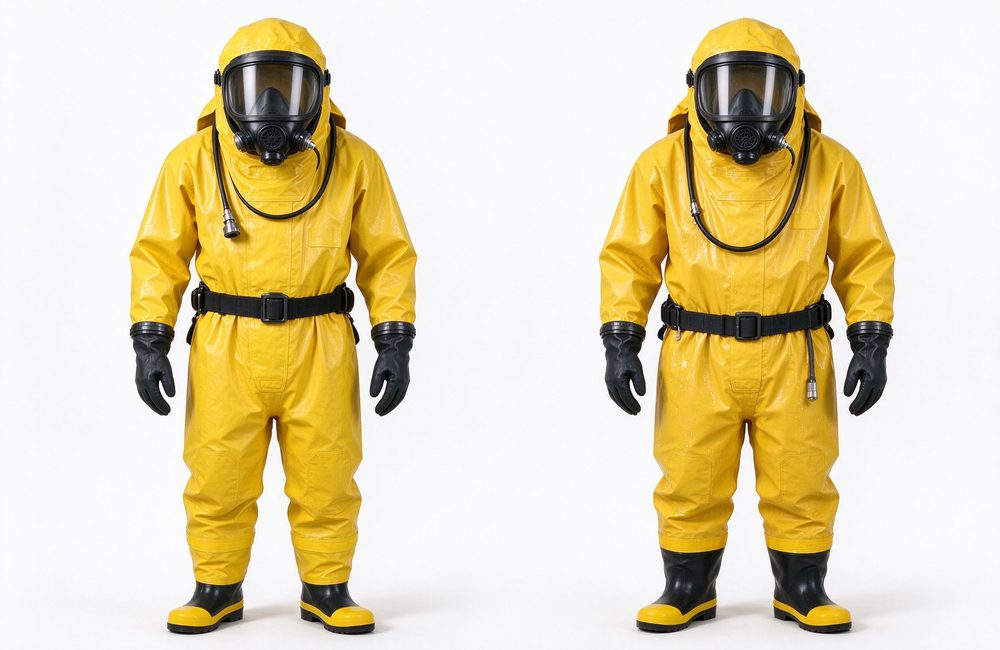
Level 1 gas-tight suits are fully encapsulated and designed to be worn with an SCBA.
A hazmat response moves as a unit, and the firefighter hazmat suit is only one part of the chain.
When a fire involves chemicals, the two hazards multiply instead of adding up. Heat speeds up evaporation, so toxic liquids become toxic vapors faster; vapors can ignite and re-flash; and runoff water spreads contamination across the scene. A firefighter in a standard turnout coat has flame protection but almost no vapor barrier, which is why response teams step up to firefighter chemical protection suits for these calls.
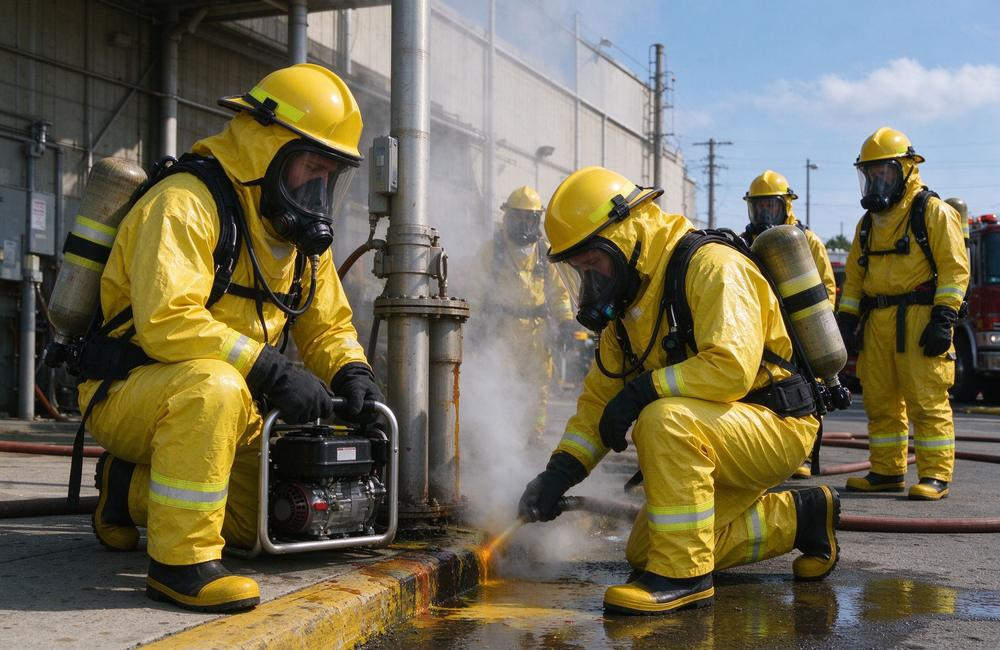
Leak response crews wear chemical protective suits while identifying the hazard.
A gas-tight suit that blocks every vapor also blocks every breath of cooling air. Inside a fully encapsulated firefighter hazmat suit, body heat builds fast: core temperature climbs, sweat cannot evaporate, and decision speed drops long before the air cylinder runs low. That is why work-rest cycles are written into chemical response procedures, why crews rotate in and out of the hot zone, and why hydration and cooling stations are set up before the first team enters. The suit stops chemicals; the rotation plan stops heat exhaustion.
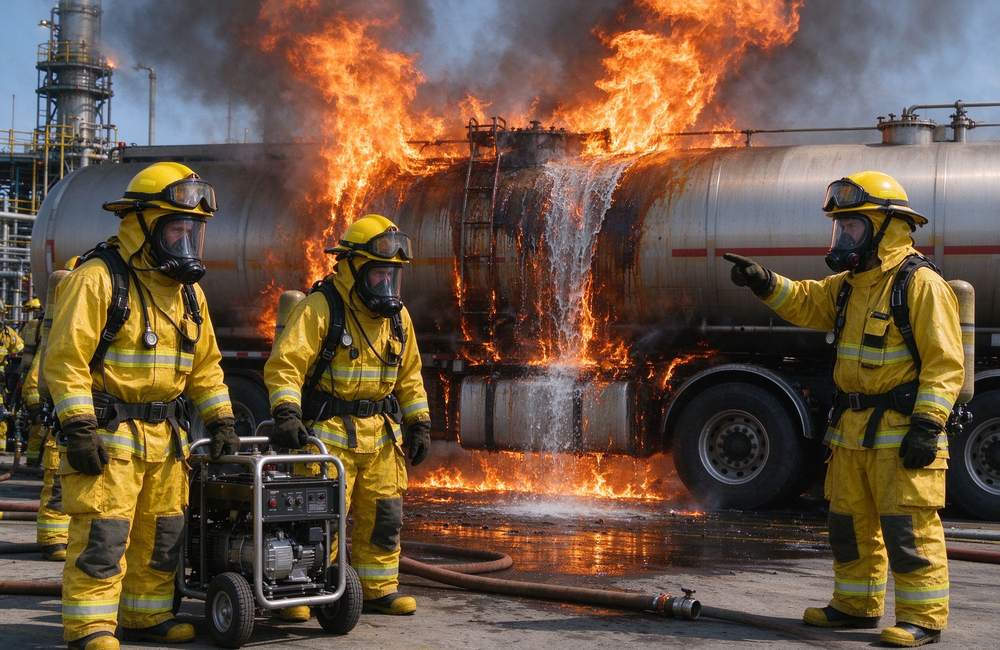
Industry records the highest injury rates in events where a leak ignites. A storage tank ruptures, vapor spreads, a spark lights it, and now the scene has both a fire and a continuing release. The rescue team must approach to close the valve, cool the tank or extract casualties while vapors keep coming. That is exactly the job of a firefighter hazmat suit certified for flame exposure and chemical barrier performance.
How does an officer decide whether to dress the crew in chemical suits? Watch for the signals: a known chemical is involved, the fire burns with unusual colors or heavy smoke, the smell is sharp or sweet, runoff water foams, or people downwind feel irritation. When any of these appear, standard turnout gear is not enough and the firefighter chemical protection line takes over.
Chemical crew responds to a tank leak fire in hazmat suits.
Protection levels are the first filter when buying. International practice groups chemical suits by how much of the environment they seal out, from fully encapsulated gas-tight suits to lightweight splash coveralls. The table below summarizes the classes you will see in tender documents.
Class
Level
Barrier
Typical Use
Type 1
Gas-tight
Blocks gases, vapors and liquids
Chemical fire scenes, toxic gas release, tank entry
Type 2
Non gas-tight
High liquid resistance with positive pressure
Large-scale contamination, decontamination zones
Type 3
Liquid-tight (jet)
Blocks pressurized liquid jets
Hose cleaning, jet spray exposure
Type 4
Liquid-tight (spray)
Blocks liquid sprays
Chemical transfer, pump and valve work
Type 5
Dust-tight
Blocks airborne particles
Dust and powder handling
Type 6
Limited splash
Light splash protection
Light contamination, brief contact
The higher the class, the heavier and hotter the suit. A Type 1 gas-tight suit keeps gases out but also traps body heat, so the team must rotate more often and always work with an air supply. That trade-off is why departments keep both gas-tight and liquid-tight lines.
The fastest way to buy the wrong suit is to start from the product page. Begin instead with the chemical list: every substance on site, in what form — gas, vapor, liquid, dust — and the worst credible event for each. Chemical protective clothing for firefighters is then matched level by level: gas-tight Level 1 suits for vapor hazards, liquid-tight classes 3 and 4 for pressurized spills, class 5 for dust work and class 6 for brief splash contact. Departments that write the hazard list before the tender get quotes that are comparable, because every supplier prices against the same risk statement rather than against their own best-selling model.
Type 1 suits — often called Level 1 or fully encapsulated suits — seal the whole body including the facepiece. The certified a model built to XF 770-2008 and GB 24539-2021, protects against toxic gases, acid solvents and hot liquids, with a material system rated against more than 340 common industrial chemicals. These suits are used at chemical fires, toxic gas releases and rescue inside contaminated areas.
Protection levels run from gas-tight Type 1 suits to limited-use Type 6 coveralls.
International tenders name the same classes differently. The EN 943 series calls gas-tight suits Type 1 and non-gas-tight positive-pressure suits Type 2, while the NFPA 1991 family in North America covers vapor-protective ensembles and NFPA 1992 covers liquid splash-protective ensembles. When a specification mixes systems, translate both sides to the same level before comparing: a Type 1 gas-tight suit and an NFPA 1991 vapor-protective ensemble are close cousins, but the test methods and the certificate names differ. Ask the supplier to state the equivalent class in both systems.
Level 1 and Level 2 chemical suits compared side by side.
Walk the site before buying. List every chemical on site, its state — gas, vapor, liquid, dust — and the worst credible event for each. If the hazard is a toxic gas, start at Type 1. If the risk is spray from hoses or pumps, Type 3 or 4 covers it. If the work is dust and powders, Type 5; for brief splash contact, Type 6. Many departments publish this hazard walk as part of their tender, which makes supplier quotes comparable from the first line.
Below gas-tight, the jobs get less severe. A liquid-tight suit such as the FH-I-H jet-tight model resists hydrochloric acid, sulfuric acid, acetic acid, sodium hydroxide and sodium hypochlorite. Level 2 suits like a Level 2 model use a double storm flap, chemical hood, gloves and boots, and pair with an external positive-pressure SCBA — a practical balance for volatile solid and liquid spills where full encapsulation is not required.
Layered construction separates flame resistance from the chemical barrier.
Making one fabric resist both fire and chemicals is a layered engineering problem. The shell must hold flame away long enough to escape and act, the barrier must stop the specific chemical, and every seam and closure must not become a leak point. This section explains the construction of a fire resistant chemical suit.
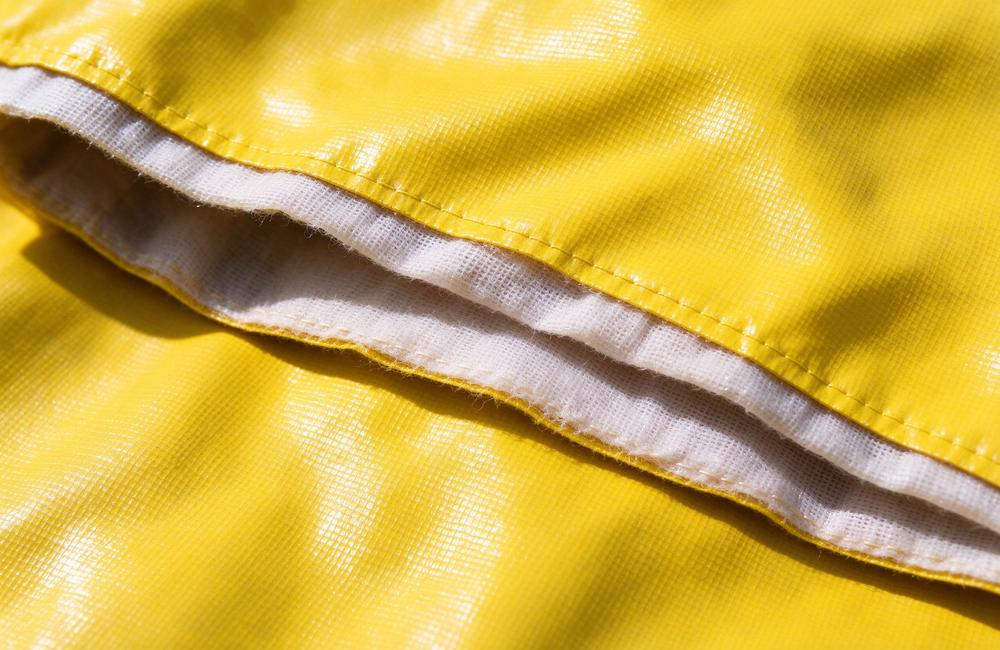
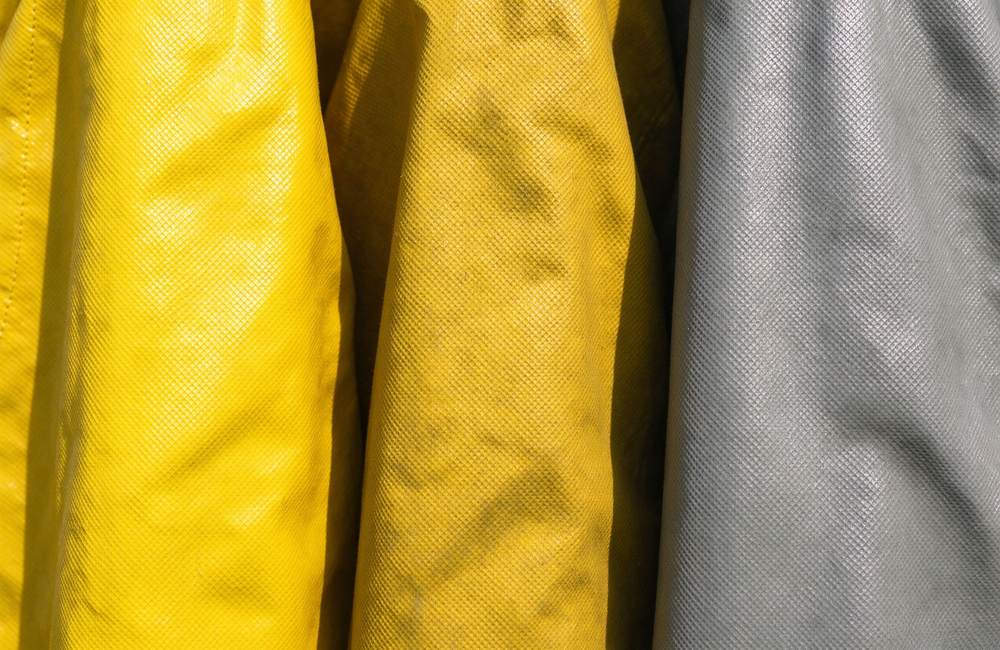
A fire resistant chemical suit reads like a sandwich because it is one. The outer layer resists heat, flame and abrasion; the middle layers carry the chemical barrier against the specific substances in the hazard list; the inner layer keeps the wearer comfortable and helps moisture move out. Each layer fails at a different rate — abrasion hits the outside first, permeation tests matter for the middle, and heat stress shows up on the inside — which is why certification reports test the full composite, not a single sheet. Comparing suits by their outer fabric alone is like judging a bridge by its paint; the certificate names the whole construction.
Chemical barrier fabric samples for fire-resistant layering.
A dual-threat suit uses an outer layer for flame and abrasion, a middle barrier for the chemical, and a comfort layer inside. The fire-proximity hazmat suit FHFHF SFPNA reports outer breaking strength of 1600 N warp and 1300 N weft against a 650 N minimum, tear strength of 160 N warp and 120 N weft against a 100 N minimum, and peel strength of 20 N/30 mm and 31 N/30 mm against a 9 N/30 mm minimum — numbers that show why certified fabric matters on sharp debris and hot surfaces.
Chemical barriers come in two broad technologies. A laminated film is bonded to the fabric as a continuous layer, giving a smooth, consistent barrier that suits the widest chemical list. A coating is applied to the fabric surface and works well for defined chemical families at lower cost. Both are valid; the right choice depends on the target chemical list and the duty cycle. When comparing firefighter chemical suits, ask which technology the barrier uses and how the seams are sealed — the seam is where most barriers fail.
Chemicals enter through openings more often than through fabric. That is why gas-tight suits use sealed zippers under a storm flap, double cuffs at the wrists and ankles, and taped seams. A Level 2 model demonstrates the principle with a double storm flap and integrated hood, gloves and boots, so the crew can kneel, climb and drag without exposing skin.
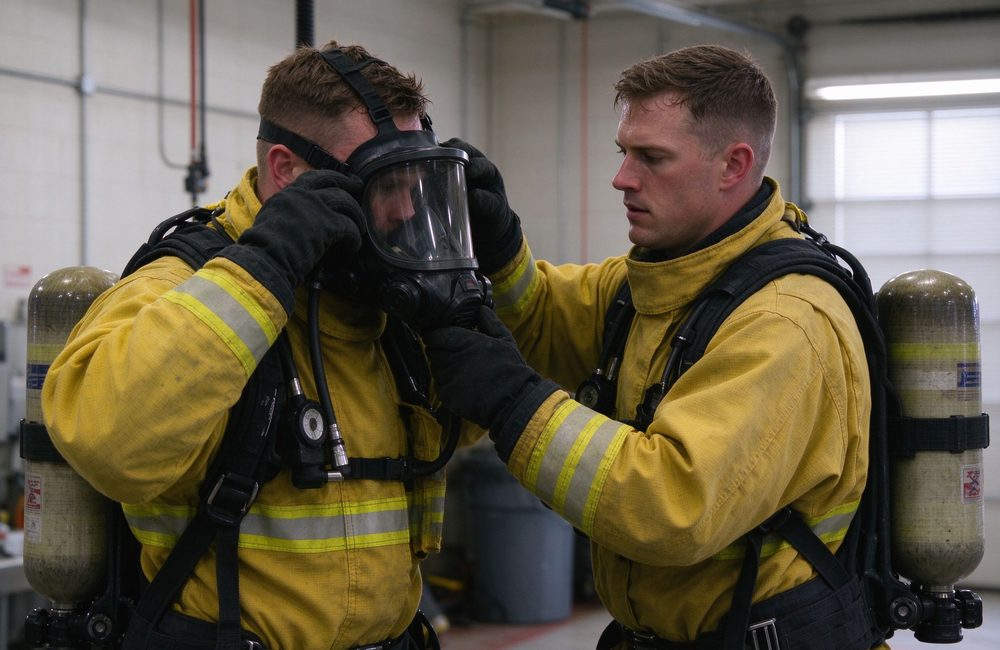
Donning a gas-tight suit with SCBA follows a strict sequence to keep the seal intact.
Inside a gas-tight suit you are sealed from the environment — which also means no breathable air. A hazmat suit with SCBA is therefore not an option but a system requirement. The table below shows the typical SCBA configurations offered with chemical suits.
|
Configuration |
SCBA Position |
Typical Cylinder |
Best For |
|
Internal SCBA |
Inside the suit |
Carbon fiber 6.8 L |
Maximum chemical barrier, sealed entry |
|
External SCBA |
Outside the suit |
Carbon fiber 3–6.8 L |
Quick donning, easier cylinder swap |
|
Supplied air |
Hose-fed |
Remote source |
Long-duration work in fixed zones |
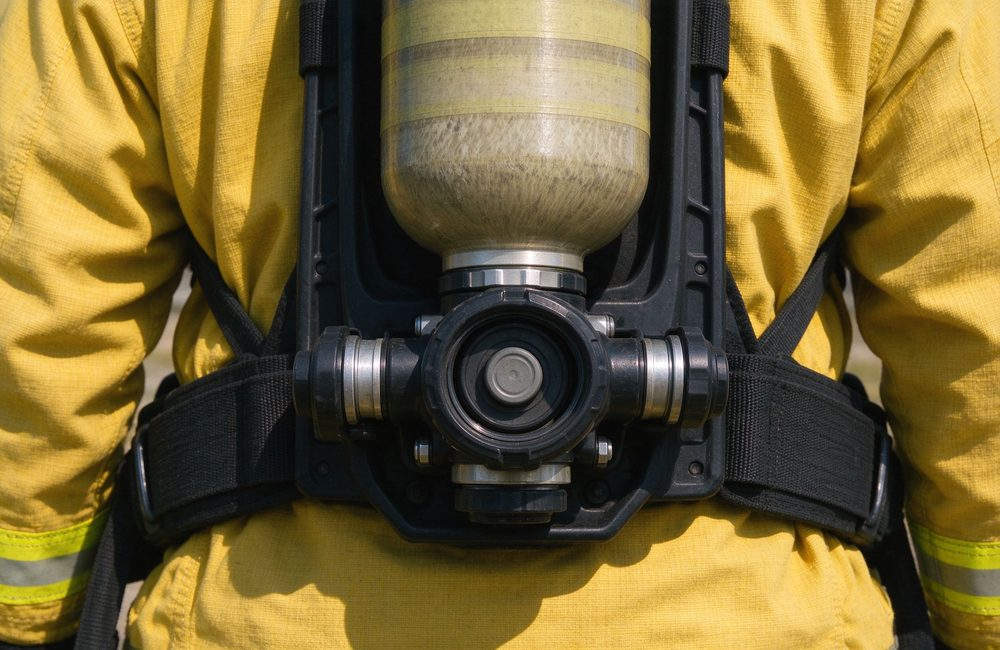
Certified SCBA models for firefighting, such as the RHZK6.8 series built to XF 124-2013, use carbon fiber cylinders from 3 L to 6.8 L with an ergonomic backplate and waist support. The suit and the SCBA must be bought as a matched set: the facepiece seal, hose routing and quick-connect points differ between brands.
An airtight suit without practiced SCBA work is a liability in both directions: a crew member who cannot read the cylinder gauge under stress, or who fumbles the quick-connect in a rescue, endangers the whole entry. Teams that run hazmat suit with SCBA drills build them into the calendar — timed donning, buddy checks on cylinder pressure and face-seal, and a hard rule that no one enters the hot zone without a partner who has verified the setup. When you procure the suits, add the SCBA interfaces to the same order: matched regulators, spare O-rings and quick-connect caps keep the system whole across both the suit and the air supply.
Chemical vapors can knock a rescuer out within seconds. Filter masks are not approved for gas-tight work because they cannot seal out every vapor and run out of capacity unpredictably. Positive-pressure SCBA keeps the facepiece at higher pressure than the environment, so contaminated air cannot leak inward even if the seal shifts.
Match the cylinder to the job. A 6.8 L carbon fiber cylinder supports roughly 30 to 60 minutes of active work depending on effort and heat; lighter 3 L bottles suit quick entries and cylinder swaps; supplied-air hose systems fit long operations in fixed decontamination and control zones. Whatever the choice, the air supply must be tested together with the suit before the unit is accepted.
A suit that is only drilled twice a year is a costume. Response teams time the donning drill quarterly and after every equipment change, because each new SCBA model or suit batch changes the sequence. The buddy check — closures, air pressure, facepiece seal — is a two-person job: one dresses, one verifies, and both sign the drill sheet. Teams that log these drills find their real-world donning time drops by half in the first season.
Buy the cylinder as part of the suit system, not as an afterthought. The quick-connect interface, the backplate curve and the hose routing differ between SCBA brands, and a mismatch at any one point turns a certified hazmat suit with SCBA into a leak risk. Confirm the cylinder pressure rating matches your fill station, order spare O-rings and quick-connect caps with the first batch, and label each cylinder with its test date. The air supply is the one component inside a gas-tight suit that keeps the rescuer alive, so it earns the same certification discipline as the barrier itself.
Teams drill the sequence: check the suit and cylinder, don the SCBA first or after per the suit design, seal every zipper and flap, run a buddy check on closures and air pressure, then enter. Doffing happens in the decontamination zone, and the suit is washed and tested before storage. A gas-tight suit is only as good as the drill the crew has practiced.
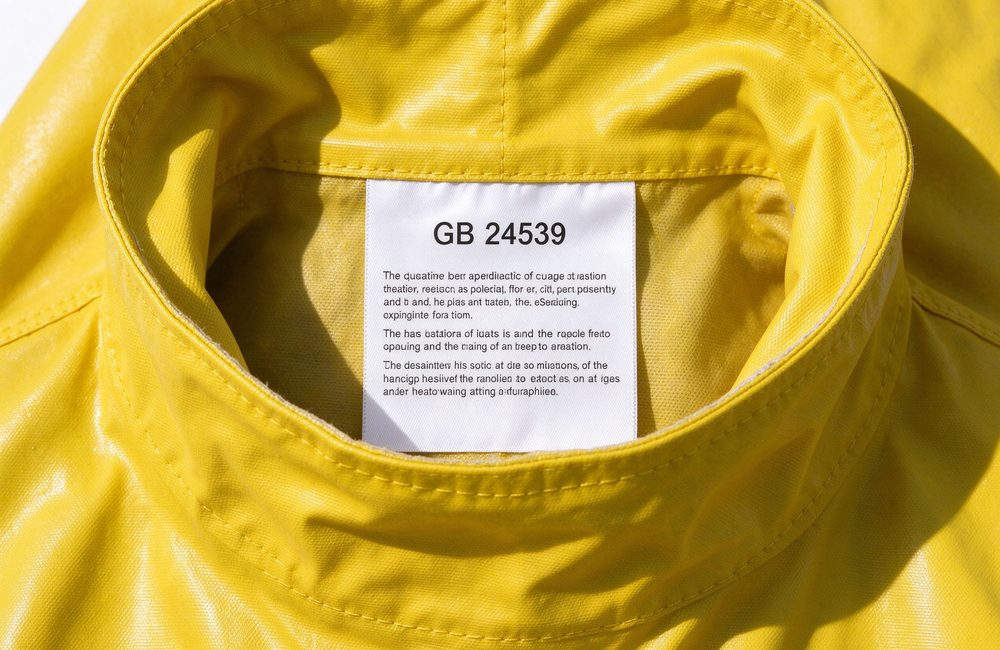
Standards are the language of a chemical suit tender. In China the current family is led by GB 24539-2021 for chemical protective clothing, supported by XF 770-2008 for hazmat suits and XF 634-2015 for thermal protection. Knowing which standard a suit claims tells you what was actually tested.
Every suit standard is an answer to the same three questions: what it protects against, how long it protects, and how you prove it. GB 24539-2021 for chemical protective clothing in China, EN 943 for European type classes, and NFPA 1991-1992 in North America each phrase the answers differently, which is why cross-referencing matters in international tenders. The practical discipline is to state the question first — "we need vapor protection for these named chemicals" — and let the standard follow, rather than starting from a standard name and assuming it covers the hazard. A certificate that names the model and the tested chemicals is the proof; a standard citation without a report is an intention.
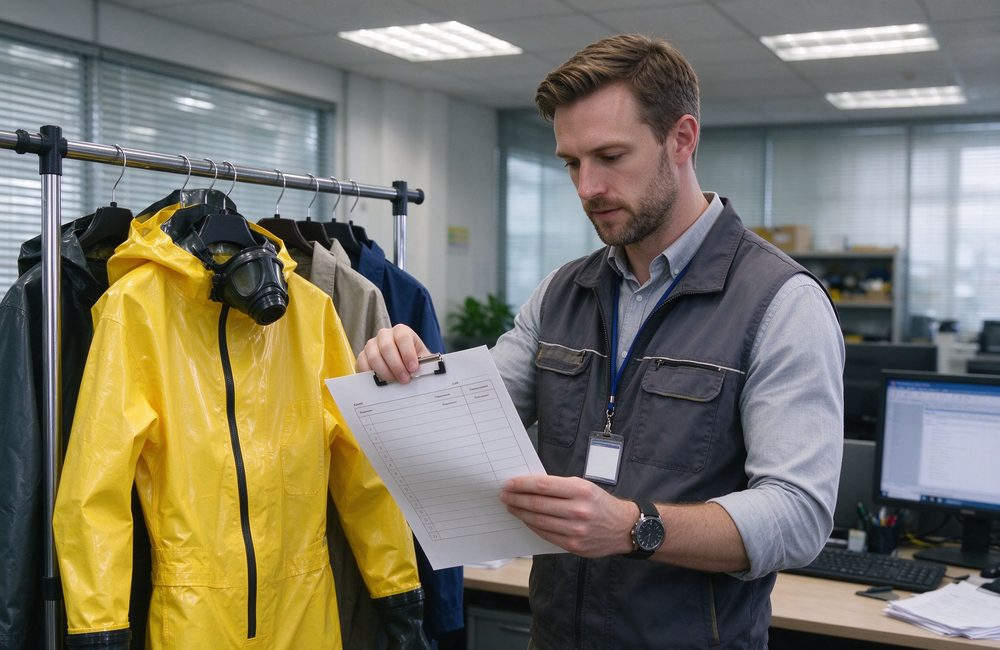
Buyer reviews the GB 24539 test report before purchase.
GB 24539-2021, Protective clothing for chemical protection, is the national standard for chemical protective clothing in China, covering classification, materials, test methods and marking. The heavy-duty Level 1 suit and the Level 2 suit are both built and tested to GB 24539-2021 together with XF 770-2008. When a supplier quotes a standard, ask for the test report naming the model number.
Read a chemical suit certificate in three lines. First, the standard number and edition — GB 24539-2021, not an older edition. Second, the model number: the certificate must name the exact suit you are buying, because a factory certificate covering one model does not transfer to another. Third, the tested properties and their values — barrier class, physical strength, and the chemical list behind the permeation report. A certificate without a model number or without test values is a decoration, not evidence.
XF 770-2008 covers hazmat protective suits for firefighting, and XF 634-2015 covers proximity fire suits. A fire-proximity hazmat model carries all three — XF 634-2015, XF 770-2008 and GB 24539-2021 — for scenes where heat and chemicals arrive together. For international projects, familiar standards include the EN 943 series for gas-tight suits and the NFPA 1991/1992 family in North America.
Verify certificates, permeation reports and samples before bulk purchase.
Choosing a supplier is a checklist exercise, not a price comparison. The table below lists the documents and checks that separate a certified line from a look-alike. We supply firefighter clothing wholesale including hazmat suits, SCBA and chemical accessories for departments and agencies.
|
Check |
What to Ask |
Why It Matters |
|
Certificate |
Standard number and model on the certificate |
Confirms the exact suit was tested |
|
Permeation report |
Breakthrough time for your target chemicals |
Shows real barrier performance per chemical |
|
Physical data |
Breaking, tear and seam strength values |
Confirms durability on debris and hot surfaces |
|
Sample |
Fit-test with your crew |
Validates sizing, mobility and donning drill |
|
SCBA match |
Facepiece seal and quick-connect compatibility |
Avoids leaks at the interface |
|
Lead time |
Production and shipping schedule |
Plans deployment and replacement |
Run the same checklist against every quote. Two suits can look identical in a photo and differ completely in the permeation report, the seam construction and the standard certificate.
Team sample fitting for firefighter hazmat suits.
Permeation is measured as breakthrough time: how long a chemical takes to pass through the material. A certified Level 1 model is rated against more than 340 industrial chemicals, while lighter suits are tested against a defined list such as 98% sulfuric acid, 30% hydrochloric acid, 60% nitric acid and 40% sodium hydroxide. Match the report's chemical list to your own site hazards.
Beyond permeation, ask for the physical data sheet: breaking, tear and seam strength, plus abrasion and flexing resistance. A certified fire-proximity hazmat suit such as the FHFHF SFPNA reports outer breaking strength of 1600 N warp and 1300 N weft, tear strength of 160 N warp and 120 N weft, and peel strength of 20 N/30 mm and 31 N/30 mm — numbers worth comparing line by line against weaker quotes.
Chemical suits degrade fastest in storage when stored badly. Keep suits away from direct sunlight, heat sources and ozone-generating equipment, hang them so creases do not set into the barrier, and store gloves and boots in the folded position they ship in. Store the suit with the zipper open so humidity does not build inside. A firefighter hazmat suit that is stored correctly lasts through its certified service life; one stored in a hot, sunlit cabinet ages in months, not years.
Ask for one suit in each size before bulk. Have the crew run the actual tasks — kneeling, crawling, valve turning, cylinder swap — and time the donning drill. A suit that fits on paper but binds at the shoulder will be left behind in a real emergency.
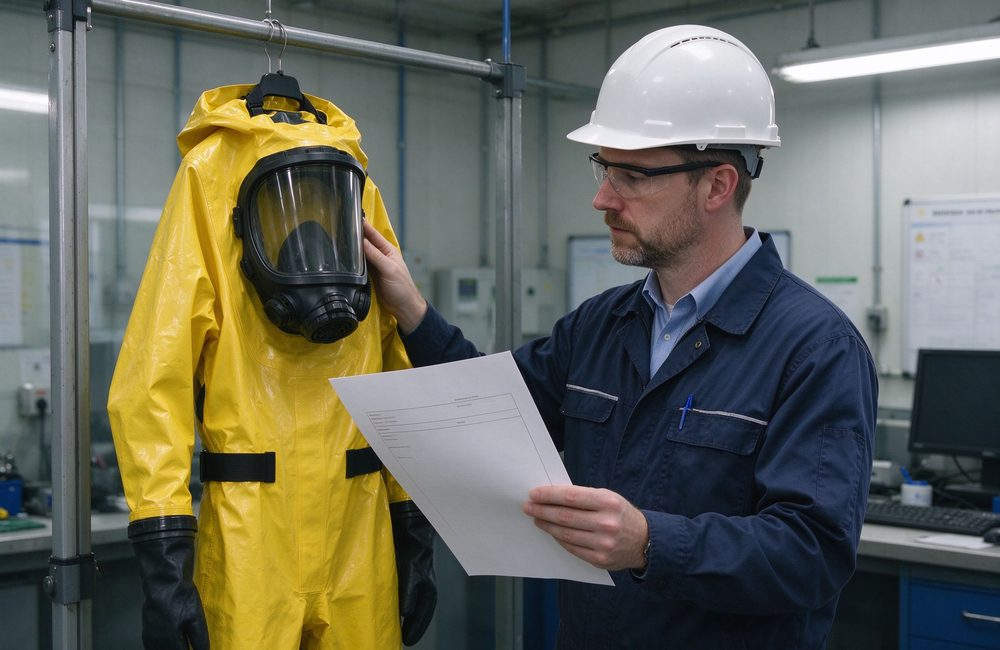
Decontamination and rinsing follow every chemical response before the suit is stored.
Chemical suits degrade even when they look fine: vapor slowly ages barrier materials, and each wash cycle stresses seams. A hazmat suit maintenance program with inspection records is part of the standard. This section covers the routine.
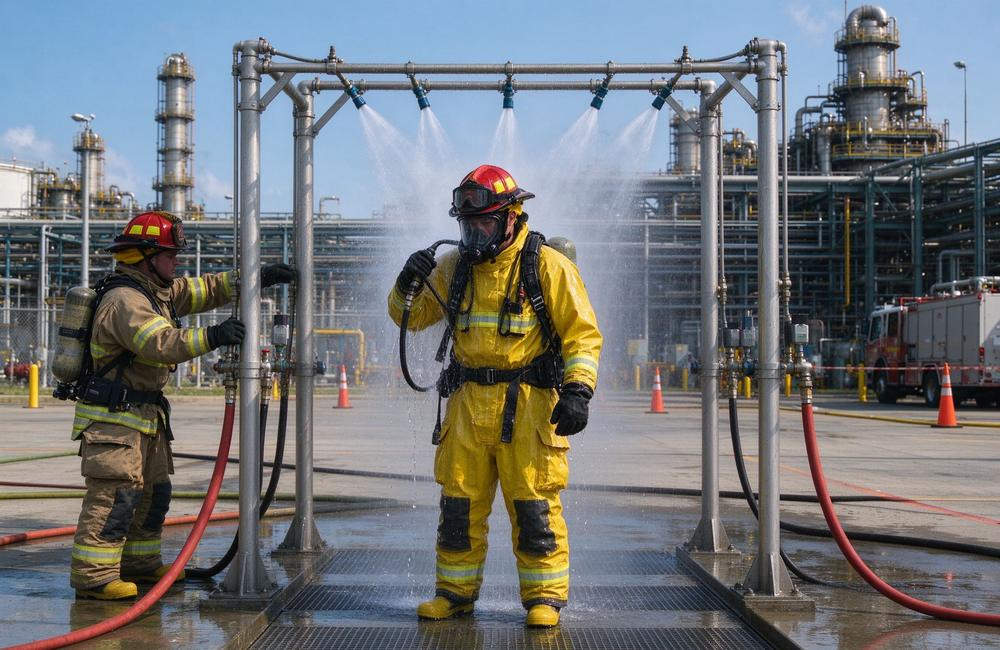
Decontamination is the first act of maintenance, and it starts before the suit comes off. In the decontamination zone, the crew rinses the outside while still in the suit, then doffs in a set order so contaminated surfaces never touch skin. The inside of the suit is cleaned according to the manufacturer's method for the exposure, and the suit is rinsed again, dried in shade, and visually inspected before it is logged back into stock. Skipping any step in this chain passes contamination forward to the next user.
After every use and at fixed intervals, check: shell for cuts, abrasion and heat damage; seams and taped joints for separation; zippers and storm flaps for full closure; visor and facepiece seal for clarity and cracks; gloves and boots for tears; and the cylinder pressure and valve function. Record each check so the history follows the suit.
Record-keeping matters as much as the checklist itself. Each suit should carry a log card with its purchase date, certificate number, inspection dates and decontamination history, so the crew can tell at a glance whether a suit is fit for today's call. Digital logs make this faster for large fleets.
Gas-tight suits can be reused after decontamination only if the manufacturer's evaluation says so, and the evaluation is documented. Any suit exposed to unknown chemicals, visible degradation or failed airtightness testing — for example the pressure-drop test used by the PATD 1300 portable airtightness tester — should be retired. Replacement policy belongs in the procurement plan, not improvised at the scene.
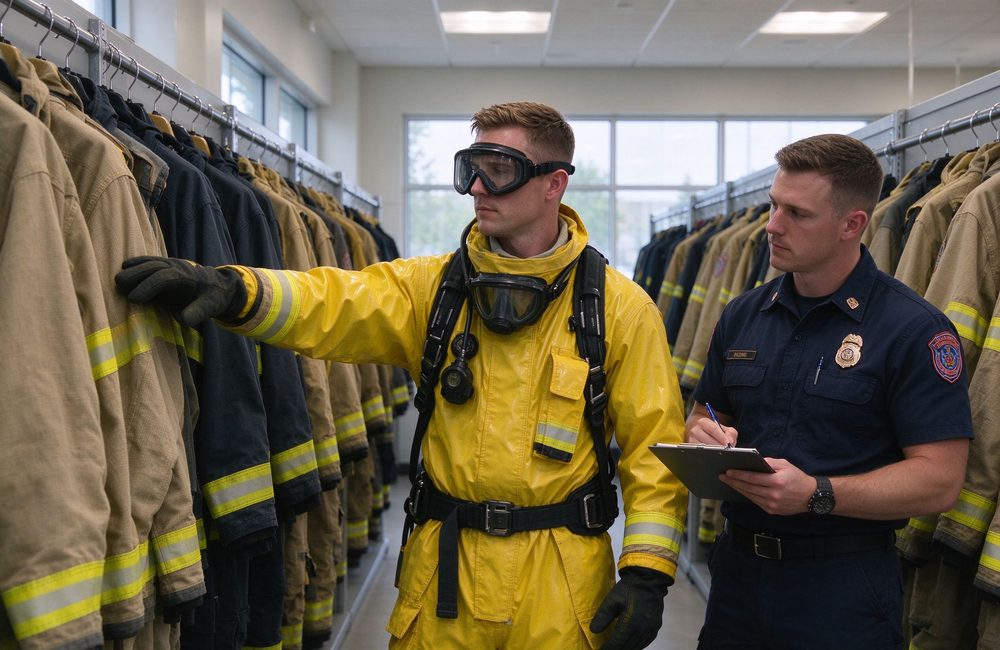
Workshop inspection of sealed seams and zippers.
Chemical parks, fire brigades and emergency agencies buy bulk hazmat suits as a system: suits in a size matrix, matched SCBA, spare gloves and boots, and a maintenance kit. Ordering the set from one line keeps standards, colors and fittings consistent.
Define the size matrix from your crew's actual measurements, choose the protection class from your site hazard list, and decide internal or external SCBA from your donning drill. Add spares for the fastest-wearing parts: gloves, boots and facepiece seals. A typical line covers sizes from 1.60 m to 1.90 m so every member of the team fits.
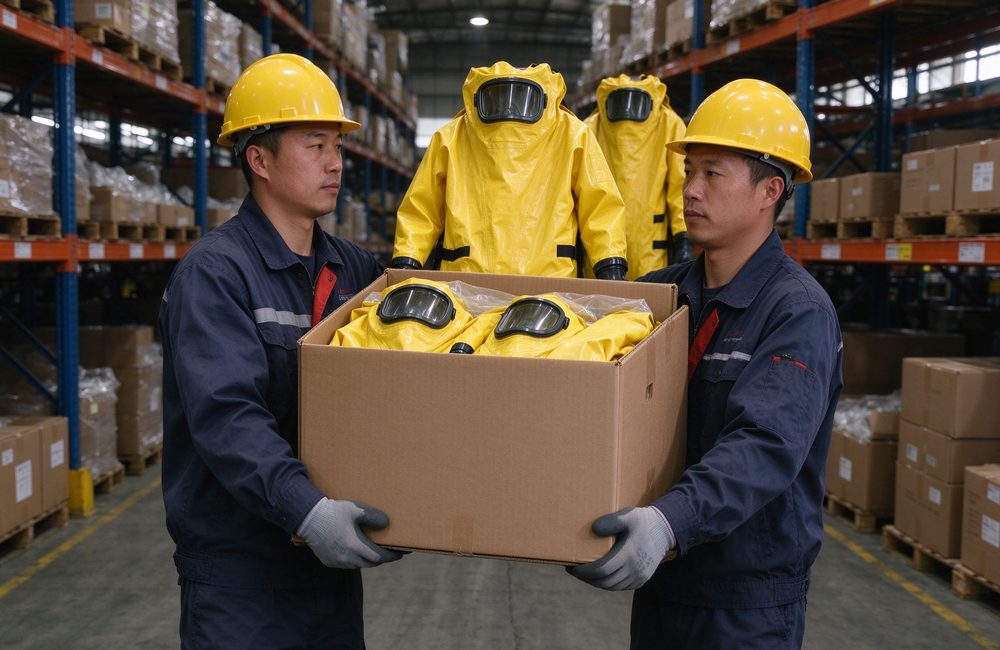
Bulk delivery is planned around the certification batch: suits, SCBA interfaces, gloves and boots are kitted and inspected before shipment, with quantity, customization and lead time confirmed in the sales contract. Send your size matrix, configuration and target chemical list to receive an accurate quote. Permeation reports and certificates ship with the batch, so the receiving team can verify each suit against the documents on arrival.
Bulk chemical suits are accepted on paper and on the rack. Before signing off, receiving teams run the acceptance sequence: model numbers matched against certificates, seams and zippers checked on every unit, a smoke or air-pressure test on a sample, and a timed donning drill by the crew who will wear them. The same session records serial numbers into the garment register that later tracks service and re-certification. This is also the moment to schedule first training, because a suit that has never been donned under a stopwatch is still an unknown. Departments that accept early, train early and log early avoid the pattern where the invoice clears and the equipment sits unproven until the first real call.
A bulk hazmat suit program succeeds on the calendar, not on the day of delivery. Schedule initial training with the delivered suits so the crew practices donning, buddy checks and decontamination on their actual stock. Plan rotation so the oldest suits are used in training and drills while new stock covers live calls. Agree an annual re-certification check with the supplier, and keep the portable airtightness tester in the maintenance kit so a suit can be verified between formal checks. These three routines — training, rotation, re-certification — turn a one-time purchase into a standing capability.
Plan for the full lifecycle, not just the first delivery. Stock spare gloves and boots for the parts that wear fastest, keep a portable airtightness tester such as the PATD 1300 in the maintenance kit, and schedule annual re-certification checks with the supplier. A chemical suit program that covers training, rotation and replacement protects the crew long after the invoice is paid.
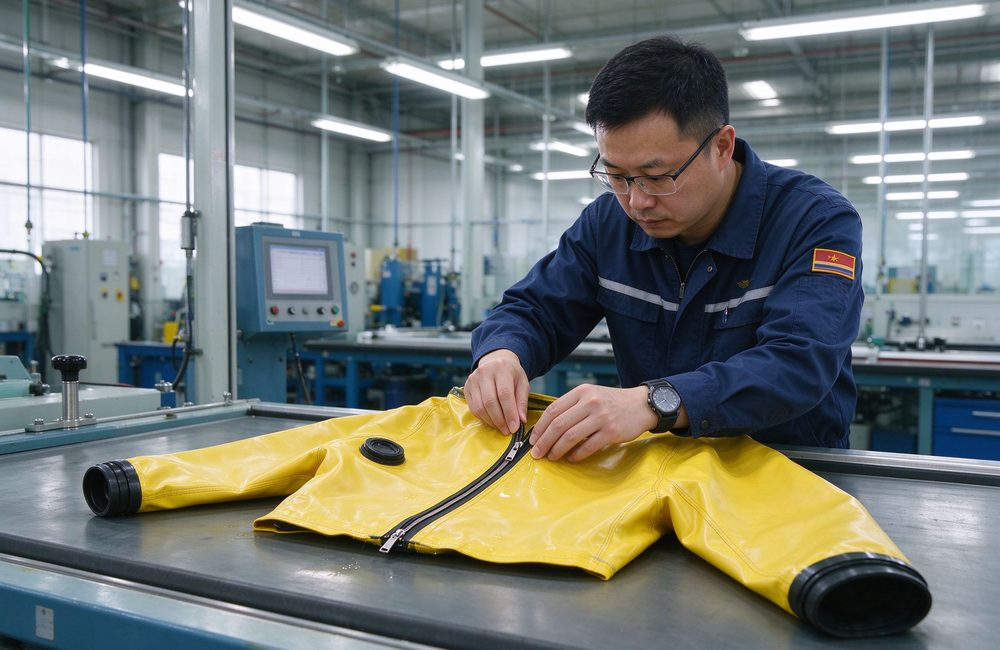
Bulk orders cover suits, SCBA, gloves and boots as one matched system.
Answers to the questions fire departments, chemical plants and procurement teams ask most when buying firefighter hazmat suits.
A firefighter hazmat suit is chemical protective clothing for firefighters that blocks hazardous gases, liquids and vapors while providing some flame resistance. It is used at chemical fires, leaks, tank incidents and contaminated rescue scenes where standard turnout gear cannot stop chemical exposure.
Gas-tight suits, usually Type 1, seal the entire body including the facepiece and block gases and vapors, so they must be worn with an SCBA. Liquid-tight suits, Types 3 and 4, block pressurized jets or sprays but are not vapor-proof. Higher protection means heavier and hotter, so teams keep both lines.
Yes, in the fire-proximity hazmat class. A fire resistant chemical suit combines an outer flame-resistant shell with a chemical barrier, such as a model certified to XF 634-2015, XF 770-2008 and GB 24539-2021. It resists flame and radiant heat for limited exposure, not entry into a burning area.
A gas-tight suit seals the wearer off from the outside atmosphere, which also means the outside atmosphere is sealed off from the wearer — there is no ambient air to breathe. The SCBA becomes the only air supply, delivering clean positive-pressure air and keeping vapors from entering through the facepiece. Filter masks cannot fill this role in vapor hazards because no filter reliably catches every chemical compound in every concentration.
GB 24539-2021 is the current Chinese standard that classifies chemical protective clothing, defines material requirements, test procedures and marking rules. In practice it appears in tenders together with XF 770-2008, and the certificate of a chemical protective suit must name the specific model that was tested — a certificate for one model does not transfer to another, so the standard number on paper is verified only when the garment label matches it.
Rated coverage and site coverage are two different lists. A heavy-duty Level 1 suit such as a Level 1 model is rated against more than 340 common industrial chemicals, but the number that matters to you is on the permeation report for the chemicals actually stored, produced or transported on your site. Use the report to confirm breakthrough time for each target chemical, and upgrade the suit class if any site hazard falls outside the tested list.
Level 1 suits are fully encapsulated and gas-tight, worn with an SCBA for toxic gas and worst-case scenes. Level 2 suits such as a Level 2 model are semi-enclosed with a double storm flap, hood, gloves and boots, protecting against volatile solids and liquids while pairing with an external positive-pressure SCBA.
Dressing for chemical work is a two-person drill, not a solo routine. The wearer checks suit and cylinder while the partner verifies every closure — zippers, flaps, cuff seals — then confirms the air supply is open before entry. Inside the hot zone the pair watches the clock together, and doffing happens only in the decontamination area where the suit is washed and re-tested before it returns to storage. Every step exists to protect the same goal: no gap, no shortcut, no guesswork on a firefighter hazmat suit.
Work time depends on the cylinder, the task and the heat. A 6.8 L carbon fiber cylinder typically supports 30 to 60 minutes of active work, and heat stress shortens it further. Teams rotate crews and use supplied-air systems for longer operations in fixed zones.
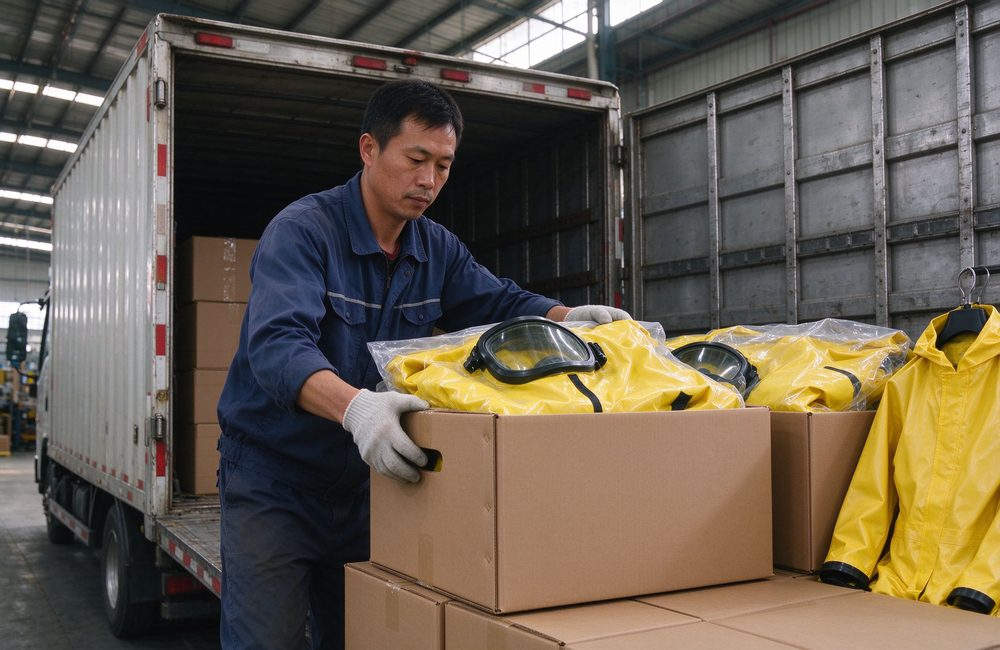
Bulk hazmat suits loaded for export delivery.
Yes, if the manufacturer's evaluation approves it and the evaluation is documented. The suit must pass inspection and airtightness testing after every exposure; a suit exposed to unknown chemicals, visible damage or failed pressure-drop testing should be retired.
Inspection is a program, not a one-time look. After every exposure and at set intervals, the team checks the shell for cuts and heat damage, seams for separation, zippers and storm flaps for full closure, the visor for cracks, gloves and boots for tears, and the cylinder and valve function. Every finding is logged on the suit's history card, so the next crew knows what was checked, when, and by whom before they dress in.
A permeation test report reads like a hazard-by-hazard answer sheet: it names each chemical and the time it takes to break through the material. Breakthrough time is the number to compare — longer means more working margin for the crew inside. When you review a chemical protective clothing certificate, check that the report lists the chemicals actually present on your site; a general 'chemical resistant' label carries no breakthrough numbers and no comparable evidence.
Define the size matrix from your crew's actual measurements, covering heights from about 1.60 m to 1.90 m. Fit-test with real rescue moves — kneeling, crawling, valve turning and cylinder swap — because a suit that fits on paper can bind at the shoulder in action.
A bulk hazmat order is quoted as a program, not a single item: suit class, SCBA interface, glove and boot package and size run all shape the price, so the minimum order is confirmed in the sales contract for your configuration. Send your size matrix, target chemical list and SCBA configuration for an accurate quote and delivery schedule.
Yes. Team colors, chest patches, name bars, pocket layouts and SCBA hose routing can be customized, but customization must not change the certified fabric, barrier or closures. Lock the final layout on a pre-production sample.
Compare on the same spec sheet: standard number, certificate, permeation report, physical strength values, protection class and SCBA compatibility must match before price matters. A low price that drops the certificate, barrier or seams is not the same suit.
 |

|
Links amigáveis :
direito autoral © Custom Disaster - Relief Bedding: Tents, Sleeping Bags, Blankets Todos os direitos reservados
a equipe profissional para o serviço !